Department of Psychiatry and Psychotherapy (CCM), Charité-Universitätsmedizin Berlin, Corporate Member of Freie Universität Berlin, Humboldt-Universität zu Berlin and Berlin Institute of Health, Berlin, Germany.
Department of Anesthesiology, Charité (CVK, CCM)-Charité-Universitätsmedizin Berlin, Corporate Member of Freie Universität Berlin, Humboldt-Universität zu Berlin and Berlin Institute of Health, Berlin, Germany.
Transl Psychiatry. 2021 Apr 12;11(1):213. doi: 10.1038/s41398-021-01304-y.
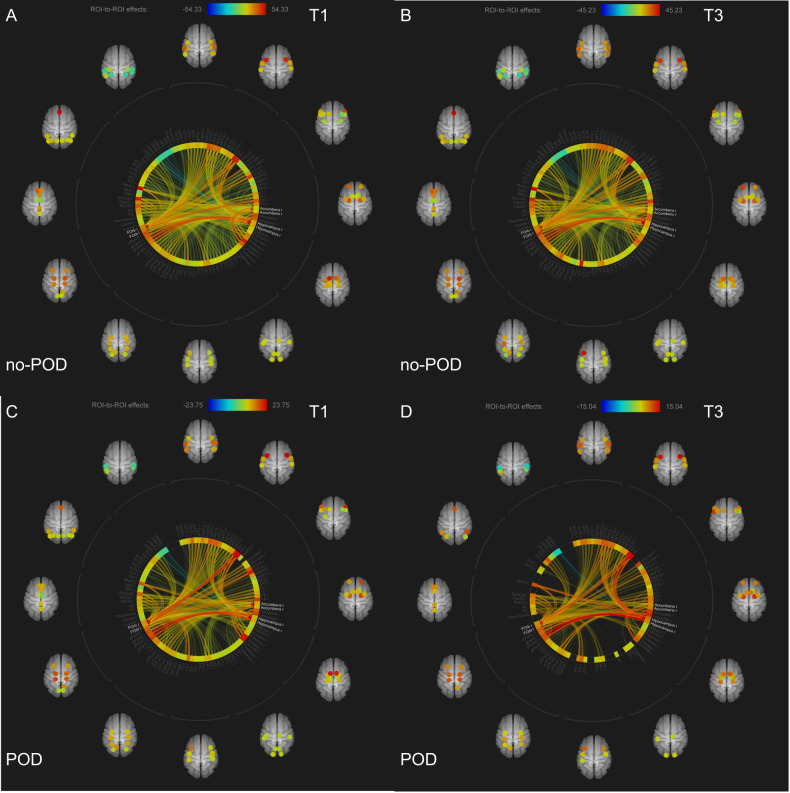
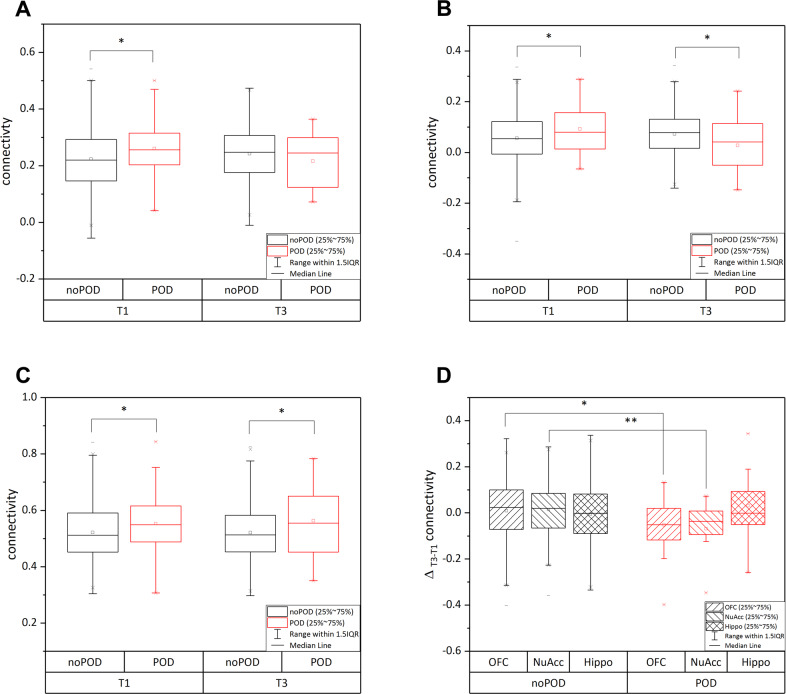
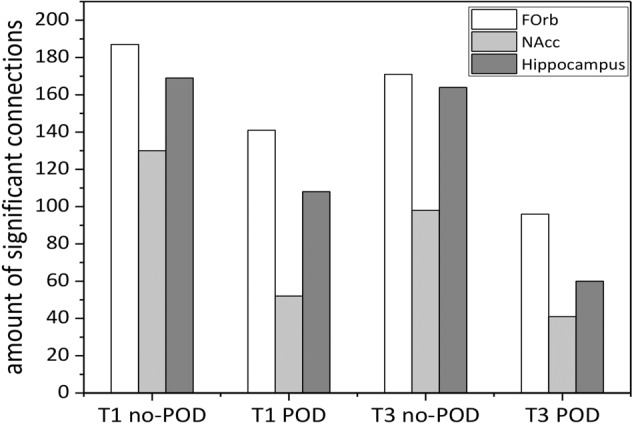
Postoperative delirium (POD) represents a confusional state during days/weeks after surgery and is particularly frequent in elderly patients. Hardly any fMRI studies were conducted to understand the underlying pathophysiology of POD patients. This prospective observational cohort study aims to examine changes of specific resting-state functional connectivity networks across different time points (pre- and 3-5 months postoperatively) in delirious patients compared to no-POD patients. Two-hundred eighty-three elderly surgical patients underwent preoperative resting-state fMRI (46 POD). One-hundred seventy-eight patients completed postoperative scans (19 POD). For functional connectivity analyses, three functional connectivity networks with seeds located in the orbitofrontal cortex (OFC), nucleus accumbens (NAcc), and hippocampus were investigated. The relationship of POD and connectivity changes between both time points (course connectivity) were examined (ANOVA). Preoperatively, delirious patients displayed hyperconnectivities across the examined functional connectivity networks. In POD patients, connectivities within NAcc and OFC networks demonstrated a decrease in course connectivity [max. F = 9.03, p = 0.003; F = 4.47, p = 0.036, resp.]. The preoperative hyperconnectivity in the three networks in the patients at risk for developing POD could possibly indicate existing compensation mechanisms for subtle brain dysfunction. The observed pathophysiology of network function in POD patients at least partially involves dopaminergic pathways.
术后谵妄(POD)是指手术后几天/几周内出现的意识混乱状态,在老年患者中尤为常见。几乎没有进行任何功能磁共振成像(fMRI)研究来了解 POD 患者的潜在病理生理学。这项前瞻性观察性队列研究旨在比较谵妄患者和非 POD 患者在不同时间点(术前和术后 3-5 个月)的特定静息态功能连接网络的变化。283 名老年手术患者接受了术前静息态 fMRI(46 例 POD)检查。178 名患者完成了术后扫描(19 例 POD)。对于功能连接分析,研究了三个具有眶额皮层(OFC)、伏隔核(NAcc)和海马种子的功能连接网络。检查了 POD 与两个时间点之间(过程连接)的连接变化之间的关系(方差分析)。术前,谵妄患者在整个检查的功能连接网络中表现出过度连接。在 POD 患者中,NAcc 和 OFC 网络内的连接在过程连接中显示出下降[最大 F=9.03,p=0.003;F=4.47,p=0.036]。在有发生 POD 风险的患者中,三个网络的术前过度连接可能表明存在对轻微脑功能障碍的现有补偿机制。POD 患者网络功能的观察到的病理生理学至少部分涉及多巴胺能途径。