Department of Urology, Marien Hospital, Ruhr-University Bochum, Hölkeskampring 40, 44625, Herne, Germany.
Department of Urology, Augusta Medical Center Bochum, University of Witten/Herdecke, Bochum, Germany.
Urolithiasis. 2021 Dec;49(6):567-573. doi: 10.1007/s00240-021-01264-4. Epub 2021 Apr 13.
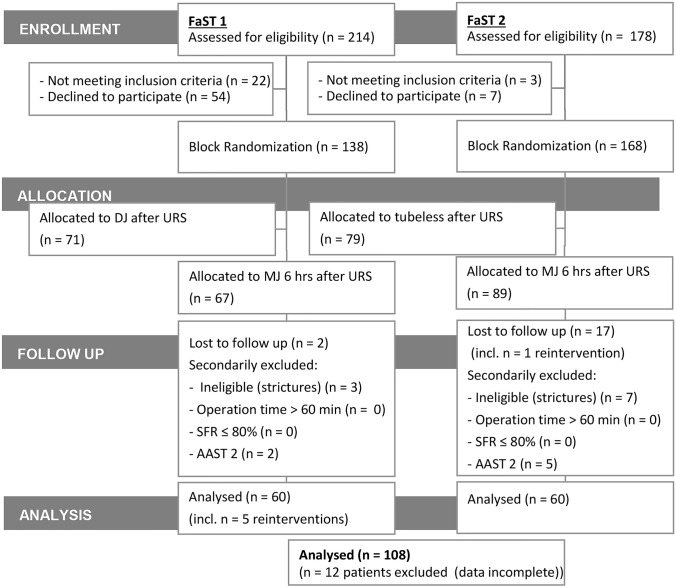
To evaluate factors affecting the outcomes of short-term Mono-J insertion for 6 h following ureteroscopic stone removal. Patients treated with a Mono-J for 6 h after ureterorenoscopy and stone removal were analysed. FaST 1 and 2 (Fast Track Stent Studies), two consecutive single academic centre studies, were conducted between August 2014 and April 2018. In each study, we randomized patients with renal or ureteral calculi to two groups before ureterorenoscopy. FaST 1 compared a Mono-J insertion for 6 h versus Double-J insertion for 3-5 days after ureterorenoscopy. FaST 2 compared a Mono-J insertion to a tubeless procedure in the same clinical setting. All patients were pre-stented for 3-5 days before URS. The study endpoint was stent-related symptoms as assessed by a validated questionnaire (USSQ). Results were stratified by clinical parameters, stone characteristics and operation details. 108 of 156 initially randomized patients undergoing ureterorenoscopy were included. USSQ scores covering the time 3-5 weeks after stone removal showed a significantly reduced urinary symptoms and pain index compared to the scores before ureterorenoscopy. USSQ results before and after stone removal did not correlate with stone size or operation time and did not differ significantly depending on stone localization, the treating endourologist, or ureterorenoscopic device used (p > 0.05). Six patients (5%) required reintervention. Following secondary ureterorenoscopy and ureteral drainage with a Mono-J for 6 h, quality of life is independent of stone size and localization, operation time, the treating endourologist, and the URS device used.
评估经输尿管镜碎石取石术后 6 小时内短期留置单 J 管的影响因素。对接受输尿管镜碎石取石术后 6 小时内留置单 J 管治疗的患者进行分析。Fast Track Stent Studies(Fast Track 支架研究),这是两项连续的单中心研究,于 2014 年 8 月至 2018 年 4 月进行。在每项研究中,我们在输尿管镜检查前将肾结石或输尿管结石患者随机分为两组。Fast Track 1 比较了输尿管镜检查后 6 小时留置单 J 管与 3-5 天留置双 J 管的效果。Fast Track 2 比较了在相同临床环境下留置单 J 管与无管操作。所有患者在 URS 前均留置支架 3-5 天。研究终点为采用经过验证的问卷(USSQ)评估的支架相关症状。结果根据临床参数、结石特征和手术细节进行分层。156 例最初随机接受输尿管镜检查的患者中有 108 例纳入研究。URS 后 3-5 周 USSQ 评分显示,与输尿管镜检查前相比,尿症状和疼痛指数明显降低。结石去除前后的 USSQ 结果与结石大小或手术时间无关,与结石定位、治疗内镜医生或使用的输尿管镜设备无关(p>0.05)。6 例(5%)患者需要再次介入治疗。在二次输尿管镜检查和 6 小时留置单 J 管引流后,生活质量与结石大小和定位、手术时间、治疗内镜医生和使用的 URS 设备无关。