Department of Cardiology, National University Heart Centre, National University Health System, Singapore.
Yong Loo Lin School of Medicine, National University of Singapore, Singapore.
Can J Cardiol. 2021 Sep;37(9):1450-1459. doi: 10.1016/j.cjca.2021.04.003. Epub 2021 Apr 20.
The COVID-19 pandemic has affected patients with ST-segment elevation myocardial infarction (STEMI) requiring primary percutaneous coronary intervention (PCI) worldwide. In this review we examine the global effect of the COVID-19 pandemic on incidence of STEMI admissions, and relationship between the pandemic and door to balloon time (D2B), all-cause mortality, and other secondary STEMI outcomes.
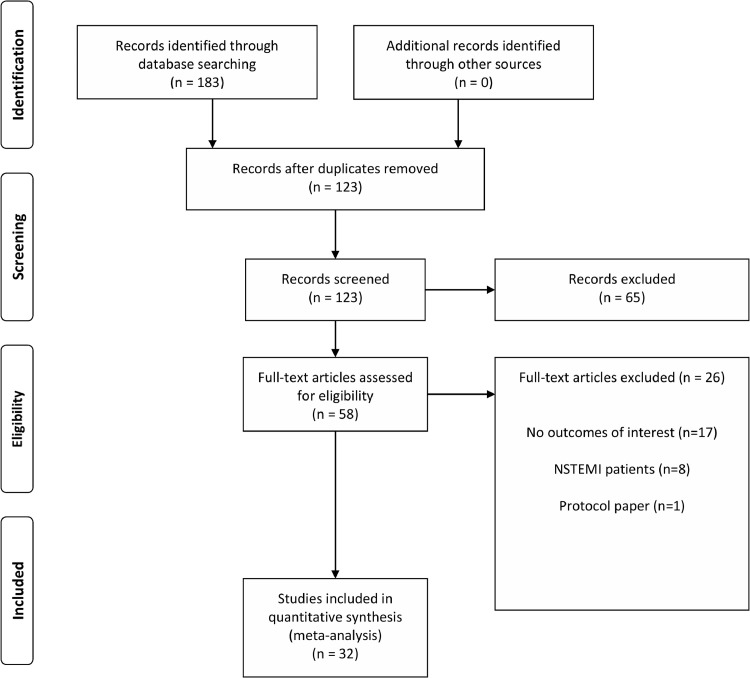
We performed a systematic review and meta-analysis to primarily compare D2B time and in-hospital mortality of STEMI patients who underwent primary PCI during and before the pandemic. Subgroup analyses were performed to investigate the influence of geographical region and income status of a country on STEMI care. An online database search included studies that compared the aforementioned outcomes of STEMI patients during and before the pandemic.
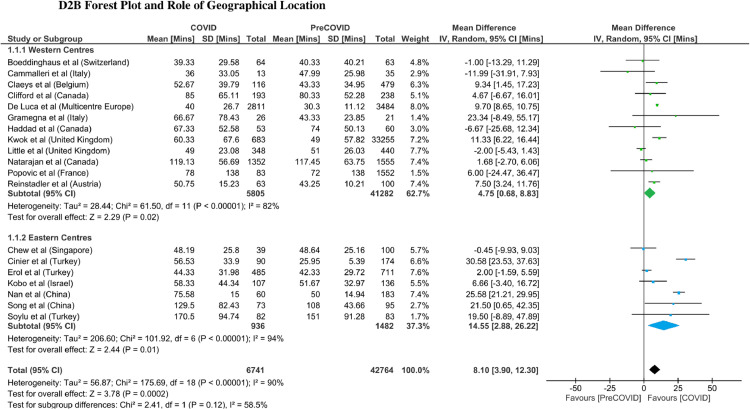
In total, 32 articles were analyzed. Overall, 19,140 and 68,662 STEMI patients underwent primary PCI during and before the pandemic, respectively. Significant delay in D2B was observed during the pandemic (weighted mean difference, 8.10 minutes; 95% confidence interval [CI], 3.90-12.30 minutes; P = 0.0002; I = 90%). In-hospital mortality was higher during the pandemic (odds ratio [OR], 1.27; 95% CI, 1.09-1.49; P = 0.002; I = 36%), however this varied with factors such as geographical location and income status of a country. Subgroup analysis showed that low-middle-income countries observed a higher rate of mortality during the pandemic (OR, 1.52; 95% CI, 1.13-2.05; P = 0.006), with a similar but insignificant trend seen among the high income countries (OR, 1.17; 95% CI, 0.95-1.44; P = 0.13).
The COVID-19 pandemic is associated with worse STEMI performance metrics and clinical outcome, particularly in the Eastern low-middle-income status countries. Better strategies are needed to address these global trends in STEMI care during the pandemic.
COVID-19 大流行影响了全球范围内需要进行直接经皮冠状动脉介入治疗 (PCI) 的 ST 段抬高型心肌梗死 (STEMI) 患者。在本综述中,我们考察了 COVID-19 大流行对 STEMI 入院发病率的全球影响,以及大流行与门球时间 (D2B)、全因死亡率和其他次要 STEMI 结局之间的关系。
我们进行了系统评价和荟萃分析,主要比较了大流行期间和之前进行直接 PCI 的 STEMI 患者的 D2B 时间和院内死亡率。进行了亚组分析,以研究国家的地理位置和收入状况对 STEMI 治疗的影响。在线数据库检索包括比较大流行期间和之前 STEMI 患者上述结局的研究。
共分析了 32 篇文章。总体而言,19140 例和 68662 例 STEMI 患者分别在大流行期间和之前进行了直接 PCI。大流行期间 D2B 明显延迟(加权平均差异,8.10 分钟;95%置信区间 [CI],3.90-12.30 分钟;P=0.0002;I=90%)。大流行期间院内死亡率较高(比值比 [OR],1.27;95%CI,1.09-1.49;P=0.002;I=36%),但这因地理位置和国家收入状况等因素而异。亚组分析显示,中低收入国家在大流行期间死亡率较高(OR,1.52;95%CI,1.13-2.05;P=0.006),高收入国家也有类似但不显著的趋势(OR,1.17;95%CI,0.95-1.44;P=0.13)。
COVID-19 大流行与 STEMI 表现指标和临床结局恶化相关,特别是在东欧中低收入地位国家。在大流行期间,需要制定更好的策略来应对这些 STEMI 治疗的全球趋势。