Godefroy Valérie, Tanguy Delphine, Bouzigues Arabella, Sezer Idil, Ferrand-Verdejo Johan, Azuar Carole, Bendetowicz David, Carle Guilhem, Rametti-Lacroux Armelle, Bombois Stéphanie, Cognat Emmanuel, Jannin Pierre, Morandi Xavier, Ber Isabelle Le, Levy Richard, Batrancourt Bénédicte, Migliaccio Raffaella
Paris Brain Institute Sorbonne Universités Paris France.
CHU Rennes Université Rennes Rennes France.
Alzheimers Dement (Amst). 2021 Apr 6;13(1):e12178. doi: 10.1002/dad2.12178. eCollection 2021.
We aimed to investigate phenotypic heterogeneity in the behavioral variant of frontotemporal dementia (bvFTD) through assessment of inhibition deficits.
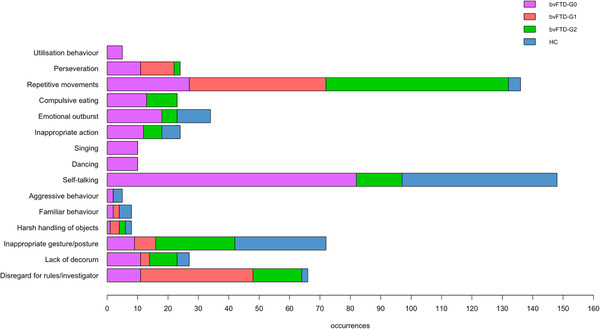
We assessed occurrences of 16 behavioral inhibition deficits from video recordings of 15 bvFTD patients (early stage) and 15 healthy controls (HC) in an ecological setting. We extracted dimensions of inhibition deficit and analyzed their correlations with cognitive and clinical measures. Using these dimensions, we isolated patient clusters whose atrophy patterns were explored.
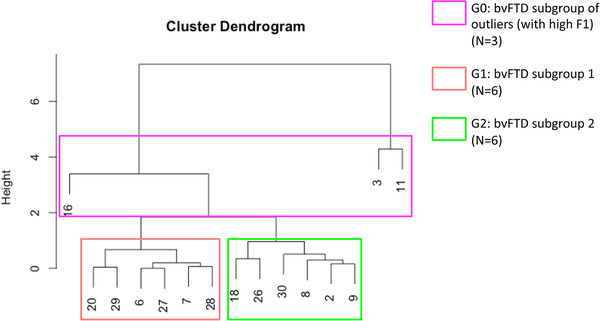
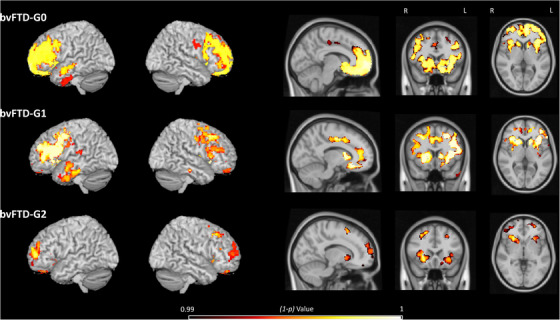
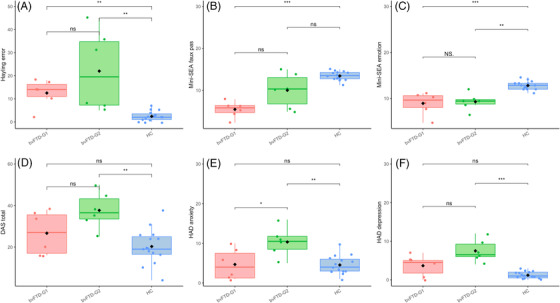
After identifying two patterns of inhibition deficit (compulsive automatic behaviors and socially unconventional behaviors), we isolated three behavioral clusters with distinct atrophy patterns. BvFTD-G0 (N = 3), an outlier group, showed severe behavioral disturbances and more severe ventromedial prefrontal cortex/orbitofrontal cortex atrophy. Compared to bvFTD-G1 (N = 6), bvFTD-G2 (N = 6) presented higher anxiety and depression along with less diffuse atrophy especially in midline regions.
Identifying clinico-anatomical profiles through behavior observation could help to stratify bvFTD patients for adapted treatments.
我们旨在通过评估抑制缺陷来研究额颞叶痴呆行为变异型(bvFTD)的表型异质性。
我们在自然环境中,通过对15例bvFTD患者(早期)和15名健康对照(HC)的视频记录,评估了16种行为抑制缺陷的发生情况。我们提取了抑制缺陷的维度,并分析了它们与认知和临床指标的相关性。利用这些维度,我们分离出了探索其萎缩模式的患者集群。
在确定了两种抑制缺陷模式(强迫性自动行为和社会非传统行为)后,我们分离出了三个具有不同萎缩模式的行为集群。bvFTD-G0(N = 3)作为一个异常组,表现出严重的行为障碍和更严重的腹内侧前额叶皮质/眶额皮质萎缩。与bvFTD-G1(N = 6)相比,bvFTD-G2(N = 6)表现出更高的焦虑和抑郁,且萎缩程度较轻,尤其是在中线区域。
通过行为观察确定临床解剖特征有助于对bvFTD患者进行分层以实施适应性治疗。