Escola Superior de Ciências, Santa Casa de Misericórdia de Vitória, Vitória, ES, Brazil.
Faculdade de Ciências Médicas, Universidade Estadual de Campinas, Campinas, SP, Brazil.
Einstein (Sao Paulo). 2021 Apr 9;19:eRW5498. doi: 10.31744/einstein_journal/2021RW5498. eCollection 2021.
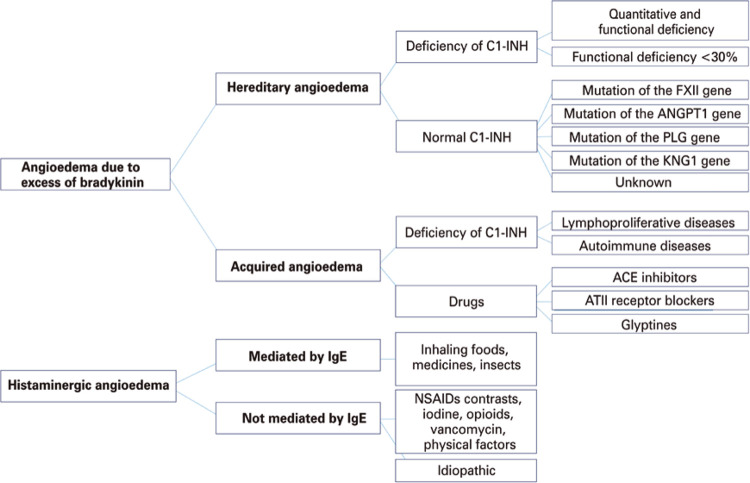
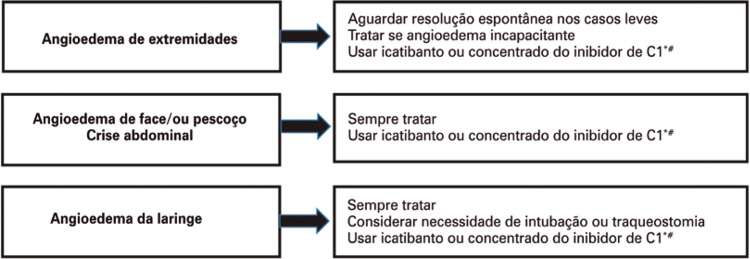
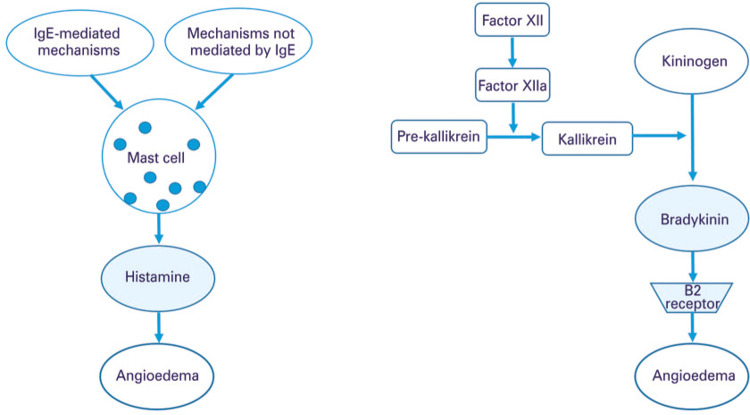
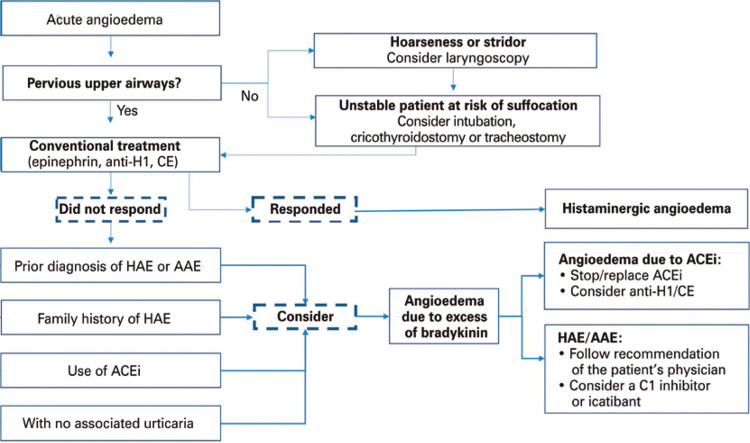
Angioedema attacks are common causes of emergency care, and due to the potential for severity, it is important that professionals who work in these services know their causes and management. The mechanisms involved in angioedema without urticaria may be histamine- or bradykinin-mediated. The most common causes of histamine-mediated angioedema are foods, medications, insect sting and idiopathic. When the mediator is bradykinin, the triggers are angiotensin-converting enzyme inhibitors and factors related to acquired angioedema with deficiency of C1-inhibitor or hereditary angioedema, which are less common, but very important because of the possibility of fatal outcome. Hereditary angioedema is a rare disease characterized by attacks of edema that affect the subcutaneous tissue and mucous membranes of various organs, manifesting mainly by angioedema and abdominal pain. This type of angioedema does not respond to the usual treatment with epinephrine, antihistamines and corticosteroids. Thus, if not identified and treated appropriately, these patients have an estimated risk of mortality from laryngeal edema of 25% to 40%. Hereditary angioedema treatment has changed dramatically in recent years with the development of new and efficient drugs for attack management: plasma-derived C1 inhibitor, recombinant human C1-inhibitor, bradykinin B2 receptor antagonist (icatibant), and the kallikrein inhibitor (ecallantide). In Brazil, plasma-derived C1 inhibitor and icatibant have already been approved for use. Proper management of these patients in the emergency department avoids unnecessary surgery and, especially, fatal outcomes.
血管性水肿发作是急诊常见的原因,由于其严重程度的潜在风险,在这些服务机构工作的专业人员了解其病因和管理非常重要。无荨麻疹的血管性水肿的发病机制可能与组胺或缓激肽有关。组胺介导的血管性水肿最常见的原因是食物、药物、昆虫叮咬和特发性。当介质为缓激肽时,触发因素是血管紧张素转换酶抑制剂和与获得性血管性水肿伴 C1 抑制剂缺乏或遗传性血管性水肿相关的因素,这些因素较少见,但非常重要,因为可能导致致命后果。遗传性血管性水肿是一种罕见的疾病,其特征为影响皮下组织和各种器官黏膜的水肿发作,主要表现为血管性水肿和腹痛。这种类型的血管性水肿对通常使用肾上腺素、抗组胺药和皮质类固醇治疗没有反应。因此,如果不能识别并适当治疗,这些患者发生喉水肿的死亡率估计为 25%至 40%。近年来,随着新的、有效的治疗发作药物的发展,遗传性血管性水肿的治疗发生了巨大变化:血浆衍生的 C1 抑制剂、重组人 C1 抑制剂、缓激肽 B2 受体拮抗剂(依卡替班)和激肽释放酶抑制剂(艾卡替班)。在巴西,已经批准使用血浆衍生的 C1 抑制剂和依卡替班。在急诊科对这些患者进行适当的管理可以避免不必要的手术,特别是致命的后果。