Department of Integrative Structural and Computational Biology, The Scripps Research Institute, La Jolla, CA 92037, USA.
Vanderbilt Vaccine Center, Vanderbilt University Medical Center, Nashville, TN 37232, USA.
Cell Rep. 2021 Apr 13;35(2):108984. doi: 10.1016/j.celrep.2021.108984.
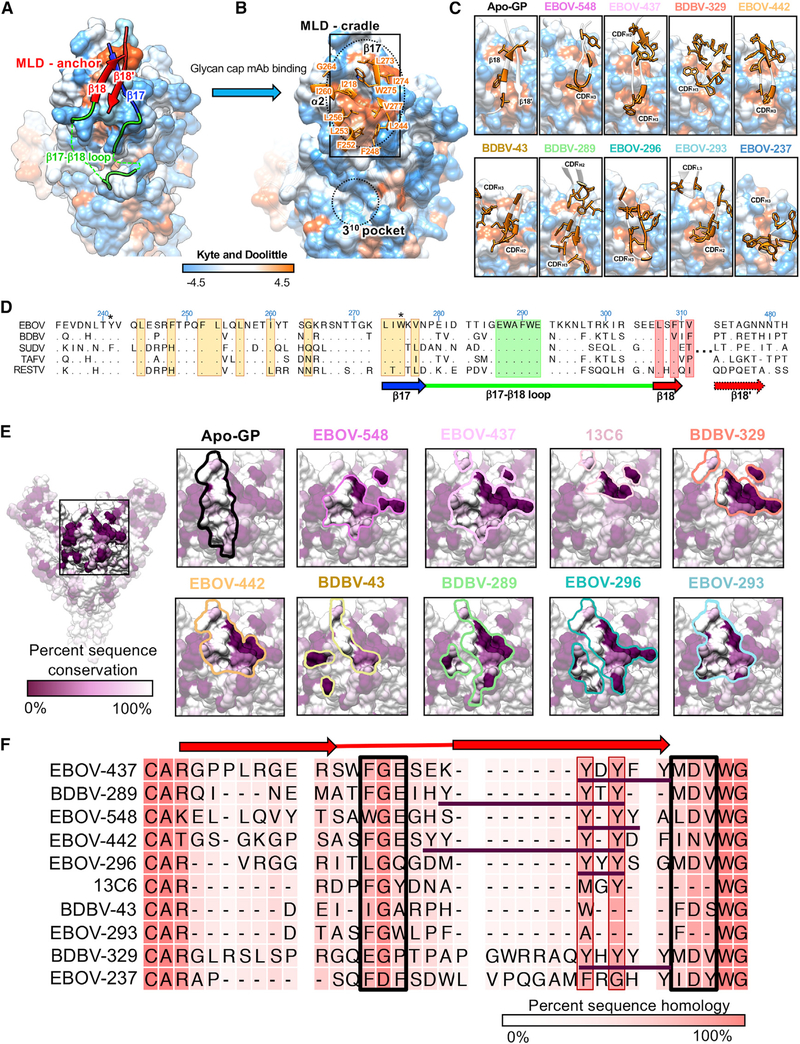
Antibodies that target the glycan cap epitope on the ebolavirus glycoprotein (GP) are common in the adaptive response of survivors. A subset is known to be broadly neutralizing, but the details of their epitopes and basis for neutralization are not well understood. Here, we present cryoelectron microscopy (cryo-EM) structures of diverse glycan cap antibodies that variably synergize with GP base-binding antibodies. These structures describe a conserved site of vulnerability that anchors the mucin-like domains (MLDs) to the glycan cap, which we call the MLD anchor and cradle. Antibodies that bind to the MLD cradle share common features, including use of IGHV1-69 and IGHJ6 germline genes, which exploit hydrophobic residues and form β-hairpin structures to mimic the MLD anchor, disrupt MLD attachment, destabilize GP quaternary structure, and block cleavage events required for receptor binding. Our results provide a molecular basis for ebolavirus neutralization by broadly reactive glycan cap antibodies.
针对埃博拉病毒糖蛋白 (GP) 上糖萼表位的抗体在幸存者的适应性反应中很常见。已知其中一部分具有广泛的中和作用,但它们的表位细节和中和机制尚不清楚。在这里,我们展示了具有不同协同作用的多种糖萼抗体的冷冻电子显微镜 (cryo-EM) 结构,这些抗体与 GP 基底结合抗体协同作用。这些结构描述了一个保守的脆弱位点,将粘蛋白样结构域 (MLD) 锚定在糖萼上,我们称之为 MLD 锚和摇篮。与 MLD 摇篮结合的抗体具有一些共同特征,包括使用 IGHV1-69 和 IGHJ6 胚系基因,这些基因利用疏水性残基并形成 β-发夹结构来模拟 MLD 锚,破坏 MLD 附着,使 GP 四级结构不稳定,并阻止受体结合所需的切割事件。我们的研究结果为广泛反应性糖萼抗体中和埃博拉病毒提供了分子基础。