Cook Sarah G, Buonarati Olivia R, Coultrap Steven J, Bayer K Ulrich
Department of Pharmacology, University of Colorado Anschutz Medical Campus, Aurora, CO 80045, USA.
Sci Adv. 2021 Apr 14;7(16). doi: 10.1126/sciadv.abe2300. Print 2021 Apr.
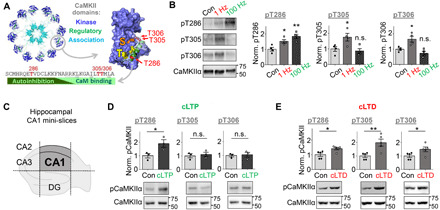
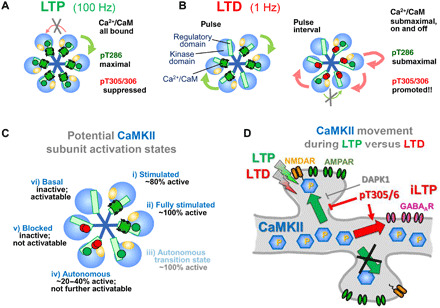
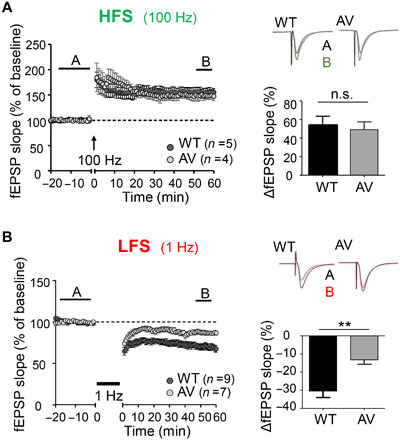
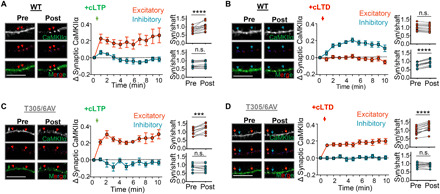
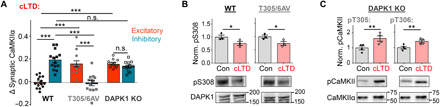
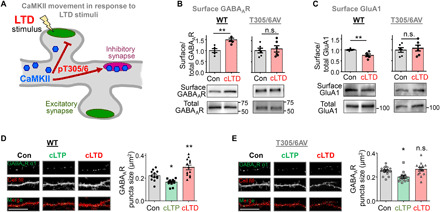
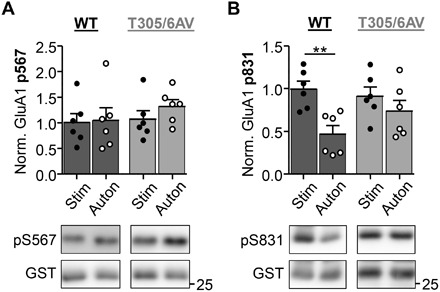
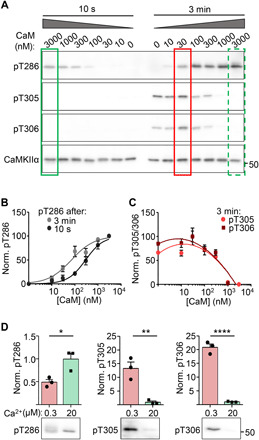
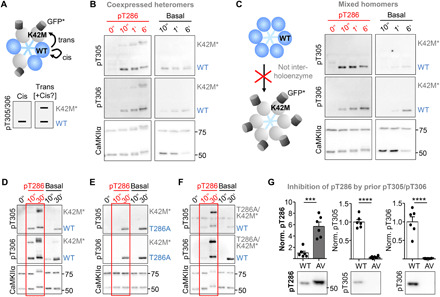
Higher brain functions are thought to require synaptic frequency decoding that can lead to long-term potentiation (LTP) or depression (LTD). We show that the LTP versus LTD decision is determined by complex cross-regulation of T286 and T305/306 autophosphorylation within the 12meric CaMKII holoenzyme, which enabled molecular computation of stimulus frequency, amplitude, and duration. Both LTP and LTD require T286 phosphorylation, but T305/306 phosphorylation selectively promoted LTD. In response to excitatory LTP versus LTD stimuli, the differential T305/306 phosphorylation directed CaMKII movement to either excitatory or inhibitory synapses, thereby coordinating plasticity at both synapse types. Fast T305/306 phosphorylation required prior T286 phosphorylation and then curbed CaMKII activity by two mechanisms: (i) a cis-subunit reaction reduced both Ca stimulation and autonomous activity and (ii) a trans-subunit reaction enabled complete activity shutdown and feed-forward inhibition of further T286 phosphorylation. These are fundamental additions to the long-studied CaMKII regulation and function in neuronal plasticity.
高级脑功能被认为需要突触频率解码,而这可能导致长时程增强(LTP)或长时程抑制(LTD)。我们发现,LTP与LTD的决定是由12聚体CaMKII全酶内T286和T305/306自身磷酸化的复杂交叉调节所决定的,这使得能够对刺激频率、幅度和持续时间进行分子计算。LTP和LTD都需要T286磷酸化,但T305/306磷酸化选择性地促进LTD。响应兴奋性LTP与LTD刺激,差异性的T305/306磷酸化将CaMKII的运动导向兴奋性或抑制性突触,从而协调两种突触类型的可塑性。快速的T305/306磷酸化需要先有T286磷酸化,然后通过两种机制抑制CaMKII活性:(i)顺式亚基反应降低了钙刺激和自主活性,(ii)反式亚基反应导致完全的活性关闭和对进一步T286磷酸化的前馈抑制。这些是对长期研究的CaMKII在神经元可塑性中的调节和功能的重要补充。