St John Michelle E, Fuller Rebecca C
School of Integrative Biology, University of Illinois Urbana-Champaign, Champaign, IL 61820, USA.
Curr Zool. 2021 Apr;67(2):215-224. doi: 10.1093/cz/zoaa049. Epub 2020 Nov 30.
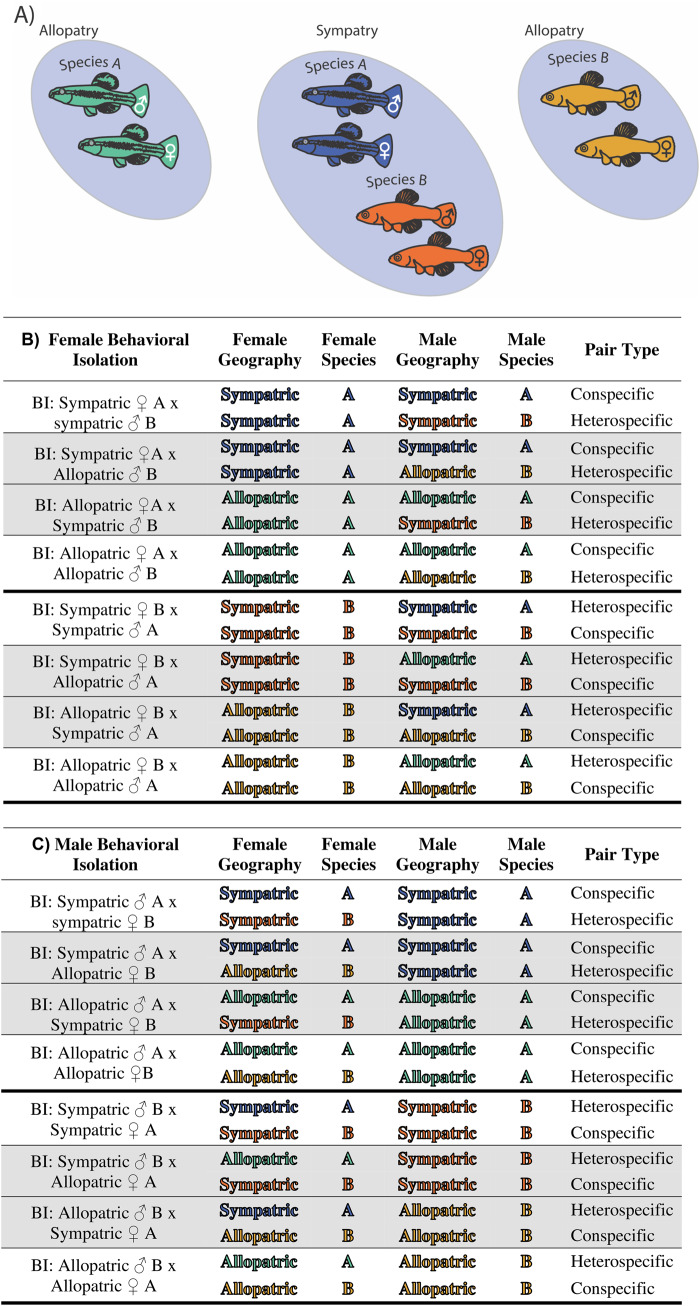
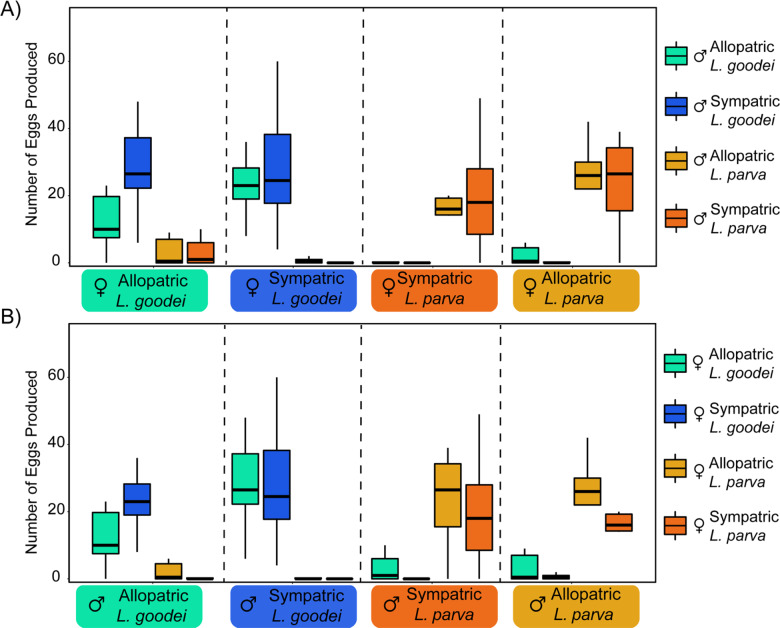
Reinforcement can occur when maladaptive hybridization in sympatry favors the evolution of conspecific preferences and target traits that promote behavioral isolation (BI). In many systems, enhanced BI is due to increased female preference for conspecifics. In others, BI is driven by male preference, and in other systems both sexes exert preferences. Some of these patterns can be attributed to classic sex-specific costs and benefits of preference. Alternatively, sex differences in conspecific preference can emerge due to asymmetric postzygotic isolation (e.g., hybrid offspring from female A × male B have lower fitness than hybrid offspring from female B × male A), which can lead to asymmetric BI (e.g., female A and male B are less likely to mate than female B and male A). Understanding reinforcement requires understanding how conspecific preferences evolve in sympatry. Yet, estimating conspecific preferences can be difficult when both sexes are choosy. In this study, we use killifish to test the hypothesis that patterns of reinforcement are driven by asymmetric postzygotic isolation between species. If true, we predicted that sympatric female and sympatric male should have lower levels of BI compared with their sympatric counterparts, as they produce hybrid offspring with the highest fitness. To address the problem of measuring BI when both sexes are choosy, we inferred the contribution to BI of each partner using assays where one sex in the mating pair comes from an allopatric population with potentially low preference, whereas the other comes from a sympatric population with high preference. For one hybrid cross direction, we found that both female and male have high contributions to BI in sympatry. In the other hybrid cross direction, we found that only female contribute to BI. Sympatric male readily engaged in hybrid spawnings with allopatric females. These results indicate that both asymmetric postzygotic isolation and the traditional sex-specific costs to preference likely affect the nature of selection on conspecific preferences and target traits.
当同域分布中的适应性不良杂交有利于促进行为隔离(BI)的同种偏好和目标性状的进化时,就会发生强化现象。在许多系统中,增强的行为隔离是由于雌性对同种个体的偏好增加。在其他系统中,行为隔离是由雄性偏好驱动的,而在其他系统中,两性都会表现出偏好。其中一些模式可归因于经典的特定性别偏好成本和收益。或者,同种偏好中的性别差异可能由于不对称的合子后隔离而出现(例如,雌性A×雄性B的杂交后代的适应性低于雌性B×雄性A的杂交后代),这可能导致不对称的行为隔离(例如,雌性A和雄性B比雌性B和雄性A更不可能交配)。理解强化现象需要了解同种偏好在同域分布中是如何进化的。然而,当两性都挑剔时,估计同种偏好可能会很困难。在这项研究中,我们使用鳉鱼来检验强化模式是由物种间不对称的合子后隔离驱动的这一假设。如果这一假设成立,我们预测同域分布的雌性和雄性与它们的同域对应个体相比,行为隔离水平应该更低,因为它们产生的杂交后代适应性最高。为了解决两性都挑剔时测量行为隔离的问题,我们使用了一种实验方法来推断每个配偶对行为隔离的贡献,在这种实验中,交配配对中的一方来自偏好可能较低的异域种群,而另一方来自偏好较高的同域种群。对于一个杂交方向,我们发现雌性和雄性在同域分布中对行为隔离都有很大贡献。在另一个杂交方向上,我们发现只有雌性对行为隔离有贡献。同域分布的雄性很容易与异域分布的雌性进行杂交产卵。这些结果表明,不对称的合子后隔离以及传统的特定性别偏好成本可能都会影响对同种偏好和目标性状的选择性质。