Lv Nannan, Liu Fei, Cheng Lan, Liu Feng, Kuang Jinsong
Department of Endocrinology and Metabolism, The Fourth People's Hospital of Shenyang; 20 Huanghe South st, Huanggu District, Shenyang,China.
J Cancer. 2021 Mar 10;12(9):2777-2786. doi: 10.7150/jca.53349. eCollection 2021.
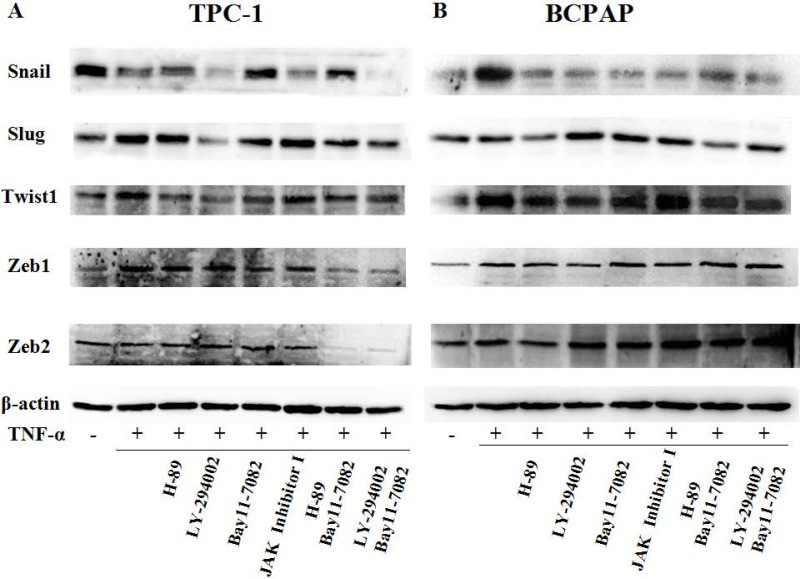
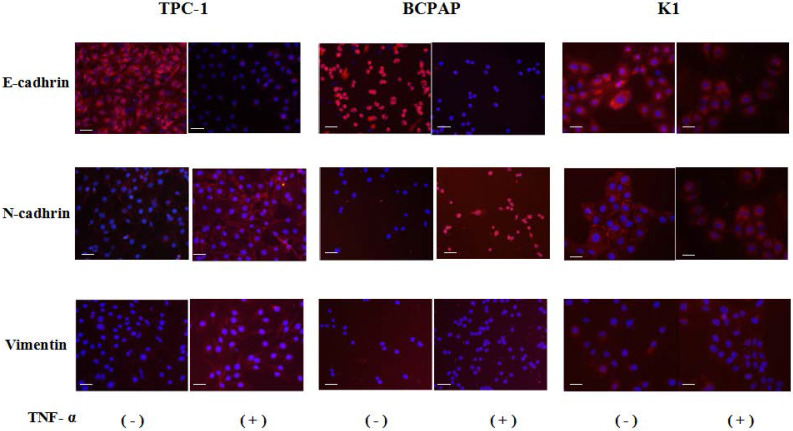
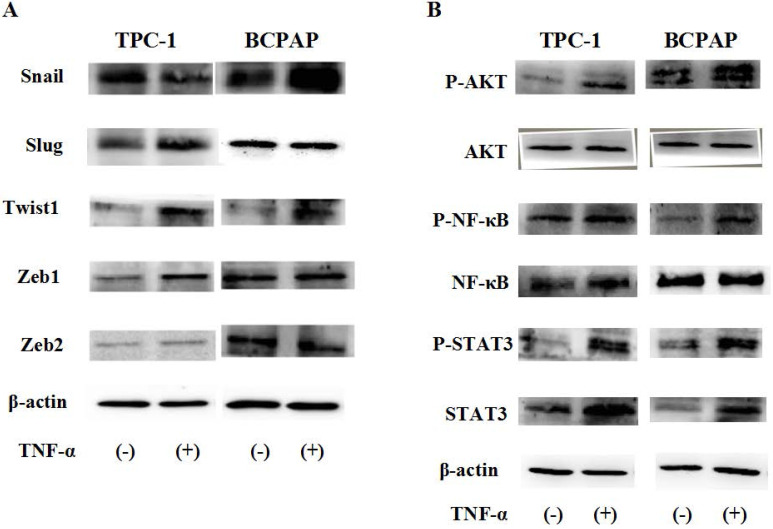
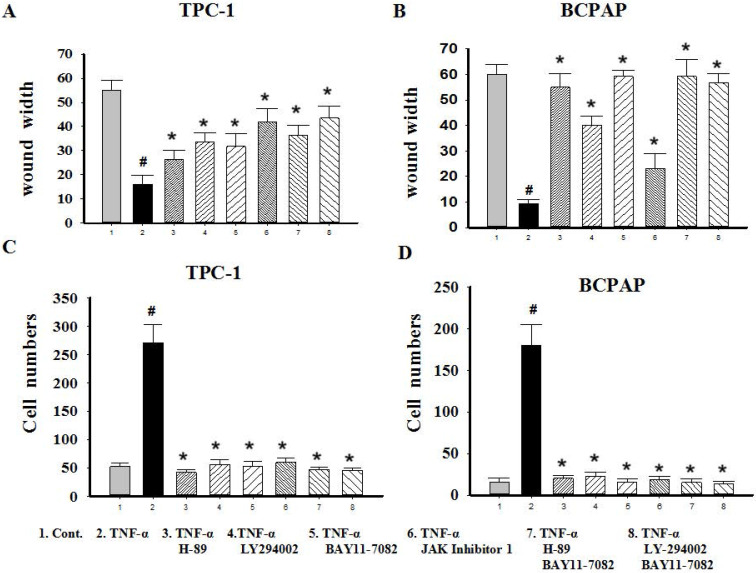
Proinflammatory factor tumor necrosis factor-α (TNF-α) is an important inflammatory mediators in tumor microenvironment and autoimmune diseases, it is highly expressed in many solid tumors and tumor microenvironment, showing a tumor promoting role. However, the molecular mechanisms underlying TNF-α-increased invasion of thyroid cancer are still not fully understood. In order to explore whether TNF-α plays a key role in the process of epithelial mesenchymal transition (EMT) in papillary thyroid carcinoma (PTC), we used TNF-α to induce EMT in different PTC cell lines, and observed the expression of different transcription factors and signal pathways. After TNF-α treatment, in TPC-1, Snail and ZEB2 mRNA levels did not change significantly, while Slug, Twist1, ZEB1 mRNA expression increased. In BCPAP, Snail mRNA level increased significantly (P < 0.01), while Twist1 showed a certain degree of increase only at the concentration of TNF - α 20 ng / ml (P < 0.01), but mRNA of Slug, ZEB1, ZEB2 showed no significant change. The expression of proteins was consistent with genes. The activation of different pathways did not show gene differences, and pathway inhibitors could reduce the invasion and metastasis of cells, but only NF-κB inhibitors could reverse the expression of transcription factors. Expressions of Snail and Slug in different PTC cell lines were dependent on pro-oncogene mutation, but the pathway had no differences. The establishment of this study model can enrich the research on the pathogenesis and metastasis of thyroid cancer, effectively link the inflammatory microenvironment with the occurrence and development of thyroid cancer.
促炎因子肿瘤坏死因子-α(TNF-α)是肿瘤微环境和自身免疫性疾病中的重要炎症介质,在许多实体瘤和肿瘤微环境中高表达,具有促肿瘤作用。然而,TNF-α促进甲状腺癌侵袭的分子机制仍未完全阐明。为了探究TNF-α在甲状腺乳头状癌(PTC)上皮-间质转化(EMT)过程中是否起关键作用,我们用TNF-α诱导不同PTC细胞系发生EMT,并观察不同转录因子和信号通路的表达。TNF-α处理后,在TPC-1细胞中,Snail和ZEB2的mRNA水平无明显变化,而Slug、Twist1、ZEB1的mRNA表达增加。在BCPAP细胞中,Snail的mRNA水平显著升高(P<0.01),而Twist1仅在TNF-α浓度为20 ng/ml时呈一定程度升高(P<0.01),但Slug、ZEB1、ZEB2的mRNA无明显变化。蛋白表达与基因表达一致。不同信号通路的激活未显示出基因差异,通路抑制剂可降低细胞的侵袭和转移,但只有NF-κB抑制剂可逆转转录因子的表达。不同PTC细胞系中Snail和Slug的表达依赖于原癌基因突变,但信号通路无差异。本研究模型的建立可丰富甲状腺癌发病机制和转移的研究,有效将炎症微环境与甲状腺癌的发生发展联系起来。