NHC Key Laboratory of AIDS Immunology (China Medical University), National Clinical Research Center for Laboratory Medicine, The First Affiliated Hospital of China Medical University, Shenyang, China.
Laboratory Medicine Innovation Unit, Chinese Academy of Medical Sciences, Shenyang, China.
Front Cell Infect Microbiol. 2021 Mar 29;11:642903. doi: 10.3389/fcimb.2021.642903. eCollection 2021.
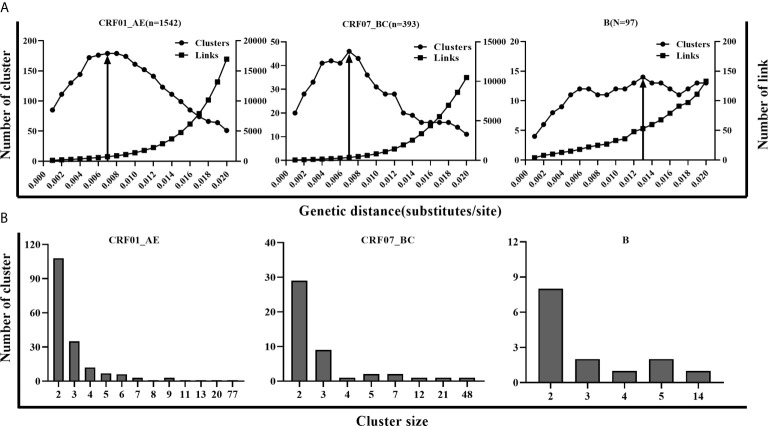
Molecular network analysis based on the genetic similarity of HIV-1 is increasingly used to guide targeted interventions. Nevertheless, there is a lack of experience regarding molecular network inferences and targeted interventions in combination with epidemiological information in areas with diverse epidemic strains of HIV-1.We collected 2,173 sequences covering 84% of the total newly diagnosed HIV-1 infections in Shenyang city, Northeast China, between 2016 and 2018. Molecular networks were constructed using the optimized genetic distance threshold for main subtypes obtained using sensitivity analysis of plausible threshold ranges. The transmission rates (TR) of each large cluster were assessed using Bayesian analyses. Molecular clusters with the characteristics of ≥5 newly diagnosed cases in 2018, high TR, injection drug users (IDUs), and transmitted drug resistance (TDR) were defined as priority clusters. Several HIV-1 subtypes were identified, with a predominance of CRF01_AE (71.0%, 1,542/2,173), followed by CRF07_BC (18.1%, 393/2,173), subtype B (4.5%, 97/2,173), other subtypes (2.6%, 56/2,173), and unique recombinant forms (3.9%, 85/2,173). The overall optimal genetic distance thresholds for CRF01_AE and CRF07_BC were both 0.007 subs/site. For subtype B, it was 0.013 subs/site. 861 (42.4%) sequences of the top three subtypes formed 239 clusters (size: 2-77 sequences), including eight large clusters (size 10 sequences). All the eight large clusters had higher TR (median TR = 52.4/100 person-years) than that of the general HIV infections in Shenyang (10.9/100 person-years). A total of ten clusters including 231 individuals were determined as priority clusters for targeted intervention, including eight large clusters (five clusters with≥5 newly diagnosed cases in 2018, one cluster with IDUs, and two clusters with TDR (K103N, Q58E/V179D), one cluster with≥5 newly diagnosed cases in 2018, and one IDUs cluster. In conclusion, a comprehensive analysis combining in-depth sampling HIV-1 molecular networks construction using subtype-specific optimal genetic distance thresholds, and baseline epidemiological information can help to identify the targets of priority intervention in an area epidemic for non-subtype B.
基于 HIV-1 遗传相似性的分子网络分析越来越多地被用于指导靶向干预。然而,在 HIV-1 流行株多样的地区,缺乏关于分子网络推断和结合流行病学信息的靶向干预的经验。
我们收集了 2016 年至 2018 年间在中国东北地区沈阳市新诊断的 HIV-1 感染患者的 2173 个序列,涵盖了总感染患者的 84%。使用合理阈值范围内的敏感性分析来优化主要亚型的遗传距离阈值,然后构建分子网络。使用贝叶斯分析评估每个大簇的传播率(TR)。将 2018 年新诊断病例≥5 例、TR 较高、注射吸毒者(IDU)和传播耐药(TDR)的分子簇定义为优先干预簇。
确定了几种 HIV-1 亚型,其中以 CRF01_AE(71.0%,1542/2173)为主,其次是 CRF07_BC(18.1%,393/2173)、B 亚型(4.5%,97/2173)、其他亚型(2.6%,56/2173)和独特重组形式(3.9%,85/2173)。CRF01_AE 和 CRF07_BC 的最佳遗传距离阈值均为 0.007 个替代/位点。B 亚型的最佳遗传距离阈值为 0.013 个替代/位点。前三种亚型的 861 个(42.4%)序列形成了 239 个簇(大小为 2-77 个序列),包括 8 个大簇(大小为 10 个序列)。所有 8 个大簇的传播率(TR)都高于沈阳市一般 HIV 感染(10.9/100 人年)(中位数 TR=52.4/100 人年)。共有 10 个包括 231 个个体的簇被确定为靶向干预的优先簇,包括 8 个大簇(2018 年新诊断病例≥5 例的 5 个簇、1 个 IDU 簇和 2 个 TDR(K103N、Q58E/V179D)簇、2018 年新诊断病例≥5 例的 1 个簇和 1 个 IDU 簇)。
总之,结合深入采样、使用亚型特异性最佳遗传距离阈值构建分子网络和基线流行病学信息的综合分析,可以帮助确定非 B 亚型流行地区的优先干预目标。