Fieldes Mathieu, Bourguignon Chloé, Assou Said, Nasri Amel, Fort Aurélie, Vachier Isabelle, De Vos John, Ahmed Engi, Bourdin Arnaud
IRMB, INSERM, Montpellier University Hospital, Montpellier, France.
Dept of Respiratory Diseases, Montpellier University Hospital, INSERM, Montpellier, France.
ERJ Open Res. 2021 Apr 12;7(2). doi: 10.1183/23120541.00437-2020. eCollection 2021 Apr.
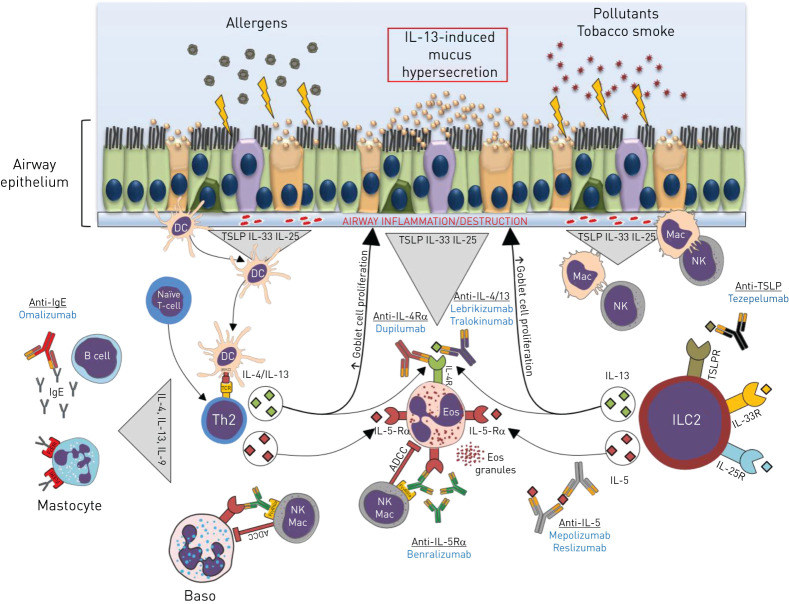
Chronic obstructive pulmonary disease (COPD) is a common and preventable airway disease causing significant worldwide mortality and morbidity. Lifetime exposure to tobacco smoking and environmental particles are the two major risk factors. Over recent decades, COPD has become a growing public health problem with an increase in incidence. COPD is defined by airflow limitation due to airway inflammation and small airway remodelling coupled to parenchymal lung destruction. Most patients exhibit neutrophil-predominant airway inflammation combined with an increase in macrophages and CD8 T-cells. Asthma is a heterogeneous chronic inflammatory airway disease. The most studied subtype is type 2 (T2) high eosinophilic asthma, for which there are an increasing number of biologic agents developed. However, both asthma and COPD are complex and share common pathophysiological mechanisms. They are known as overlapping syndromes as approximately 40% of patients with COPD present an eosinophilic airway inflammation. Several studies suggest a putative role of eosinophilia in lung function decline and COPD exacerbation. Recently, pharmacological agents targeting eosinophilic traits in uncontrolled eosinophilic asthma, especially monoclonal antibodies directed against interleukins (IL-5, IL-4, IL-13) or their receptors, have shown promising results. This review examines data on the rationale for such biological agents and assesses efficacy in T2-endotype COPD patients.
慢性阻塞性肺疾病(COPD)是一种常见且可预防的气道疾病,在全球范围内导致了显著的死亡率和发病率。终生接触烟草烟雾和环境颗粒物是两个主要风险因素。在最近几十年中,随着发病率的上升,COPD已成为一个日益严重的公共卫生问题。COPD的定义是由于气道炎症、小气道重塑以及肺实质破坏导致气流受限。大多数患者表现为以中性粒细胞为主的气道炎症,同时巨噬细胞和CD8 T细胞增多。哮喘是一种异质性慢性炎症性气道疾病。研究最多的亚型是2型(T2)高嗜酸性粒细胞性哮喘,针对该亚型开发的生物制剂越来越多。然而,哮喘和COPD都很复杂,且具有共同的病理生理机制。它们被称为重叠综合征,因为约40%的COPD患者存在嗜酸性粒细胞性气道炎症。多项研究表明嗜酸性粒细胞增多在肺功能下降和COPD急性加重中可能起作用。最近,针对未控制的嗜酸性粒细胞性哮喘中嗜酸性粒细胞特征的药物,尤其是针对白细胞介素(IL-5、IL-4、IL-13)或其受体的单克隆抗体,已显示出有前景的结果。本综述研究了此类生物制剂的理论依据数据,并评估了其在T2内型COPD患者中的疗效。