National Institute of Mental Health, Topolova 748, 250 67, Klecany, Czech Republic.
First Faculty of Medicine, Charles University, Prague, Czech Republic.
J Neurodev Disord. 2021 Apr 17;13(1):14. doi: 10.1186/s11689-021-09357-2.
Tuberous sclerosis complex (TSC), a multi-system genetic disorder often associated with autism spectrum disorder (ASD), is caused by mutations of TSC1 or TSC2, which lead to constitutive overactivation of mammalian target of rapamycin (mTOR). In several Tsc1+/- and Tsc2+/- animal models, cognitive and social behavior deficits were reversed by mTOR inhibitors. However, phase II studies have not shown amelioration of ASD and cognitive deficits in individuals with TSC during mTOR inhibitor therapy. We asked here if developmental epilepsy, common in the majority of individuals with TSC but absent in most animal models, could explain the discrepancy.
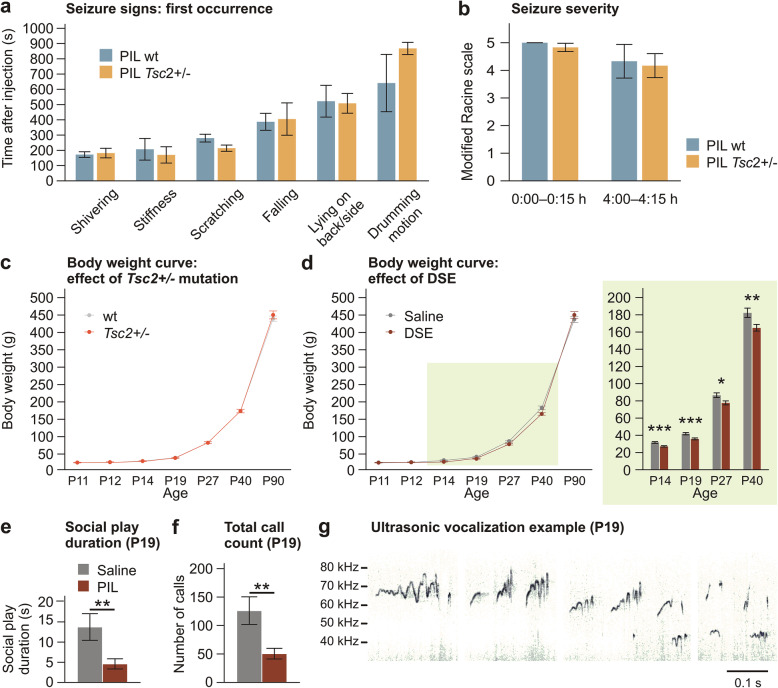
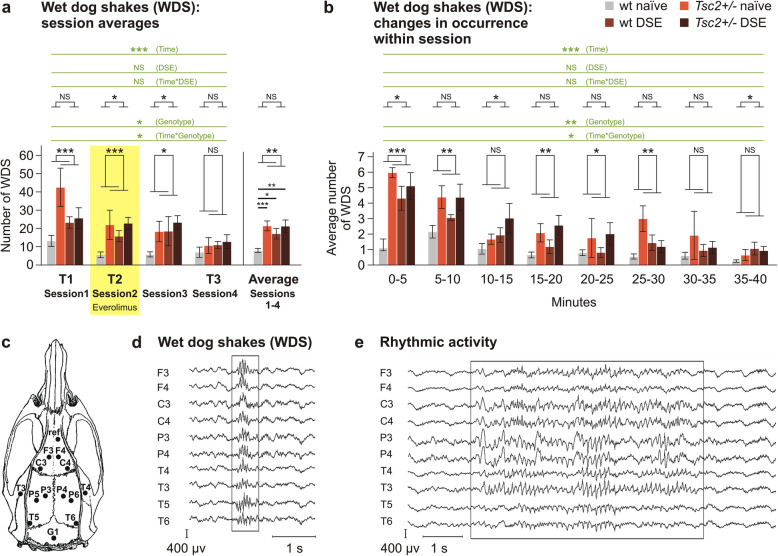
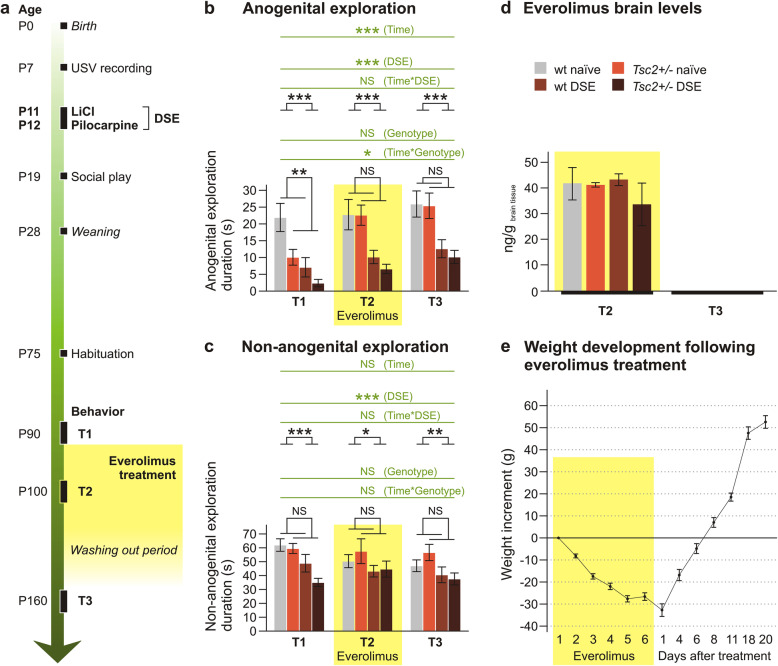
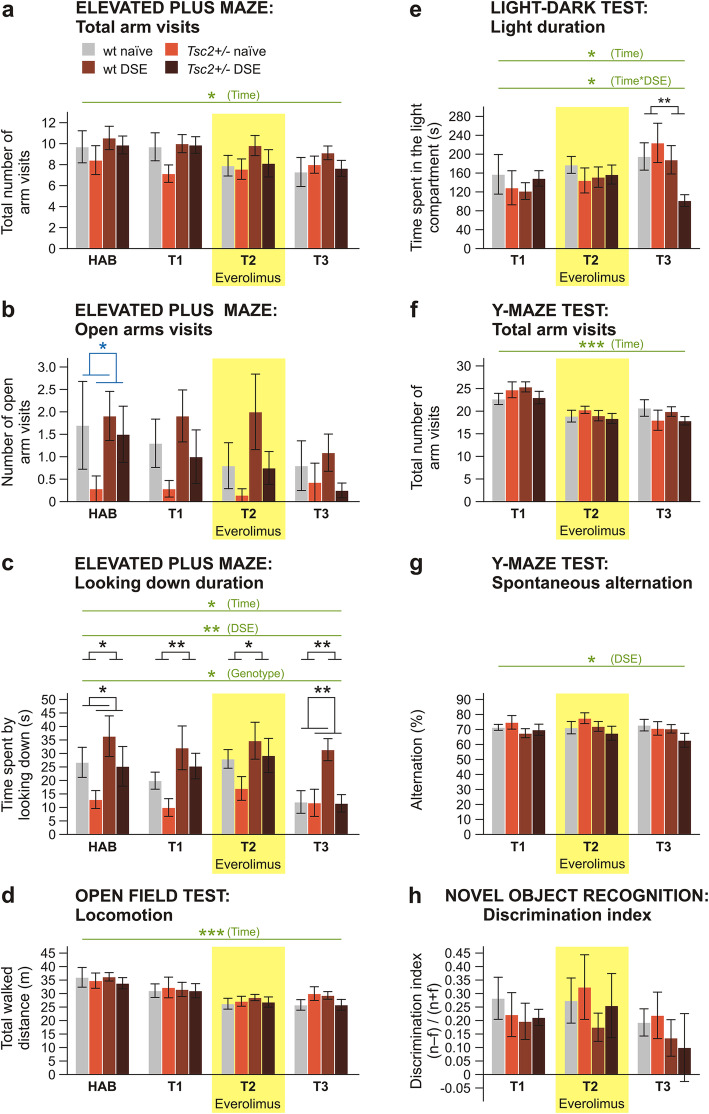
At postnatal day P12, developmental status epilepticus (DSE) was induced in male Tsc2+/- (Eker) and wild-type rats, establishing four experimental groups including controls. In adult animals (n = 36), the behavior was assessed in the paradigms of social interaction test, elevated plus-maze, light-dark test, Y-maze, and novel object recognition. The testing was carried out before medication (T1), during a 2-week treatment with the mTOR inhibitor everolimus (T2) and after an 8-week washing-out (T3). Electroencephalographic (EEG) activity was recorded in a separate set of animals (n = 18).
Both Tsc2+/- mutation and DSE caused social behavior deficits and epileptiform EEG abnormalities (T1). Everolimus led to a persistent improvement of the social deficit induced by Tsc2+/-, while deficits related to DSE did not respond to everolimus (T2, T3).
These findings may contribute to an explanation why ASD symptoms in individuals with TSC, where comorbid early-onset epilepsy is common, were not reliably ameliorated by mTOR inhibitors in clinical studies.
结节性硬化症(TSC)是一种多系统遗传性疾病,常伴有自闭症谱系障碍(ASD),由 TSC1 或 TSC2 的突变引起,导致哺乳动物雷帕霉素靶蛋白(mTOR)的组成性过度激活。在几种 Tsc1+/-和 Tsc2+/-动物模型中,mTOR 抑制剂可逆转认知和社交行为缺陷。然而,II 期研究并未显示在 TSC 个体的 mTOR 抑制剂治疗中改善 ASD 和认知缺陷。我们在这里询问,是否发育性癫痫(在大多数 TSC 患者中常见,但在大多数动物模型中不存在)可以解释这种差异。
在出生后第 12 天(P12),诱导雄性 Tsc2+/-(Eker)和野生型大鼠发生发育性癫痫持续状态(DSE),建立包括对照组在内的四个实验组。在成年动物(n = 36)中,采用社会互动测试、高架十字迷宫、明暗测试、Y 迷宫和新物体识别测试进行行为评估。在未用药(T1)、用 mTOR 抑制剂依维莫司治疗 2 周(T2)和停药 8 周(T3)期间进行测试。在另一组动物(n = 18)中记录脑电图(EEG)活动。
Tsc2+/-突变和 DSE 均导致社交行为缺陷和癫痫样 EEG 异常(T1)。依维莫司可持久改善 Tsc2+/-引起的社交缺陷,而与 DSE 相关的缺陷对依维莫司无反应(T2、T3)。
这些发现可能有助于解释为什么在伴有早期发病癫痫的 TSC 患者中,mTOR 抑制剂在临床研究中不能可靠地改善 ASD 症状。