Institute of Parasitology, Biology Centre, Czech Academy of Sciences, České Budějovice, Czech Republic.
Department of Biological Sciences, University of Rhode Island, Kingston, RI, USA.
BMC Biol. 2021 Apr 16;19(1):77. doi: 10.1186/s12915-021-01007-2.
Apicomplexa is a diverse phylum comprising unicellular endobiotic animal parasites and contains some of the most well-studied microbial eukaryotes including the devastating human pathogens Plasmodium falciparum and Cryptosporidium hominis. In contrast, data on the invertebrate-infecting gregarines remains sparse and their evolutionary relationship to other apicomplexans remains obscure. Most apicomplexans retain a highly modified plastid, while their mitochondria remain metabolically conserved. Cryptosporidium spp. inhabit an anaerobic host-gut environment and represent the known exception, having completely lost their plastid while retaining an extremely reduced mitochondrion that has lost its genome. Recent advances in single-cell sequencing have enabled the first broad genome-scale explorations of gregarines, providing evidence of differential plastid retention throughout the group. However, little is known about the retention and metabolic capacity of gregarine mitochondria.
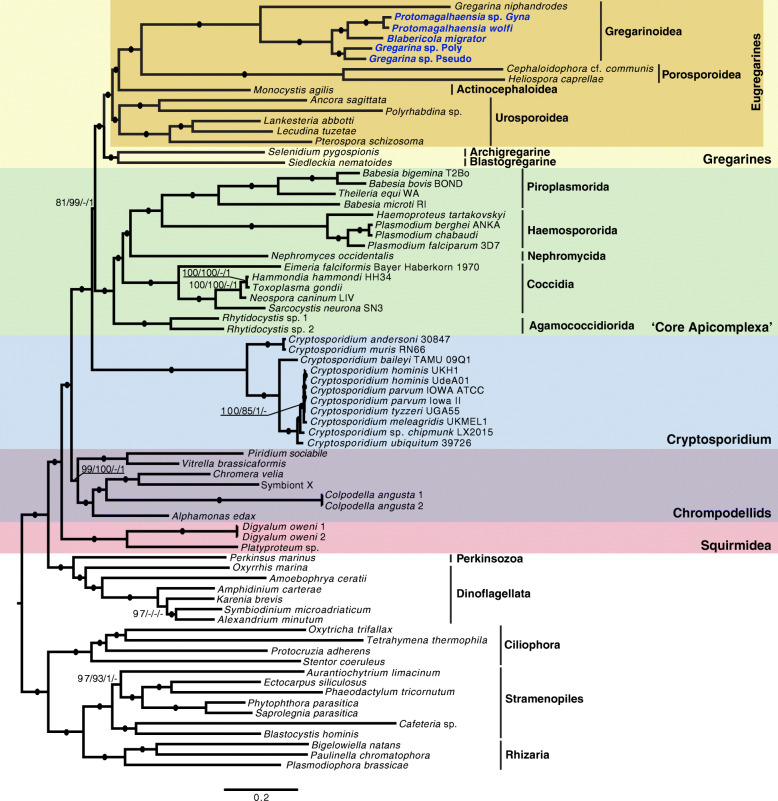
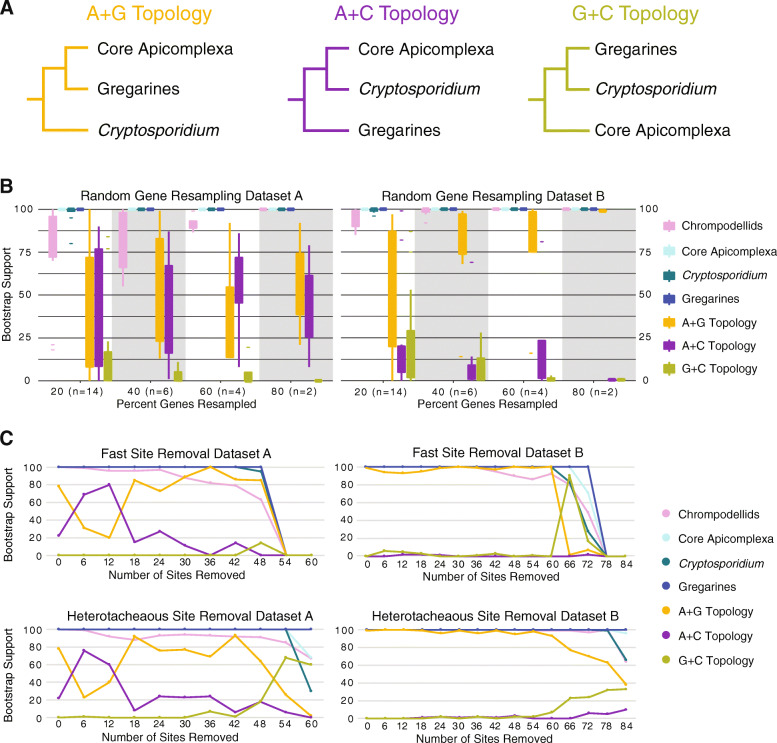
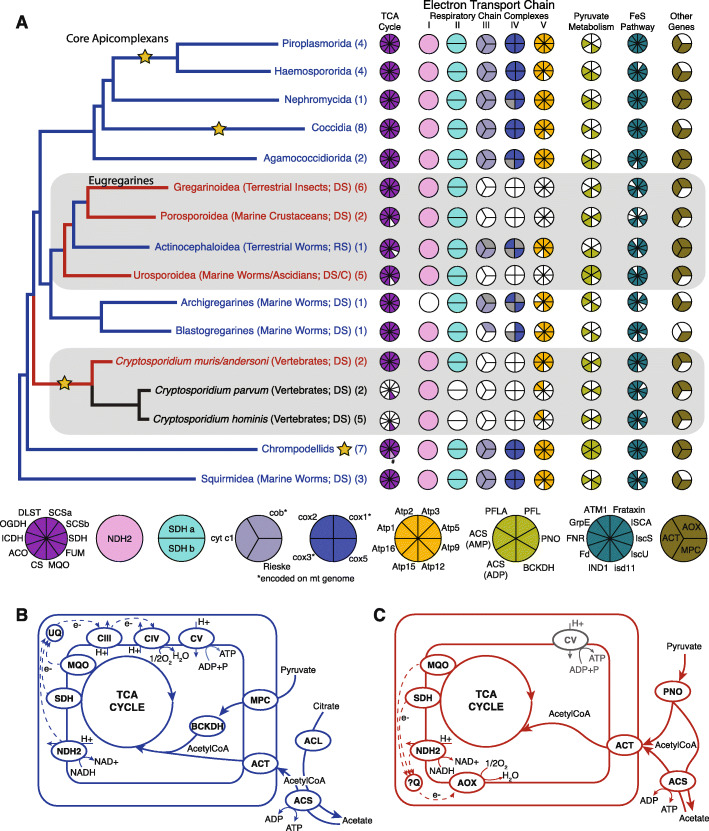
Here, we sequenced transcriptomes from five species of gregarines isolated from cockroaches. We combined these data with those from other apicomplexans, performed detailed phylogenomic analyses, and characterized their mitochondrial metabolism. Our results support the placement of Cryptosporidium as the earliest diverging lineage of apicomplexans, which impacts our interpretation of evolutionary events within the phylum. By mapping in silico predictions of core mitochondrial pathways onto our phylogeny, we identified convergently reduced mitochondria. These data show that the electron transport chain has been independently lost three times across the phylum, twice within gregarines.
Apicomplexan lineages show variable functional restructuring of mitochondrial metabolism that appears to have been driven by adaptations to parasitism and anaerobiosis. Our findings indicate that apicomplexans are rife with convergent adaptations, with shared features including morphology, energy metabolism, and intracellularity.
肉足鞭毛门是一个多样化的门,包含单细胞内共生动物寄生虫,其中包括一些研究最深入的微生物真核生物,包括致命的人类病原体疟原虫和人隐孢子虫。相比之下,关于感染无脊椎动物的疟原虫的数据仍然很少,它们与其他肉足鞭毛门的进化关系仍然不清楚。大多数肉足鞭毛门保留了一个高度修饰的质体,而它们的线粒体在代谢上保持保守。隐孢子虫属栖息在无氧的宿主-肠道环境中,是已知的例外,它们完全失去了质体,同时保留了一个极度缩小的线粒体,这个线粒体已经失去了基因组。单细胞测序的最新进展使得对疟原虫进行了首次广泛的基因组规模探索,为整个群体中质体的差异保留提供了证据。然而,关于疟原虫线粒体的保留和代谢能力知之甚少。
在这里,我们从蟑螂中分离出的五种疟原虫测序了转录组。我们将这些数据与其他肉足鞭毛门的数据结合起来,进行了详细的系统基因组分析,并对其线粒体代谢进行了表征。我们的结果支持将隐孢子虫作为肉足鞭毛门最早分化的谱系,这影响了我们对该门内进化事件的解释。通过将核心线粒体途径的计算机预测映射到我们的系统发育树上,我们鉴定出趋同减少的线粒体。这些数据表明,电子传递链在整个门中已经独立丢失了三次,其中两次发生在疟原虫中。
肉足鞭毛门的谱系显示线粒体代谢的功能结构具有可变性,这似乎是由寄生和无氧适应驱动的。我们的研究结果表明,肉足鞭毛门存在着趋同适应,包括形态、能量代谢和内共生性等共同特征。