Smyth Lillian M, Batist Gerald, Meric-Bernstam Funda, Kabos Peter, Spanggaard Iben, Lluch Ana, Jhaveri Komal, Varga Andrea, Wong Andrea, Schram Alison M, Ambrose Helen, Carr T Hedley, de Bruin Elza C, Salinas-Souza Carolina, Foxley Andrew, Hauser Joana, Lindemann Justin P O, Maudsley Rhiannon, McEwen Robert, Moschetta Michele, Nikolaou Myria, Schiavon Gaia, Razavi Pedram, Banerji Udai, Baselga José, Hyman David M, Chandarlapaty Sarat
Memorial Sloan Kettering Cancer Center, New York, NY, USA.
Loxo Oncology Inc., Stamford, CT, USA.
NPJ Breast Cancer. 2021 Apr 16;7(1):44. doi: 10.1038/s41523-021-00251-7.
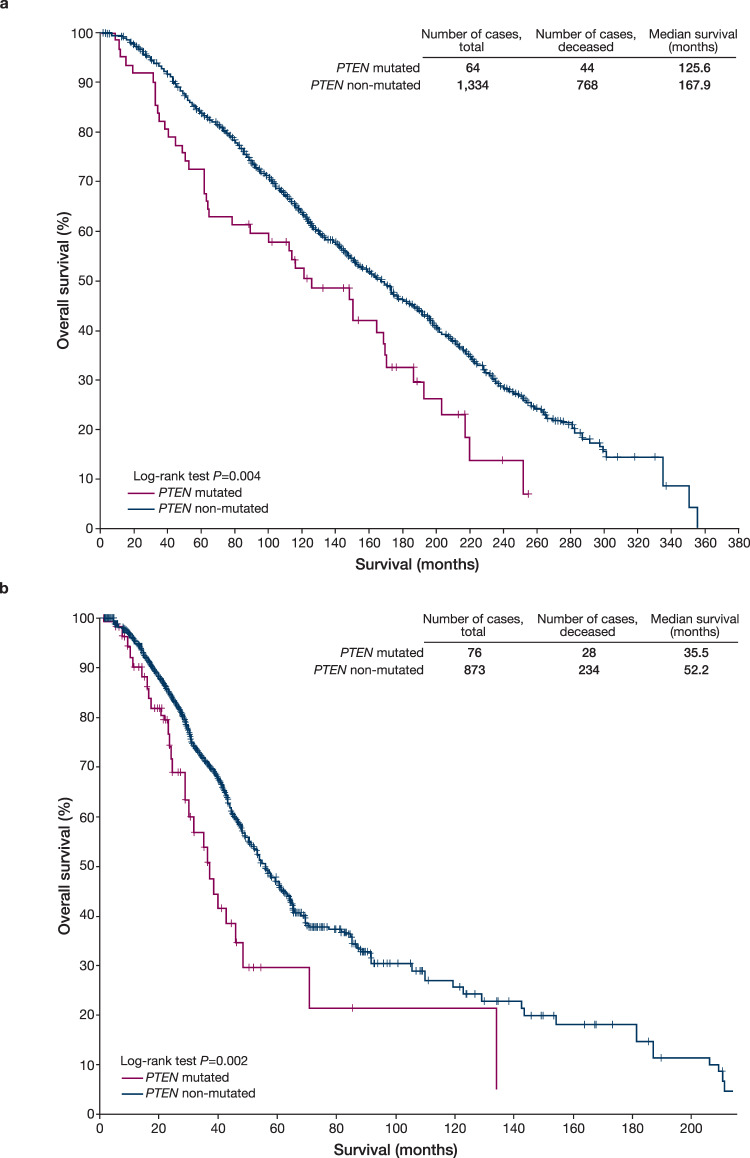
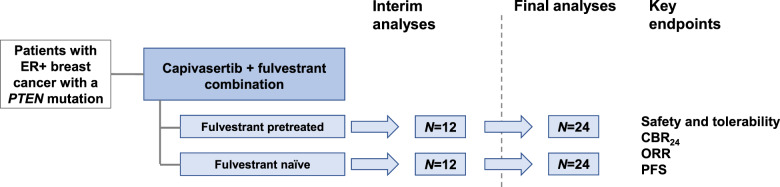
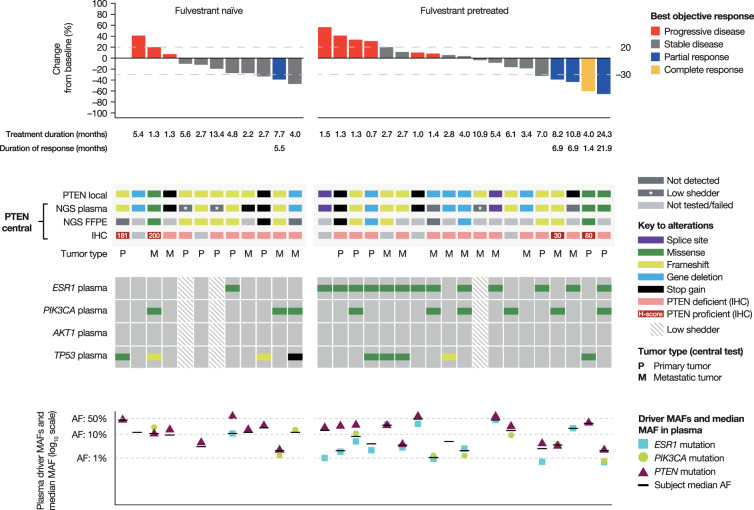
Five to ten percent of ER+ metastatic breast cancer (MBC) tumors harbor somatic PTEN mutations. Loss of function of this tumor-suppressor gene defines a highly aggressive, treatment-refractory disease for which new therapies are urgently needed. This Phase I multipart expansion study assessed oral capivasertib with fulvestrant in patients with PTEN-mutant ER+ MBC. Safety and tolerability were assessed by standard methods. Plasma and tumor were collected for NGS and immunohistochemistry analyses of PTEN protein expression. In 31 eligible patients (12 fulvestrant naive; 19 fulvestrant pretreated), the 24-week clinical benefit rate was 17% in fulvestrant-naive and 42% in fulvestrant-pretreated patients, with objective response rate of 8% and 21%, respectively. Non-functional PTEN was centrally confirmed in all cases by NGS or immunohistochemistry. Co-mutations occurred in PIK3CA (32%), with less ESR1 (10% vs 72%) and more TP53 (40% vs 28%) alterations in fulvestrant-naive versus fulvestrant-pretreated patients, respectively. PTEN was clonally dominant in most patients. Treatment-related grade ≥3 adverse events occurred in 32% of patients, most frequently diarrhea and maculopapular rash (both n = 2). In this clinical study, which selectively targeted the aggressive PTEN-mutant ER+ MBC, capivasertib plus fulvestrant was tolerable and clinically active. Phenotypic and genomic differences were apparent between fulvestrant-naive and -pretreated patients.Trial registration number for the study is NCT01226316.
5%至10%的雌激素受体阳性(ER+)转移性乳腺癌(MBC)肿瘤存在体细胞磷酸酶及张力蛋白同源物(PTEN)突变。这种肿瘤抑制基因功能的丧失定义了一种高度侵袭性、难治性疾病,迫切需要新的治疗方法。这项I期多队列扩展研究评估了口服卡匹西利联合氟维司群治疗PTEN突变的ER+MBC患者的疗效。通过标准方法评估安全性和耐受性。收集血浆和肿瘤组织用于PTEN蛋白表达的二代测序(NGS)和免疫组化分析。在31例符合条件的患者中(12例未接受过氟维司群治疗;19例接受过氟维司群治疗),未接受过氟维司群治疗的患者24周临床获益率为17%,接受过氟维司群治疗的患者为42%,客观缓解率分别为8%和21%。所有病例均通过NGS或免疫组化在中心实验室确认PTEN无功能。在未接受过氟维司群治疗与接受过氟维司群治疗的患者中,分别有32%的患者发生磷脂酰肌醇-3激酶催化亚基α(PIK3CA)共突变,雌激素受体1(ESR1)改变较少(分别为10%对72%),而肿瘤蛋白p53(TP53)改变较多(分别为40%对28%)。在大多数患者中,PTEN是克隆性优势基因。32%的患者发生了与治疗相关的≥3级不良事件,最常见的是腹泻和斑丘疹(均为n = 2)。在这项选择性针对侵袭性PTEN突变的ER+MBC的临床研究中,卡匹西利联合氟维司群耐受性良好且具有临床活性。未接受过氟维司群治疗与接受过氟维司群治疗的患者之间存在明显的表型和基因组差异。该研究的试验注册号为NCT01226316。