Schwartzberg Lee S, Kiedrowski Lesli A
West Cancer Center, 7945 Wolf River Blvd., Germantown, TN 38138, USA.
Department of Medical Affairs, Guardant Health, Inc., Redwood City, CA, USA.
Ther Adv Med Oncol. 2021 Apr 5;13:17588359211006962. doi: 10.1177/17588359211006962. eCollection 2021.
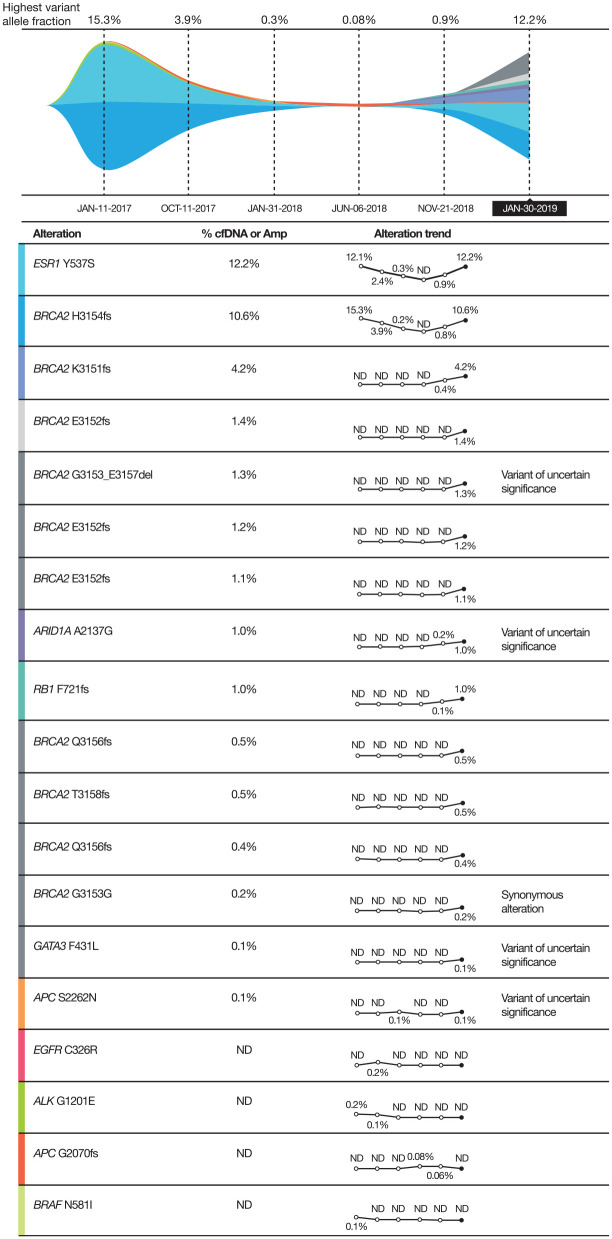
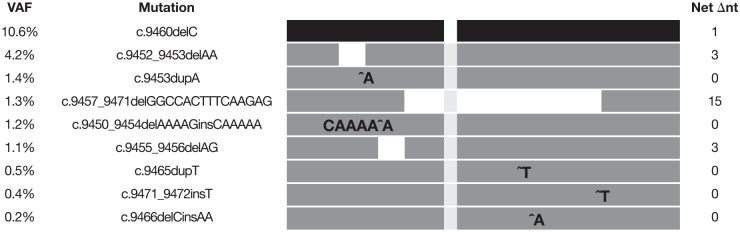
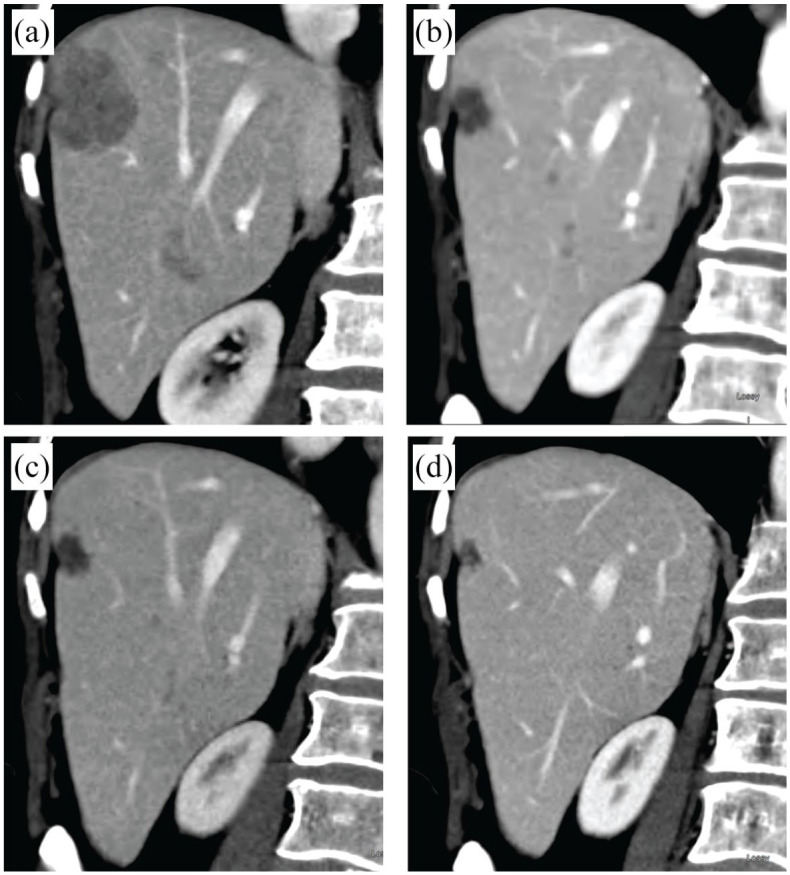
The oral poly(adenosine diphosphate-ribose) polymerase inhibitor olaparib is approved for the treatment of patients with human epidermal growth factor 2-negative (HER2-) metastatic breast cancer (mBC) and a germline breast cancer susceptibility gene (BRCA) mutation who have been treated with chemotherapy. This case report describes a 63-year-old postmenopausal woman with somatic -mutated mBC who responded to olaparib treatment following multiple prior lines of therapy. The patient presented in January 2012 with locally advanced, hormone receptor-positive (HR+), HER2- BC which, despite initial response to neoadjuvant chemotherapy, recurred as bone disease in February 2014, and subsequently skin (June 2016) and liver (October 2016) metastases. A comprehensive 592-gene next-generation sequencing panel (Caris Life Sciences), performed on a skin biopsy, detected a pathogenic frameshift mutation in (H3154fs, c.9460delC), which was not identified in a 28-gene hereditary cancer germline analysis (Myriad Genetics, Inc.), and was therefore considered to be a somatic mutation. In January 2017, cell-free DNA (cfDNA) analysis (Guardant Health, Inc.) confirmed the H3154fs mutation in plasma. After several lines of chemotherapy and endocrine therapy, deriving clinical benefit from eribulin and capecitabine, the disease progressed by October 2017, and olaparib (300 mg orally twice daily) was initiated in January 2018. By April 2018, the liver lesions had shrunk by 80% and a >90% response in multiple skin lesions was noted. Clinical response was maintained for 8 months, followed by progression in the skin in September 2018. Biopsy of recurrent lesions revealed a novel mutation, E3152del (c.9455_9457delAGG), predicted to restore the open reading frame and presumably the mechanism of resistance to olaparib. Further likely resistance mutations were noted in subsequent cfDNA analyses. This case demonstrated a clinical response with olaparib as a later-line therapy for HR+, HER2- mBC with a somatic mutation.
口服聚(二磷酸腺苷 - 核糖)聚合酶抑制剂奥拉帕利被批准用于治疗接受过化疗的人表皮生长因子2阴性(HER2-)转移性乳腺癌(mBC)且存在种系乳腺癌易感基因(BRCA)突变的患者。本病例报告描述了一名63岁的绝经后女性,患有体细胞突变的mBC,在接受多线先前治疗后对奥拉帕利治疗有反应。该患者于2012年1月出现局部晚期、激素受体阳性(HR+)、HER2-乳腺癌,尽管对新辅助化疗有初始反应,但于2014年2月复发为骨转移,随后于2016年6月出现皮肤转移,2016年10月出现肝转移。对皮肤活检进行的全面的592基因下一代测序面板(Caris生命科学公司)检测到 (H3154fs,c.9460delC)中的致病性移码突变,该突变在28基因遗传性癌症种系分析(Myriad遗传学公司)中未被鉴定,因此被认为是体细胞突变。2017年1月,游离DNA(cfDNA)分析(Guardant健康公司)证实血浆中存在 H3154fs突变。在接受多线化疗和内分泌治疗,从艾瑞布林和卡培他滨中获得临床获益后,疾病于2017年10月进展,2018年1月开始使用奥拉帕利(每日口服两次,每次300mg)。到2018年4月,肝脏病变缩小了80%,多个皮肤病变出现>90%的反应。临床反应维持了8个月,随后于2018年9月皮肤病变进展。复发病变的活检显示了一个新的 突变,E3152del(c.9455_9457delAGG),预计可恢复开放阅读框,可能也是对奥拉帕利耐药的机制。在随后的cfDNA分析中还发现了其他可能的耐药突变。本病例证明了奥拉帕利作为HR+、HER2- mBC伴有体细胞 突变的后线治疗具有临床反应。