Liger-Belair Gérard, Cilindre Clara
Equipe Effervescence, Champagne et Applications (GSMA), UMR CNRS 7331, Université de Reims Champagne-Ardenne, BP 1039, 51687 Reims Cedex 2, France.
ACS Omega. 2021 Mar 31;6(14):9672-9679. doi: 10.1021/acsomega.1c00256. eCollection 2021 Apr 13.
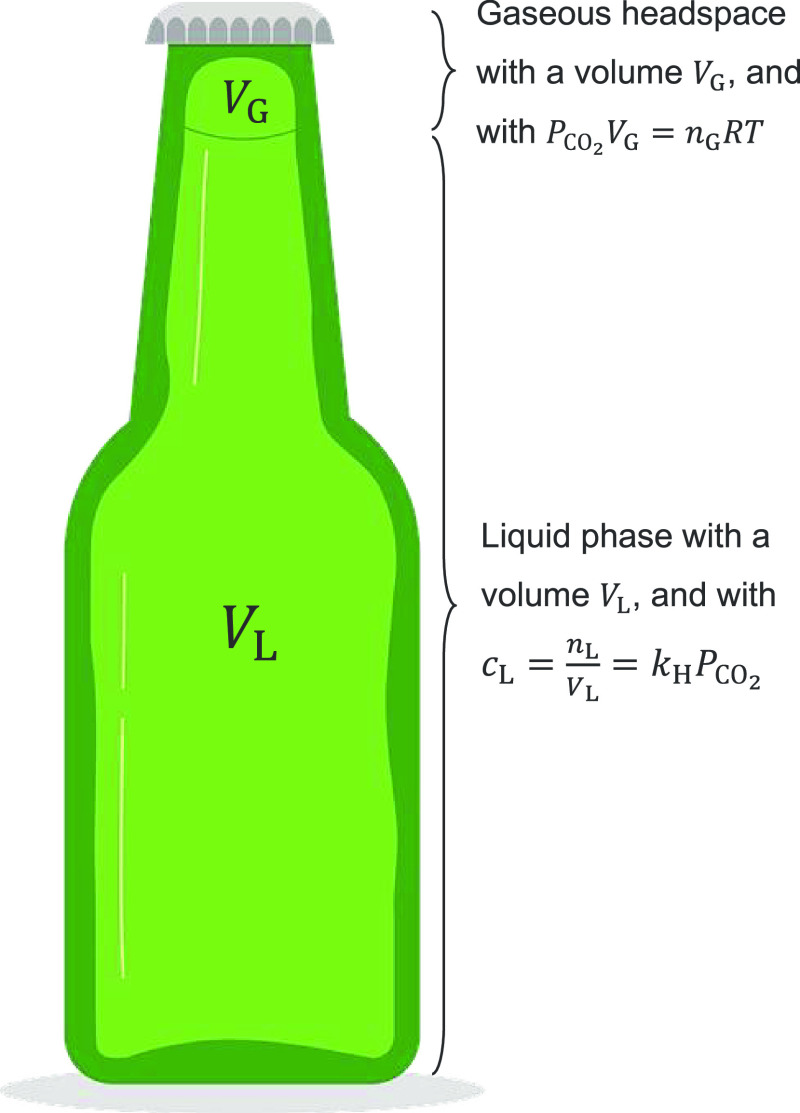
The number of bubbles likely to form in a glass of beer is the result of the fine interplay between dissolved CO, tiny particles or glass imperfections acting as bubble nucleation sites, and ascending bubble dynamics. Experimental and theoretical developments about the thermodynamic equilibrium of dissolved and gas-phase carbon dioxide (CO) were made relevant to the bottling and service of a commercial lager beer, with 5% alcohol by volume and a concentration of dissolved CO close to 5.5 g L. The critical radius and the subsequent critical concentration of dissolved CO needed to trigger heterogeneous nucleation of CO bubbles from microcrevices once the beer was dispensed in a glass were derived. The subsequent total number of CO bubbles likely to form in a single glass of beer was theoretically approached as a function of the various key parameters under standard tasting conditions. The present results with the lager beer were compared with previous sets of data measured with a standard commercial Champagne wine (with 12.5% alcohol by volume and a concentration of dissolved CO close to 11 g L).
一杯啤酒中可能形成的气泡数量是溶解的二氧化碳、充当气泡成核位点的微小颗粒或玻璃瑕疵以及上升气泡动力学之间精细相互作用的结果。关于溶解态和气态二氧化碳(CO₂)热力学平衡的实验和理论进展与一种商业贮藏啤酒的装瓶和饮用相关,该啤酒的酒精体积分数为5%,溶解的CO₂浓度接近5.5 g/L。推导了啤酒倒入玻璃杯中后,引发CO₂气泡从微缝隙中异相成核所需的临界半径和随后的溶解CO₂临界浓度。理论上探讨了在标准品尝条件下,一杯啤酒中可能形成的CO₂气泡总数与各种关键参数的函数关系。将贮藏啤酒的当前结果与之前用标准商业香槟酒(酒精体积分数为12.5%,溶解的CO₂浓度接近11 g/L)测量的几组数据进行了比较。