Department of Medicine Amager Hvidovre Hospital in Glostrup University of Copenhagen Glostrup Denmark.
Department of Clinical Physiology, Nuclear Medicine, and PET Rigshospitalet Glostrup University of Copenhagen Glostrup Denmark.
J Am Heart Assoc. 2021 May 4;10(9):e018716. doi: 10.1161/JAHA.120.018716. Epub 2021 Apr 19.
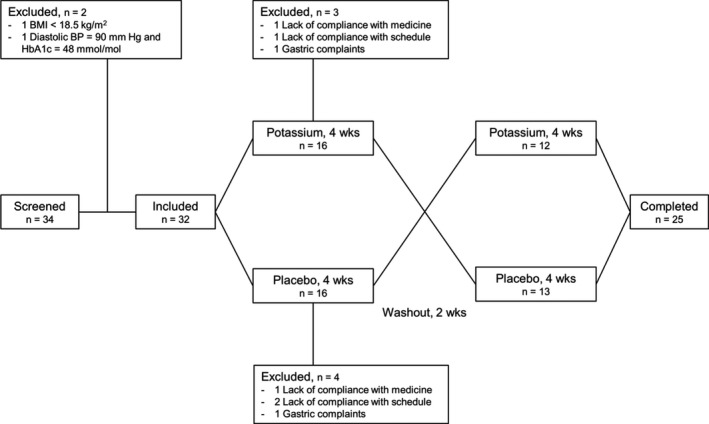
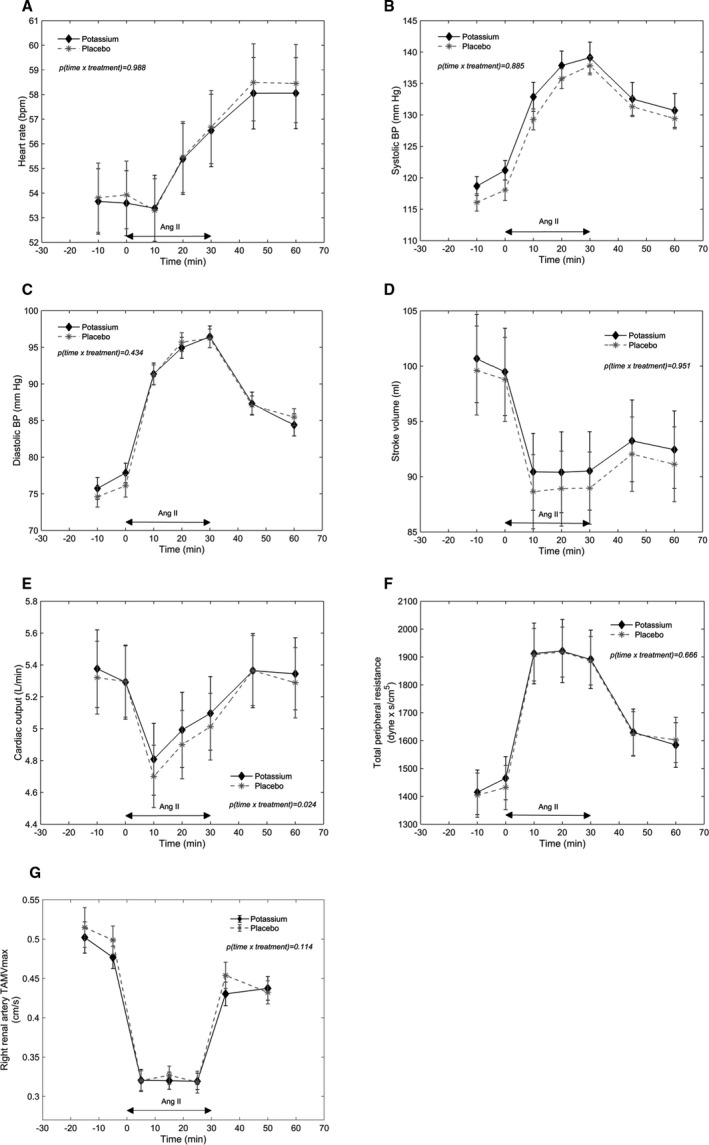
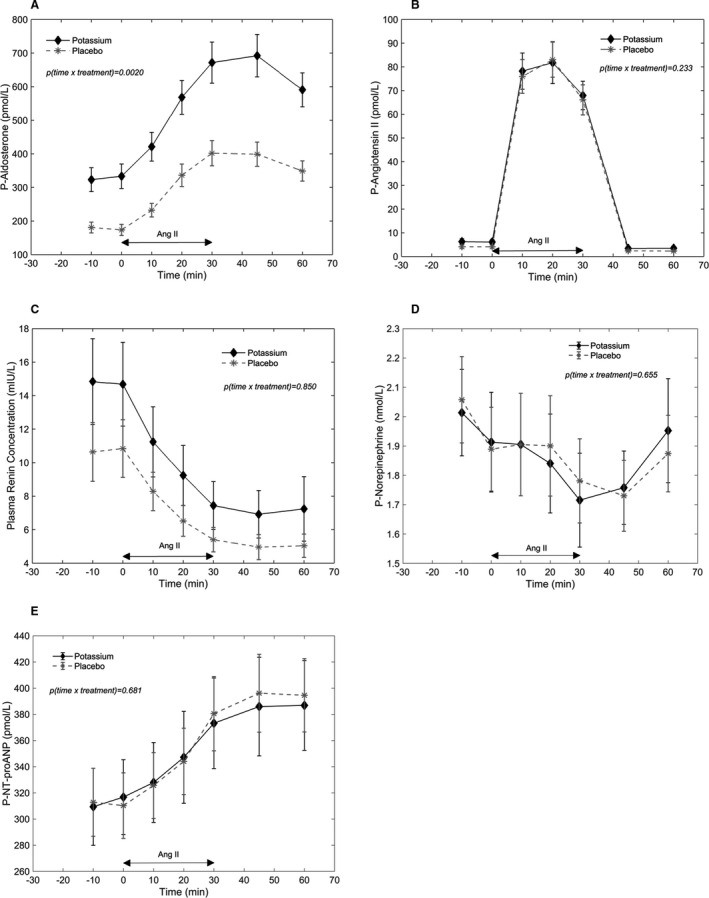
Background Increased potassium intake lowers blood pressure in patients with hypertension, but increased potassium intake also elevates plasma concentrations of the blood pressure-raising hormone aldosterone. Besides its well-described renal effects, aldosterone is also believed to have vascular effects, acting through mineralocorticoid receptors present in endothelial and vascular smooth muscle cells, although mineralocorticoid receptors-independent actions are also thought to be involved. Methods and Results To gain further insight into the effect of increased potassium intake and potassium-stimulated hyperaldosteronism on the human cardiovascular system, we conducted a randomized placebo-controlled double-blind crossover study in 25 healthy normotensive men, where 4 weeks treatment with a potassium supplement (90 mmol/day) was compared with 4 weeks on placebo. At the end of each treatment period, we measured potassium and aldosterone in plasma and performed an angiotensin II (AngII) infusion experiment, during which we assessed the aldosterone response in plasma. Hemodynamics were also monitored during the AngII infusion using ECG, impedance cardiography, finger plethysmography (blood pressure-monitoring), and Doppler ultrasound. The study showed that higher potassium intake increased plasma potassium (mean±SD, 4.3±0.2 versus 4.0±0.2 mmol/L; =0.0002) and aldosterone (median [interquartile range], 440 [336-521] versus 237 [173-386] pmol/L; <0.0001), and based on a linear mixed model for repeated measurements, increased potassium intake potentiated AngII-stimulated aldosterone secretion (=0.0020). In contrast, the hemodynamic responses (blood pressure, total peripheral resistance, cardiac output, and renal artery blood flow) to AngII were similar after potassium and placebo. Conclusions Increased potassium intake potentiates AngII-stimulated aldosterone secretion without affecting systemic cardiovascular hemodynamics in healthy normotensive men. Registration EudraCT Number: 2013-004460-66; URL: https://www.ClinicalTrials.gov; Unique identifier: NCT02380157.
增加钾的摄入量可降低高血压患者的血压,但增加钾的摄入量也会升高升高血压的激素醛固酮的血浆浓度。除了其描述明确的肾脏作用外,醛固酮还被认为具有血管作用,通过存在于血管内皮细胞和血管平滑肌细胞中的盐皮质激素受体发挥作用,尽管也认为存在盐皮质激素受体非依赖性作用。
为了更深入地了解增加钾的摄入量和钾刺激的醛固酮增多症对人体心血管系统的影响,我们在 25 名健康的血压正常男性中进行了一项随机、安慰剂对照、双盲交叉研究,其中 4 周的钾补充剂(90mmol/天)治疗与 4 周的安慰剂治疗进行了比较。在每个治疗期结束时,我们测量了血浆中的钾和醛固酮,并进行了血管紧张素 II(AngII)输注实验,在此期间评估了血浆中的醛固酮反应。在 AngII 输注期间,还通过心电图、阻抗心图、指容积描记法(血压监测)和多普勒超声监测血流动力学。研究表明,较高的钾摄入量增加了血浆钾(平均值±标准差,4.3±0.2 与 4.0±0.2mmol/L;=0.0002)和醛固酮(中位数[四分位距],440[336-521]与 237[173-386]pmol/L;<0.0001),并且基于重复测量的线性混合模型,钾的摄入增加增强了 AngII 刺激的醛固酮分泌(=0.0020)。相比之下,在钾和安慰剂后,AngII 引起的血压、总外周阻力、心输出量和肾动脉血流的血流动力学反应相似。
在健康的血压正常男性中,增加钾的摄入量增强了 AngII 刺激的醛固酮分泌,而不会影响全身心血管血流动力学。
EudraCT Number:2013-004460-66;网址:https://www.ClinicalTrials.gov;独特标识符:NCT02380157。