Department of General Surgery, Shantou Central Hospital, Shantou, Guangdong, China.
Department of Medical Oncology, Shantou Central Hospital, Shantou, Guangdong, China.
World J Surg Oncol. 2021 Apr 19;19(1):127. doi: 10.1186/s12957-021-02240-3.
Most previous studies compared survival between left-sided and right-sided colon cancer without adjustment for clinicopathological parameters. We investigated the effect of sidedness on survival among patients with early-stage colon cancer, using a propensity score matching method.
The 18 registry custom data within the SEER database were used to identify patients who were diagnosed with colon cancer between 2010 and 2014. A propensity score matching analysis was performed using the nearest neighbor method. Survival was estimated using the Kaplan-Meier method. A Cox proportional hazards model was applied to determine the prognostic factors.
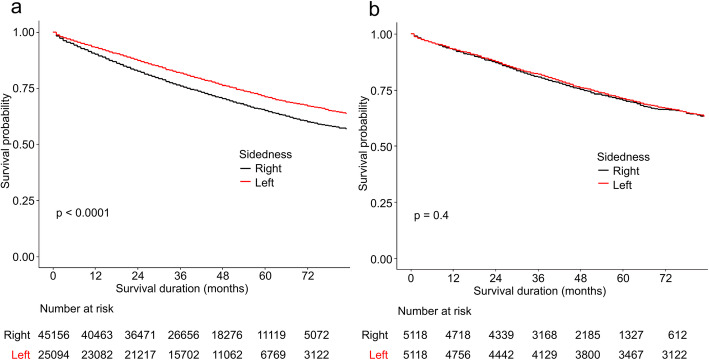
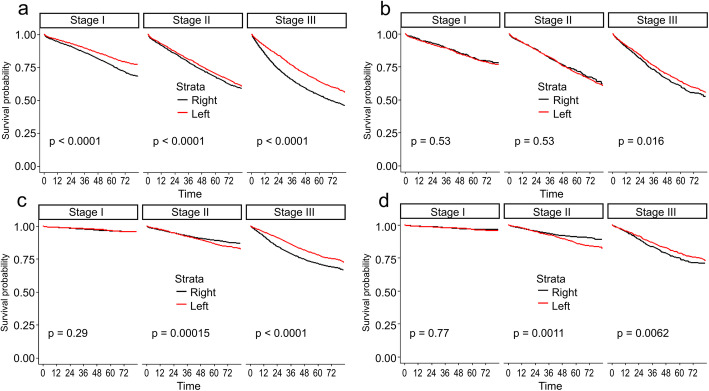
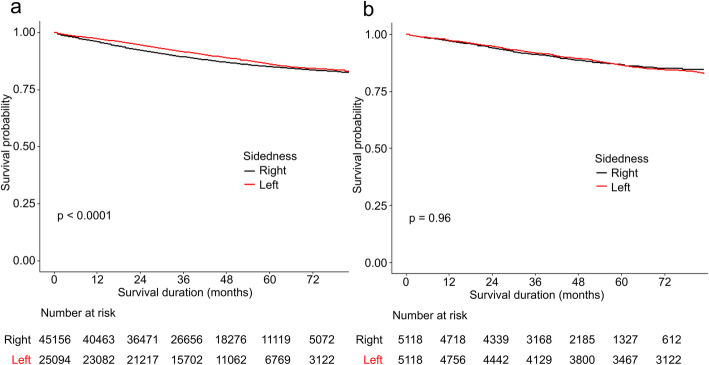
In the unmatched cohort, 25,094 (35.72%) patients were diagnosed with left-sided colon cancer and 45,156 (64.28%) with right-sided colon cancer. After propensity score matching, each cohort included 5118 patients, and the clinicopathological characteristics were well balanced. In the unmatched cohort, left-sided colon cancer had superior all-cause (χ=315, P<0.01) and cancer-specific (χ=43, P<0.01) survival than right-sided tumors. However, in the matched cohort, no difference was observed for all-cause (χ=0.7, P=0.4) and cancer-specific (χ=0, P=0.96) survival between left and right colon cancer. The Cox model did not indicate sidedness as a prognostic factor. In the subgroup analysis, stage II right-sided colon cancer had a better survival outcome, while stage III left-sided tumors had a better survival outcome.
After adjusting for clinicopathological characteristics in this study, sidedness showed no impact on survival in early-stage colon cancer. However, sidedness was associated with prognostic differences in stages II and III early-stage colon cancer.
大多数既往研究均未调整临床病理参数而直接比较左半结肠癌与右半结肠癌的生存情况。本研究采用倾向评分匹配方法,旨在探讨在早期结肠癌患者中,结肠癌侧别对生存的影响。
利用 SEER 数据库中的 18 个登记处定制数据,确定 2010 年至 2014 年间诊断为结肠癌的患者。采用最近邻匹配法进行倾向评分匹配分析。采用 Kaplan-Meier 法评估生存情况。应用 Cox 比例风险模型确定预后因素。
在未匹配队列中,35.72%(25094 例)的患者被诊断为左半结肠癌,64.28%(45156 例)的患者被诊断为右半结肠癌。经倾向评分匹配后,每个队列各包含 5118 例患者,且临床病理特征均衡。在未匹配队列中,左半结肠癌的全因(χ²=315,P<0.01)和癌症特异性(χ²=43,P<0.01)生存率均优于右半结肠癌。然而,在匹配队列中,左、右半结肠癌的全因(χ²=0.7,P=0.4)和癌症特异性(χ²=0,P=0.96)生存率均无差异。Cox 模型未提示结肠癌侧别是预后因素。亚组分析显示,Ⅱ期右半结肠癌的生存结局更好,而Ⅲ期左半结肠癌的生存结局更好。
在本研究中,调整临床病理特征后,结肠癌侧别对早期结肠癌的生存无影响。然而,结肠癌侧别与Ⅱ期和Ⅲ期早期结肠癌的预后差异有关。