Diao Jingyu, Komura Rie, Sano Tatsuya, Pantua Homer, Storek Kelly M, Inaba Hiroko, Ogawa Haruhiko, Noland Cameron L, Peng Yutian, Gloor Susan L, Yan Donghong, Kang Jing, Katakam Anand Kumar, Volny Michael, Liu Peter, Nickerson Nicholas N, Sandoval Wendy, Austin Cary D, Murray Jeremy, Rutherford Steven T, Reichelt Mike, Xu Yiming, Xu Min, Yanagida Hayato, Nishikawa Junichi, Reid Patrick C, Cunningham Christian N, Kapadia Sharookh B
Department of Infectious Diseases, Genentech, South San Francisco, California, USA.
Peptidream Inc., Kawasaki, Kanagawa, Japan.
J Bacteriol. 2021 Jun 8;203(13):e0014921. doi: 10.1128/JB.00149-21.
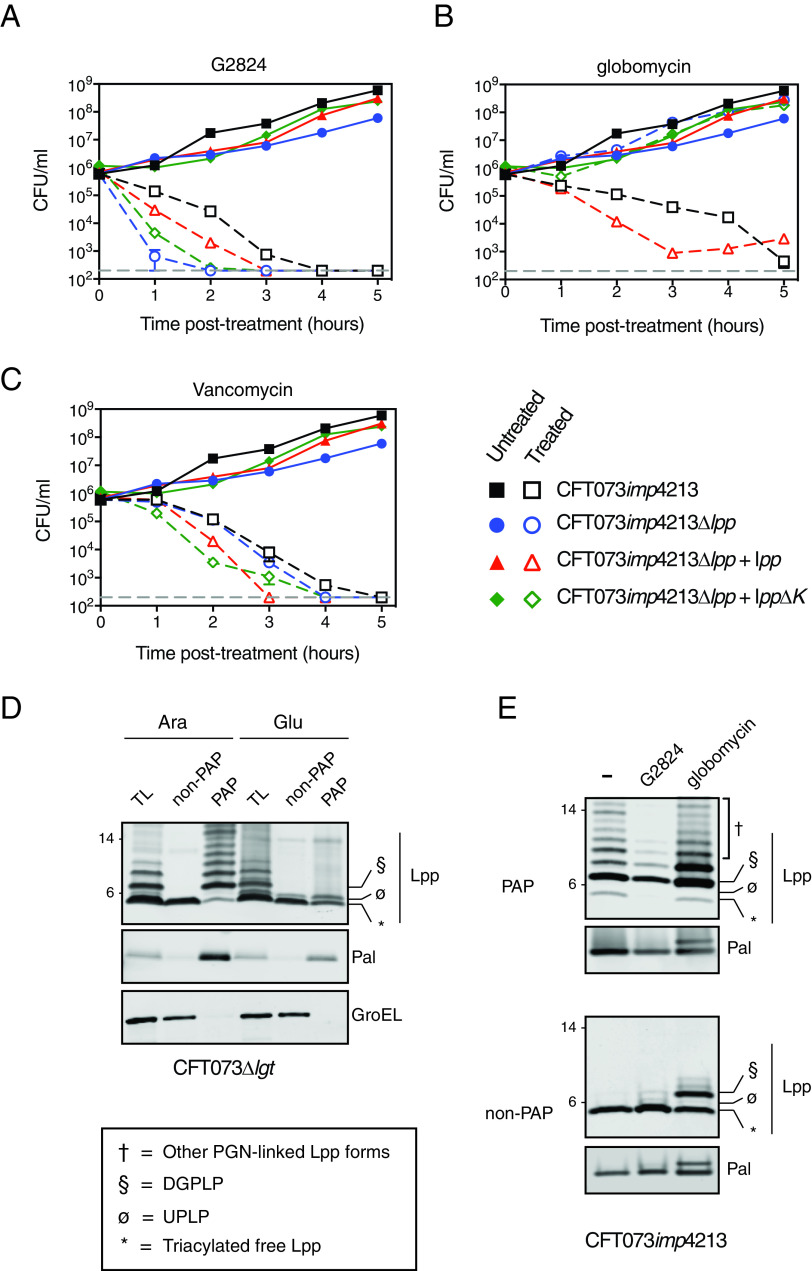
Lipoprotein diacylglyceryl transferase (Lgt) catalyzes the first step in the biogenesis of Gram-negative bacterial lipoproteins which play crucial roles in bacterial growth and pathogenesis. We demonstrate that Lgt depletion in a clinical uropathogenic Escherichia coli strain leads to permeabilization of the outer membrane and increased sensitivity to serum killing and antibiotics. Importantly, we identify G2824 as the first-described Lgt inhibitor that potently inhibits Lgt biochemical activity and is bactericidal against wild-type Acinetobacter baumannii and E. coli strains. While deletion of a gene encoding a major outer membrane lipoprotein, , leads to rescue of bacterial growth after genetic depletion or pharmacologic inhibition of the downstream type II signal peptidase, LspA, no such rescue of growth is detected after Lgt depletion or treatment with G2824. Inhibition of Lgt does not lead to significant accumulation of peptidoglycan-linked Lpp in the inner membrane. Our data validate Lgt as a novel antibacterial target and suggest that, unlike downstream steps in lipoprotein biosynthesis and transport, inhibition of Lgt may not be sensitive to one of the most common resistance mechanisms that invalidate inhibitors of bacterial lipoprotein biosynthesis and transport. As the emerging threat of multidrug-resistant (MDR) bacteria continues to increase, no new classes of antibiotics have been discovered in the last 50 years. While previous attempts to inhibit the lipoprotein biosynthetic (LspA) or transport (LolCDE) pathways have been made, most efforts have been hindered by the emergence of a common mechanism leading to resistance, namely, the deletion of the gene encoding a major Gram-negative outer membrane lipoprotein . Our unexpected finding that inhibition of Lgt is not susceptible to deletion-mediated resistance uncovers the complexity of bacterial lipoprotein biogenesis and the corresponding enzymes involved in this essential outer membrane biogenesis pathway and potentially points to new antibacterial targets in this pathway.
脂蛋白二酰甘油转移酶(Lgt)催化革兰氏阴性菌脂蛋白生物合成的第一步,这些脂蛋白在细菌生长和发病机制中起关键作用。我们证明,临床致病性大肠杆菌菌株中Lgt的缺失会导致外膜通透性增加,并增加对血清杀伤和抗生素的敏感性。重要的是,我们鉴定出G2824是首个被描述的Lgt抑制剂,它能有效抑制Lgt的生化活性,并且对野生型鲍曼不动杆菌和大肠杆菌菌株具有杀菌作用。虽然缺失编码主要外膜脂蛋白的基因会导致在基因敲除或下游II型信号肽酶LspA受到药理抑制后细菌生长得到挽救,但在Lgt缺失或用G2824处理后未检测到这种生长挽救现象。抑制Lgt不会导致肽聚糖连接的Lpp在内膜中大量积累。我们的数据验证了Lgt是一个新的抗菌靶点,并表明,与脂蛋白生物合成和转运的下游步骤不同,抑制Lgt可能对使细菌脂蛋白生物合成和转运抑制剂失效的最常见耐药机制之一不敏感。随着多重耐药(MDR)细菌的新威胁持续增加,过去50年中尚未发现新的抗生素类别。虽然此前曾尝试抑制脂蛋白生物合成(LspA)或转运(LolCDE)途径,但大多数努力都因导致耐药的常见机制的出现而受阻,即缺失编码主要革兰氏阴性外膜脂蛋白的基因。我们意外发现抑制Lgt不易受到缺失介导的耐药性影响,这揭示了细菌脂蛋白生物合成以及参与这一必需外膜生物合成途径的相应酶的复杂性,并可能指向该途径中的新抗菌靶点。