Department of Geography and Environmental Systems, University of Maryland Baltimore County, Baltimore, MD 21250;
School of Geography, Development and Environment, University of Arizona, Tucson, AZ 85721.
Proc Natl Acad Sci U S A. 2021 Apr 27;118(17). doi: 10.1073/pnas.2023483118.
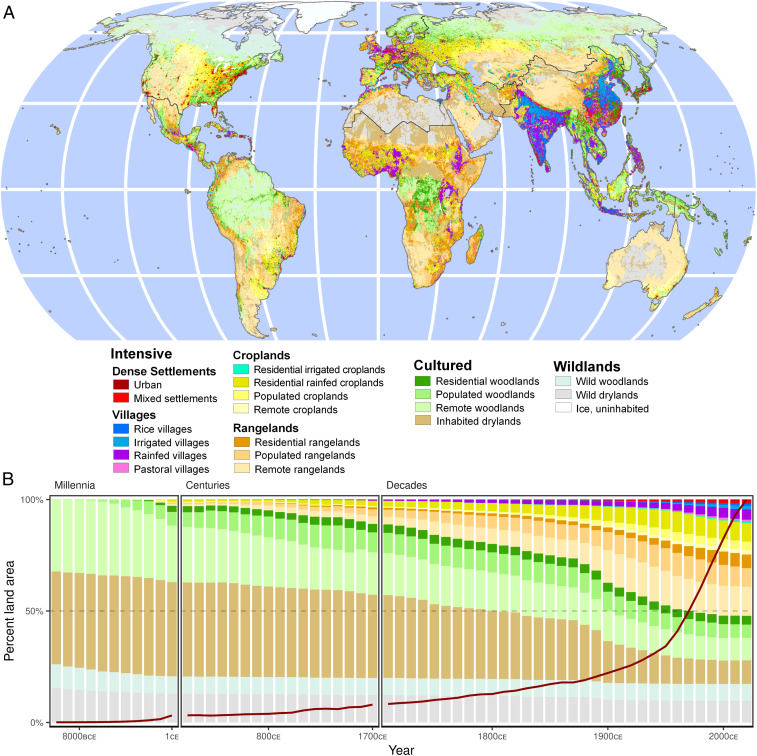
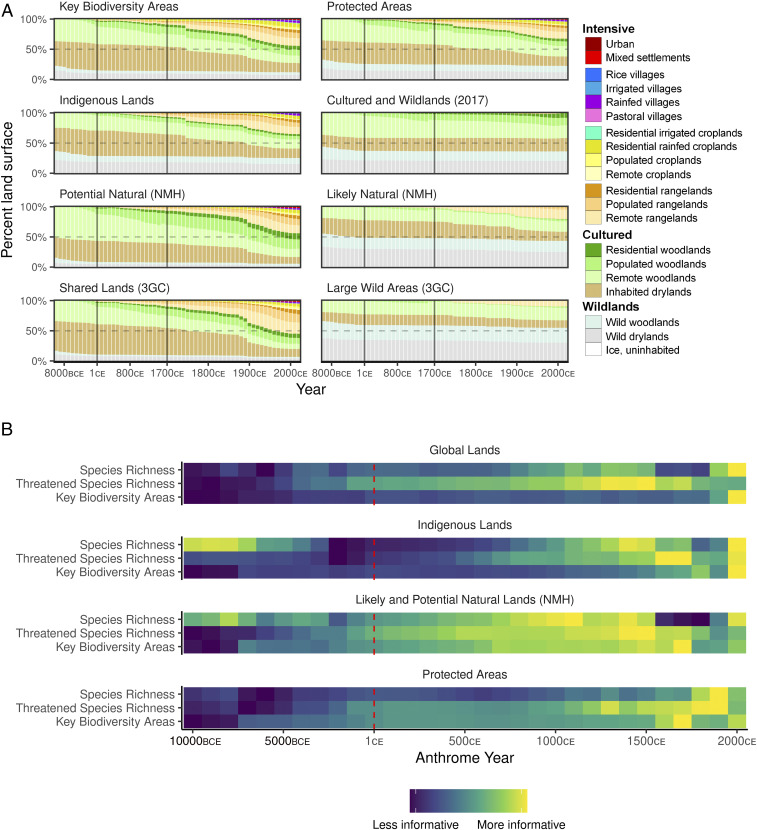
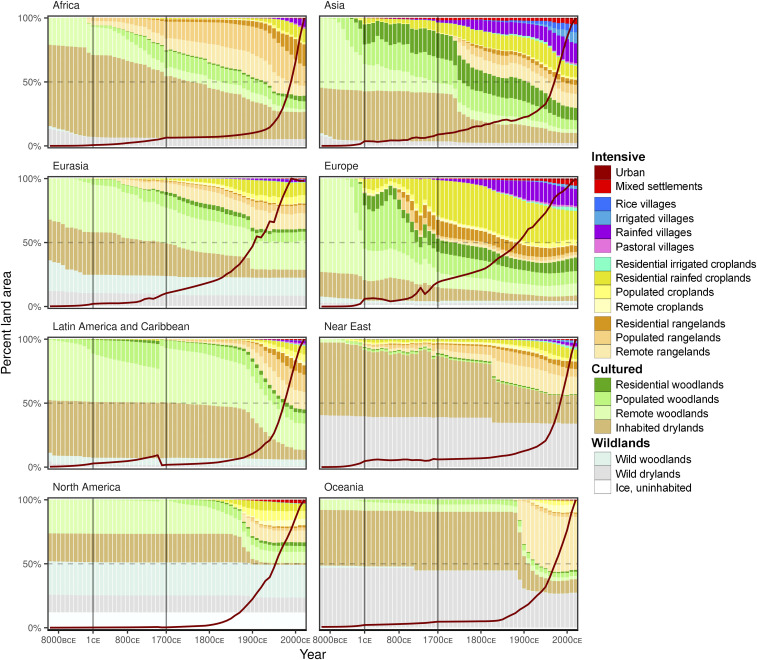
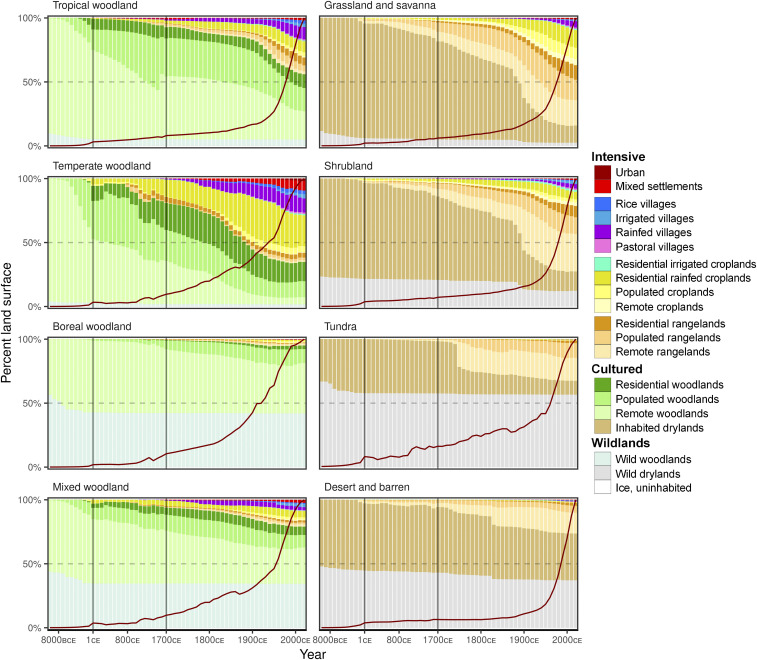
Archaeological and paleoecological evidence shows that by 10,000 BCE, all human societies employed varying degrees of ecologically transformative land use practices, including burning, hunting, species propagation, domestication, cultivation, and others that have left long-term legacies across the terrestrial biosphere. Yet, a lingering paradigm among natural scientists, conservationists, and policymakers is that human transformation of terrestrial nature is mostly recent and inherently destructive. Here, we use the most up-to-date, spatially explicit global reconstruction of historical human populations and land use to show that this paradigm is likely wrong. Even 12,000 y ago, nearly three quarters of Earth's land was inhabited and therefore shaped by human societies, including more than 95% of temperate and 90% of tropical woodlands. Lands now characterized as "natural," "intact," and "wild" generally exhibit long histories of use, as do protected areas and Indigenous lands, and current global patterns of vertebrate species richness and key biodiversity areas are more strongly associated with past patterns of land use than with present ones in regional landscapes now characterized as natural. The current biodiversity crisis can seldom be explained by the loss of uninhabited wildlands, resulting instead from the appropriation, colonization, and intensifying use of the biodiverse cultural landscapes long shaped and sustained by prior societies. Recognizing this deep cultural connection with biodiversity will therefore be essential to resolve the crisis.
考古学和古生态学证据表明,到 10000 年前,所有人类社会都采用了不同程度的具有生态转化性的土地利用实践,包括燃烧、狩猎、物种繁殖、驯化、种植等,这些实践在陆地生物圈中留下了长期的遗产。然而,自然科学家、自然资源保护主义者和政策制定者中仍然存在一种挥之不去的范式,即人类对陆地自然的改造主要是最近发生的,而且具有内在的破坏性。在这里,我们利用最新的、具有空间明确性的全球历史人口和土地利用重建,来表明这种范式可能是错误的。即使在 12000 年前,地球近四分之三的土地已经有人居住,并因此受到人类社会的影响,其中包括超过 95%的温带林地和 90%的热带林地。现在被描述为“自然的”、“完整的”和“野生的”的土地,通常都有着悠久的使用历史,保护区和原住民土地也是如此,而当前全球脊椎动物物种丰富度和关键生物多样性区域的模式与现在被描述为自然的区域景观中的当前模式相比,与过去的土地利用模式更为密切相关。当前的生物多样性危机很少可以用无人居住的荒地的丧失来解释,而是由于先前社会长期塑造和维持的生物多样性文化景观的侵占、殖民化和强化利用所导致的。因此,认识到与生物多样性的这种深刻的文化联系,对于解决这场危机至关重要。