Xu Xuan, Wan Yujin, Li Xizhe, Hu Yong, Tian Shanshan, Mei Qingyan, Jiao Chunyan, Guo Changmin
PetroChina Research Institute of Petroleum Exploration and Development, Beijing, 100083, China.
China Petroleum Pipeline Engineering Corporation, Hebei, 065000, China.
Sci Rep. 2021 Apr 19;11(1):8509. doi: 10.1038/s41598-021-87856-x.
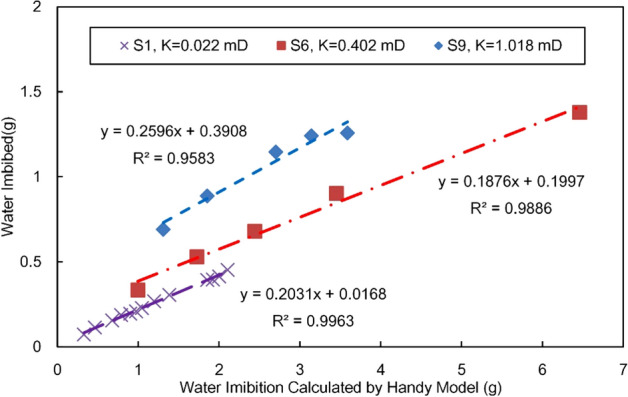
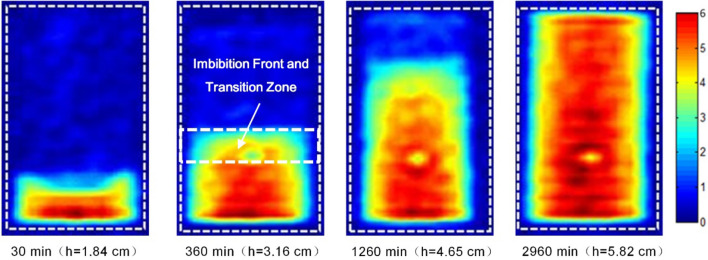
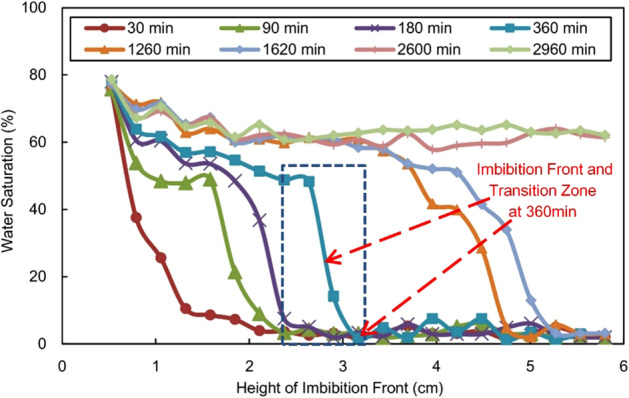
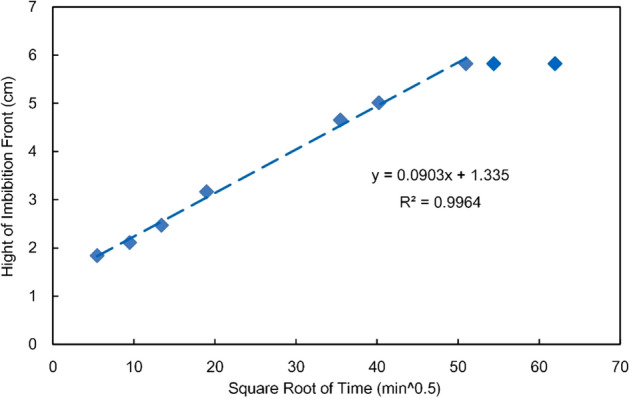
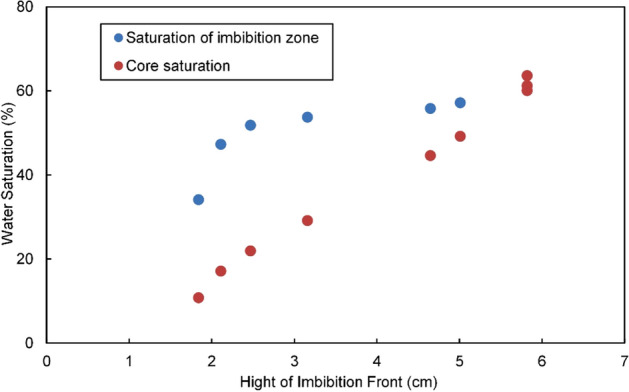
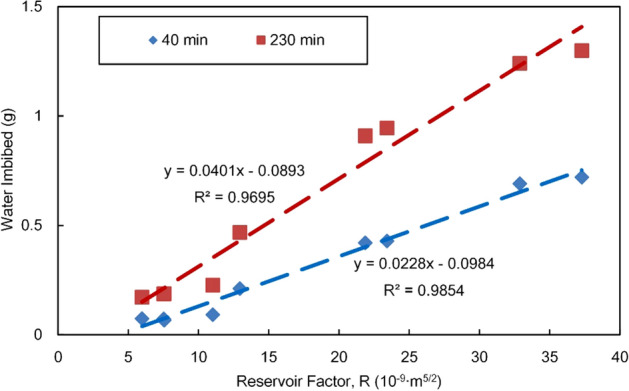
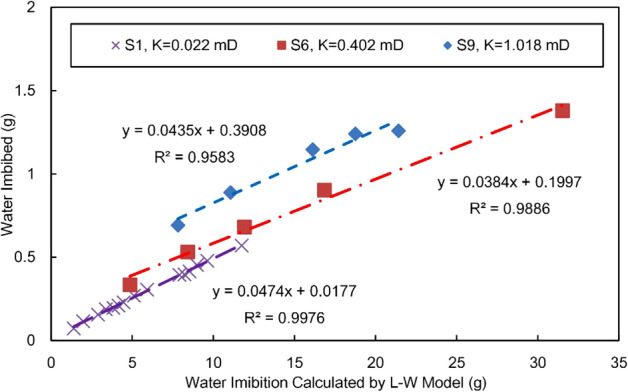
Traditional porous media imbibition models deviate from the actual imbibition process in oil and gas reservoirs. Experimental studies on gas-water imbibition in reservoirs were carried out to describe the dynamic profile variation process of wet phase saturation in reservoirs and to further reveal the variation of the imbibition front and the imbibition amount. Optimization and correction methods were established, and experimental verifications were performed. Studies have shown the following: (1) Unlike homogeneous porous media, the water phase imbibition process in oil and gas reservoirs is more complicated, and it is impossible for the maximum saturation of imbibition to reach 100%. (2) Contrary to the theoretical hypothesis, the imbibition of water is not piston-like, and there is a clear transition zone at the imbibition front. This transition zone is the main cause of water saturation variations in the imbibition zone; with the expansion of the imbibition zone, the influence of the transition zone on water saturation weakens. (3) Traditional theoretical models predict a positive correlation between the imbibition amount and the measurements; however, there is a large deviation in the numerical values, which must be corrected. (4) The L-W model was optimized and the parameter group fluid factor F and the reservoir factor R were proposed to characterize the properties of the fluid and the reservoir, respectively. These two parameters have a clear physical significance and are easy to accurately test. After experimental correction, the optimized model is favourably suitable for oil and gas reservoirs.
传统的多孔介质渗吸模型与油气藏中的实际渗吸过程存在偏差。开展了油藏气水渗吸实验研究,以描述油藏中湿相饱和度的动态剖面变化过程,并进一步揭示渗吸前缘和渗吸量的变化。建立了优化和校正方法,并进行了实验验证。研究结果表明:(1)与均质多孔介质不同,油气藏中的水相渗吸过程更为复杂,渗吸的最大饱和度不可能达到100%。(2)与理论假设相反,水的渗吸不是活塞式的,在渗吸前缘存在明显的过渡带。这个过渡带是渗吸带内含水饱和度变化的主要原因;随着渗吸带的扩展,过渡带对含水饱和度的影响减弱。(3)传统理论模型预测渗吸量与测量值呈正相关;然而,数值存在较大偏差,必须进行校正。(4)对L-W模型进行了优化,提出了参数组流体因子F和储层因子R,分别表征流体和储层的性质。这两个参数具有明确的物理意义,且易于精确测试。经过实验校正后,优化后的模型非常适合油气藏。