van Rooij S J H, Sippel Lauren M, McDonald William M, Holtzheimer Paul E
Department of Psychiatry and Behavioral Sciences, School of Medicine, Emory University, Atlanta, Georgia, USA.
U.S. Department of Veterans Affairs, National Center for PTSD, White River Junction, Vermont, USA.
Depress Anxiety. 2021 Apr 20. doi: 10.1002/da.23159.
Focal brain stimulation has potential as a treatment for posttraumatic stress disorder (PTSD). In this review, we aim to inform selection of focal brain stimulation targets for treating PTSD by examining studies of the functional neuroanatomy of PTSD and treatment response. We first briefly review data on brain stimulation interventions for PTSD. Although published data suggest good efficacy overall, the neurobiological rationale for each stimulation target is not always clear.
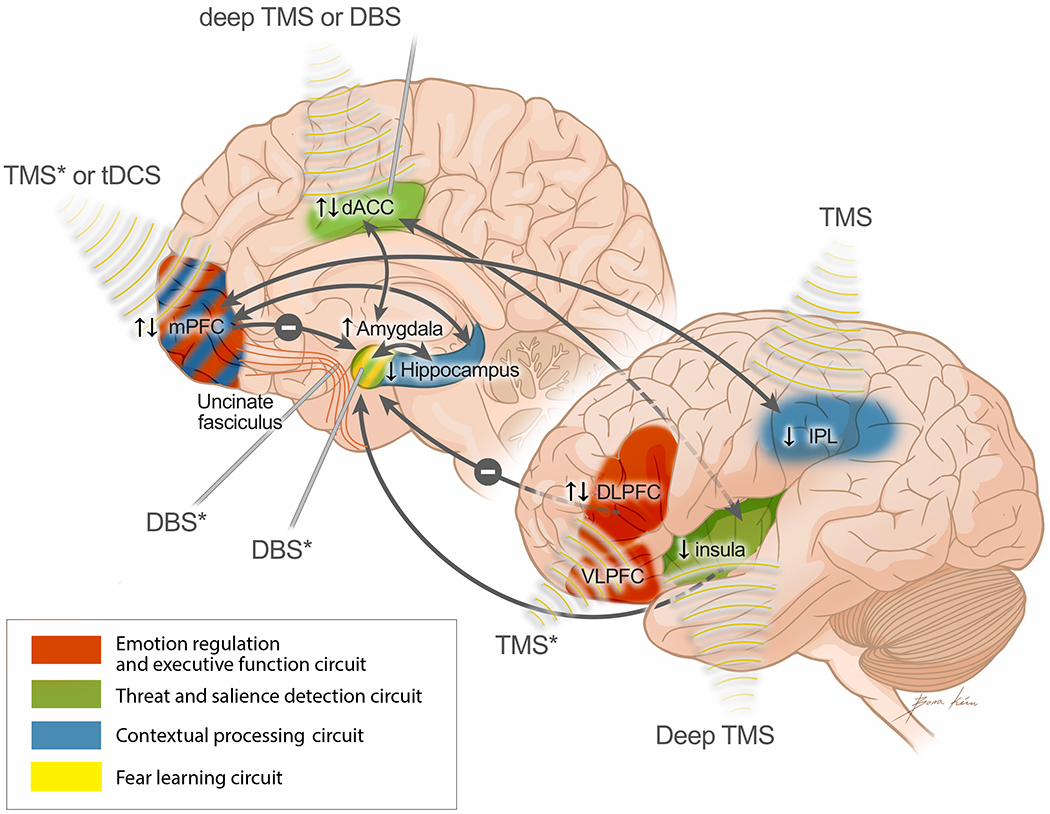
Therefore, we assess pre- and post-treatment (predominantly psychotherapy) functional neuroimaging studies in PTSD to determine which brain changes seem critical to treatment response. Results of these studies are presented within a previously proposed functional neural systems model of PTSD.
While not completely consistent, research suggests that downregulating the fear learning and threat and salience detection circuits (i.e., amygdala, dorsal anterior cingulate cortex and insula) and upregulating the emotion regulation and executive function and contextual processing circuits (i.e., prefrontal cortical regions and hippocampus) may mediate PTSD treatment response.
This literature review provides some justification for current focal brain stimulation targets. However, the examination of treatment effects on neural networks is limited, and studies that include the stimulation targets are lacking. Further, additional targets, such as the cingulate, medial prefrontal cortex, and inferior parietal lobe, may also be worth investigation, especially when considering how to achieve network level changes. Additional research combining PTSD treatment with functional neuroimaging will help move the field forward by identifying and validating novel targets, providing better rationale for specific treatment parameters and personalizing treatment for PTSD.
局灶性脑刺激有潜力成为创伤后应激障碍(PTSD)的一种治疗方法。在本综述中,我们旨在通过研究PTSD的功能神经解剖学及治疗反应的相关研究,为治疗PTSD的局灶性脑刺激靶点的选择提供参考依据。我们首先简要回顾关于PTSD脑刺激干预的数据。尽管已发表的数据总体显示出良好的疗效,但每个刺激靶点的神经生物学原理并不总是清晰的。
因此,我们评估PTSD患者治疗前和治疗后(主要是心理治疗)的功能神经影像学研究,以确定哪些脑区变化似乎对治疗反应至关重要。这些研究结果在先前提出的PTSD功能神经系统模型中呈现。
虽然不完全一致,但研究表明,下调恐惧学习、威胁和显著性检测回路(即杏仁核、背侧前扣带回皮质和脑岛),上调情绪调节、执行功能和情境处理回路(即前额叶皮质区域和海马体)可能介导PTSD的治疗反应。
这篇文献综述为当前的局灶性脑刺激靶点提供了一些依据。然而,对神经网络治疗效果的研究有限,且缺乏包含这些刺激靶点的研究。此外,其他靶点,如扣带回、内侧前额叶皮质和顶下小叶,也可能值得研究,尤其是在考虑如何实现网络水平的变化时。将PTSD治疗与功能神经影像学相结合的更多研究,将有助于通过识别和验证新靶点、为特定治疗参数提供更好的理论依据以及为PTSD进行个性化治疗,推动该领域向前发展。