Penell Johanna Christina, Kushnir Mark M, Lind Lars, Bergquist Jonatan, Bergquist Jonas, Lind P Monica, Naessen Tord
Department of Clinical Sciences, Swedish University of Agricultural Sciences, Uppsala, Sweden.
Department of Medical Sciences, Occupational and Environmental Medicine, Uppsala University, Uppsala, Sweden.
Endocr Connect. 2021 May 13;10(5):511-520. doi: 10.1530/EC-21-0045.
Circulating concentrations of endogenous steroids have systemic implications on health in elderly. However, population-based age- and ethnicity-specific data are scarce. The aim was to report sex-specific plasma concentrations of endogenous sex and adrenal steroids in elderly Swedish Caucasians, to examine the impact of BMI and to present concentrations in apparently healthy subjects.
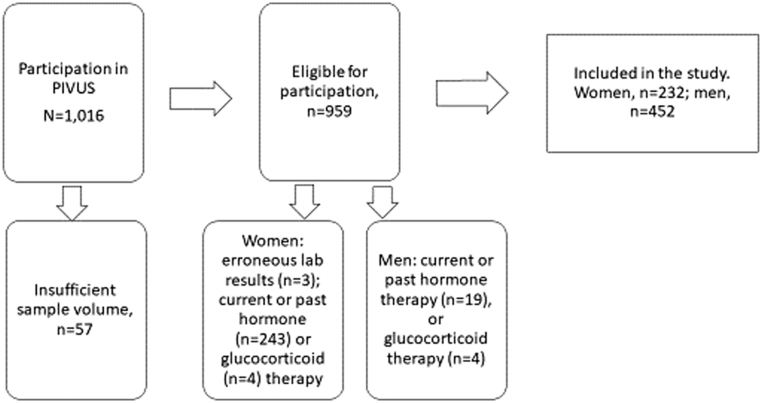
A population-based observational study of 70-year olds, including 684 community-dwelling men and women enrolled in the PIVUS study, Sweden. Median plasma concentrations were determined using liquid chromatography-tandem mass spectrometry (LC-MS/MS) for pregnenolone, 17-hydroxypregnenolone, 17-hydroxy-progesterone, 11-deoxycortisol, DHEA, androstenedione, testosterone, estrone and estradiol.
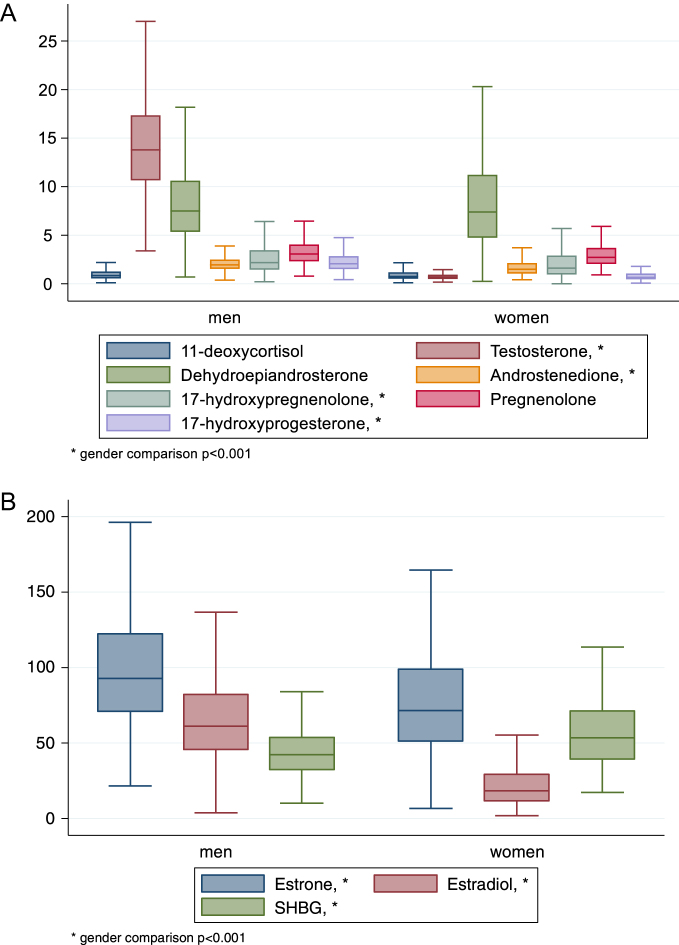
Plasma concentrations were significantly higher in men (n = 452) than in women (n = 232) for estradiol: median 61.3 pmol/L (95% CI, 11.4, 142.7) vs 18.4 (4.0, 127.3), for estrone: 92.8 (33.3, 206) vs 71.6 (17.8, 209) pmol/L, and for testosterone 13.8 (5.7, 28.0) vs 0.7 (0.2, 2.0) nmol/L. Higher concentrations of estrone and estradiol were observed in obese than non-obese women. Compared to non-obese men, obese men had lower concentrations of testosterone and its precursors: 17-hydroxypregnenolone, 17-hydroxyprogesterone, androstenedione and DHEA. The subgroup of apparently healthy individuals had median values > 20% lower for estrone and estradiol in women but slightly higher for testosterone in both sexes.
Concentrations of estradiol, estrone and testosterone were higher in 70-year-old men than in women. BMI associated positively to estradiol and estrone in women and negatively to testosterone in men. Apparently healthy women had lower median concentrations of estradiol and estrone and men had higher median testosterone compared to all individuals.
内源性甾体激素的循环浓度对老年人的健康具有全身性影响。然而,基于人群的年龄和种族特异性数据却很匮乏。本研究旨在报告瑞典老年高加索人群中内源性性激素和肾上腺甾体激素的性别特异性血浆浓度,探讨体重指数(BMI)的影响,并呈现健康受试者的激素浓度。
对瑞典参加PIVUS研究的70岁人群进行基于人群的观察性研究,纳入684名社区居住的男性和女性。采用液相色谱 - 串联质谱法(LC-MS/MS)测定孕烯醇酮、17α-羟孕烯醇酮、17α-羟孕酮、11-脱氧皮质醇、脱氢表雄酮(DHEA)、雄烯二酮、睾酮、雌酮和雌二醇的血浆中位数浓度。
男性(n = 452)的雌二醇血浆浓度显著高于女性(n = 232):中位数为61.3 pmol/L(95%CI,11.4,142.7),而女性为18.4(4.0,127.3);雌酮:92.8(33.3,206)对71.6(17.8,209)pmol/L;睾酮:13.8(5.7,28.0)对0.7(0.2,2.0)nmol/L。肥胖女性的雌酮和雌二醇浓度高于非肥胖女性。与非肥胖男性相比,肥胖男性的睾酮及其前体(17α-羟孕烯醇酮、17α-羟孕酮、雄烯二酮和DHEA)浓度较低。健康个体亚组中,女性的雌酮和雌二醇中位数浓度低>20%,但两性的睾酮浓度略高。
70岁男性的雌二醇、雌酮和睾酮浓度高于女性。BMI与女性的雌二醇和雌酮呈正相关,与男性的睾酮呈负相关。与所有个体相比,健康女性的雌二醇和雌酮中位数浓度较低,而男性的睾酮中位数浓度较高。