Bond Kathy S, Cottrill Fairlie A, Mackinnon Andrew, Morgan Amy J, Kelly Claire M, Armstrong Greg, Kitchener Betty A, Reavley Nicola J, Jorm Anthony F
Mental Health First Aid Australia, Parkville, VIC, Australia.
Centre for Mental Health, Melbourne School of Population and Global Health, The University of Melbourne, Parkville, VIC, Australia.
Int J Ment Health Syst. 2021 Apr 20;15(1):36. doi: 10.1186/s13033-021-00459-x.
Suicide is a significant concern in Australia and globally. There is a strong argument for training community gatekeepers in how to recognise and support suicidal people in their social network. One such training course is the Mental Health First Aid for the Suicidal Person course. This course was developed using suicide prevention best practice guidelines based on expert opinion (determined using the Delphi Method).
We evaluated the impact of attending the Mental Health First Aid for the Suicidal Person course on suicide literacy and stigma, confidence in and quality of intended and actual helping behaviours towards a person who is suicidal, and course satisfaction. Surveys were administered before and immediately after the course, and at 6-month follow-up. Data were analysed to yield descriptive statistics (percentages, means, standard deviations), with linear mixed models and generalized linear mixed models being used to test the statistical significance of changes over occasions of measurement.
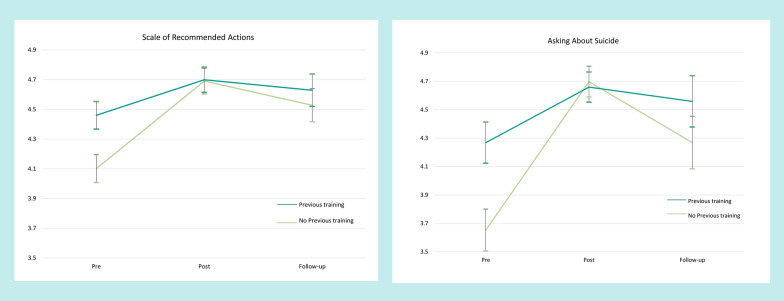
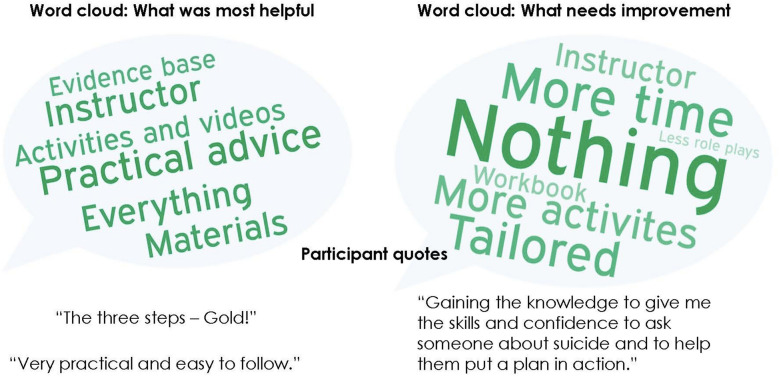
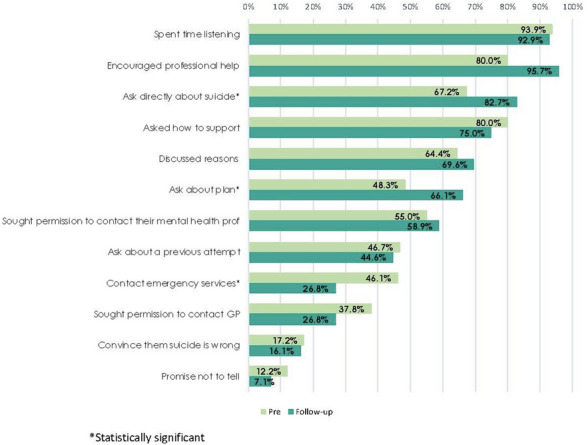
We recruited 284 participants from workplaces and general community networks. The mean age was 41 years and 74% were female. 85% of people undertook the course as part of professional development, and almost half (44%) did the course because they had contact with a suicidal person. The majority (59%) of participants had previous mental health and suicide prevention training. The majority of participants held knowledge (suicide literacy) before undertaking the course. The major effect of training was to strengthen this knowledge. There was a significant improvement from pre-course (M = 1.79, SD 0.56) to post-course (M = 1.48, SD 0.82, p < 0.0001), which was maintained at follow-up (M = 1.51, SD 0.49, p < 0.0001). Confidence in gatekeeper skills significantly improved after the course and at follow-up (M = 3.15, SD 0.95 before the course to M = 4.02, SD 0.68 afterward and 3.87, SD 0.77 at follow-up, p < 0.0001 and p < 0.0001, respectively). The quality of intended helping behaviours significantly improved from pre-course (intended actions M = 4.28, SD 0.58) and to post-course (M = 4.70, SD 0.50, p < 0.0001) and were maintained at follow-up (M = 4.64, SD 0.41, p < 0.0001). There was significant improvement in some of the actions taken by participants to help a suicidal person from pre-course to post-course (e.g. asking about suicidal thoughts and plan, contacting emergency services). The course was highly acceptable to participants.
These results indicate that this course is an acceptable intervention that delivers a broad spectrum of beneficial outcomes to community and workplace gatekeepers.
自杀在澳大利亚乃至全球都是一个重大问题。对于培训社区守门人如何识别并支持其社交网络中有自杀倾向的人,有充分的理由。“自杀者心理健康急救”课程就是这样一种培训课程。该课程是根据基于专家意见(采用德尔菲法确定)的自杀预防最佳实践指南开发的。
我们评估了参加“自杀者心理健康急救”课程对自杀知识素养、耻辱感、对有自杀倾向者的预期及实际帮助行为的信心和质量以及课程满意度的影响。在课程开始前、课程结束后立即以及6个月随访时进行了调查。对数据进行分析以得出描述性统计数据(百分比、均值、标准差),并使用线性混合模型和广义线性混合模型来检验不同测量时间点变化的统计学意义。
我们从工作场所和一般社区网络中招募了284名参与者。平均年龄为41岁,74%为女性。85%的人将该课程作为职业发展的一部分来参加,近一半(44%)的人参加该课程是因为他们接触过有自杀倾向的人。大多数(59%)参与者之前接受过心理健康和自杀预防培训。大多数参与者在参加课程之前就掌握了相关知识(自杀知识素养)。培训的主要作用是强化了这些知识。从课程前(M = 1.79,标准差0.56)到课程后(M = 1.48,标准差0.82,p < 0.0001)有显著改善,在随访时保持不变(M = 1.51,标准差0.49,p < 0.0001)。课程结束后及随访时,守门人技能的信心显著提高(课程前M = 3.15,标准差0.95,课程后M = 4.02,标准差0.68,随访时M = 3.87,标准差0.7 < 0.0001和p < 0.0001)。预期帮助行为的质量从课程前(预期行为M = 4.28,标准差0.58)到课程后(M = 4.70,标准差0.50,p < 0.0001)有显著改善,并在随访时保持(M = 4.64,标准差0.41,p < 0.0001)。参与者在帮助有自杀倾向者方面采取的一些行动从课程前到课程后有显著改善(例如询问自杀想法和计划、联系紧急服务)。该课程受到参与者的高度认可。
这些结果表明,该课程是一种可接受的干预措施,能为社区和工作场所的守门人带来广泛的有益成果。