Institute of Infection, Veterinary and Ecological Sciences, University of Liverpool, Liverpool, Merseyside, UK.
Department of Plastic Surgery, Alder Hey Children's NHS Foundation Trust, Liverpool, Merseyside, UK.
BMJ Paediatr Open. 2021 Apr 2;5(1):e001040. doi: 10.1136/bmjpo-2021-001040. eCollection 2021.
Responses to the COVID-19 pandemic include strict public health measures, such as national lockdowns. During these measures, paediatric emergency department attendances have declined and the prevalence of presenting complaints has changed. This study sought to identify whether dog bite attendance and victim demographics changed during COVID-19 public health measures.
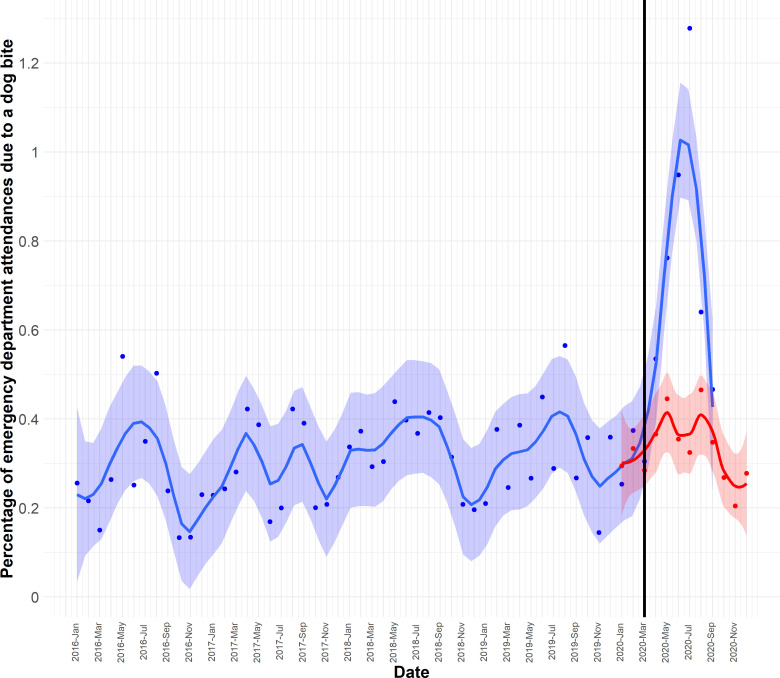
An audit was conducted of emergency department attendance data from a UK tertiary paediatric hospital between January 2016 and September 2020. Dog bite attendance and victim demographics were explored using χ tests and multivariable Poisson regression. The mean monthly percentage of attendance due to dog bites in 2020 was compared against predicted percentages based on previous years' data.
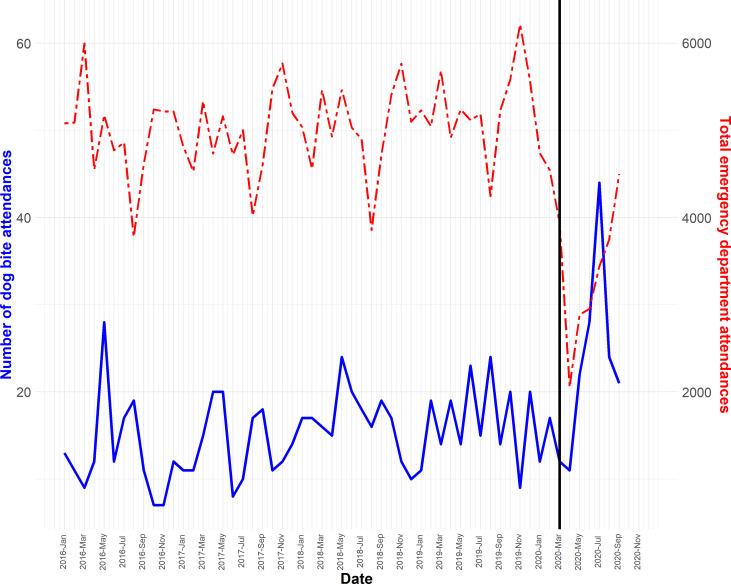
Dog bite attendance rose in conjunction with the introduction of COVID-19 public health measures and reached a peak in July 2020 (44 dog bites, 1.3% of all attendances were due to dog bites). This was a threefold increase in dog bite attendance. By September 2020, attendance had returned to normal. The demographic profile of child dog bite victims remained the same. Boys had the highest attendance rates in 7-12 year-olds, girls in 4-6 year-olds. Girls showed higher attendance rates in the summer, while boys' attendance rates were constant throughout the year. COVID-19 public health measures were associated with a 78% increase in attendance for boys and a 66% increase in girls.
COVID-19 national public health measures were associated with an increase in paediatric emergency department dog bite attendance, and may be due to increased child exposure to dogs via 'stay at home' orders and school closures. National lockdowns are likely to continue globally throughout the COVID-19 pandemic; this is likely to result in more dog bites. Urgent public health communication and injury prevention strategies are needed to help prevent these avoidable injuries.
应对 COVID-19 大流行的措施包括严格的公共卫生措施,如全国封锁。在这些措施下,儿科急诊就诊人数下降,就诊主诉的流行情况发生变化。本研究旨在确定 COVID-19 公共卫生措施期间,狗咬伤就诊情况和受害者人口统计学特征是否发生变化。
对英国一家三级儿科医院 2016 年 1 月至 2020 年 9 月的急诊就诊数据进行了审核。使用 χ 检验和多变量泊松回归分析探讨了狗咬伤就诊情况和受害者人口统计学特征。将 2020 年每月因狗咬伤就诊的平均百分比与基于前几年数据的预测百分比进行了比较。
随着 COVID-19 公共卫生措施的实施,狗咬伤就诊人数增加,并在 2020 年 7 月达到高峰(44 例狗咬伤,占所有就诊人数的 1.3%)。狗咬伤就诊人数增加了两倍。到 2020 年 9 月,就诊人数已恢复正常。儿童狗咬伤受害者的人口统计学特征保持不变。7-12 岁男孩的就诊率最高,4-6 岁女孩的就诊率最高。女孩在夏季的就诊率较高,而男孩的就诊率全年保持不变。COVID-19 公共卫生措施与男孩就诊率增加 78%和女孩就诊率增加 66%相关。
国家公共卫生措施与儿科急诊狗咬伤就诊人数增加有关,这可能是由于“居家令”和学校关闭导致儿童接触狗的机会增加所致。在 COVID-19 大流行期间,全球各国可能会继续实施全国封锁;这可能会导致更多的狗咬伤。需要紧急开展公共卫生宣传和伤害预防策略,以帮助预防这些可避免的伤害。