Tagliapietra Matteo, Cardellini Davide, Ferrarini Moreno, Testi Silvia, Ferrari Sergio, Monaco Salvatore, Cavallaro Tiziana, Fabrizi Gian Maria
Department of Neurosciences, Biomedicine, and Movement Sciences, University of Verona, Policlinico G.B. Rossi, Piazzale L.A. Scuro 10, 37134, Verona, VR, Italy.
J Neurol. 2021 Nov;268(11):4280-4290. doi: 10.1007/s00415-021-10552-3. Epub 2021 Apr 21.
A biallelic intronic AAGGG repeat expansion in the Replication Factor C subunit 1 (RFC1) gene has been recently associated with Cerebellar Ataxia, Neuropathy, Vestibular Areflexia Syndrome, a disorder often presenting as a slowly evolving sensory neuropathy at the onset. "Chronic Idiopathic Axonal Polyneuropathy" (CIAP) is a common indolent axonal neuropathy of adulthood which remains without an identifiable cause despite thorough investigations.
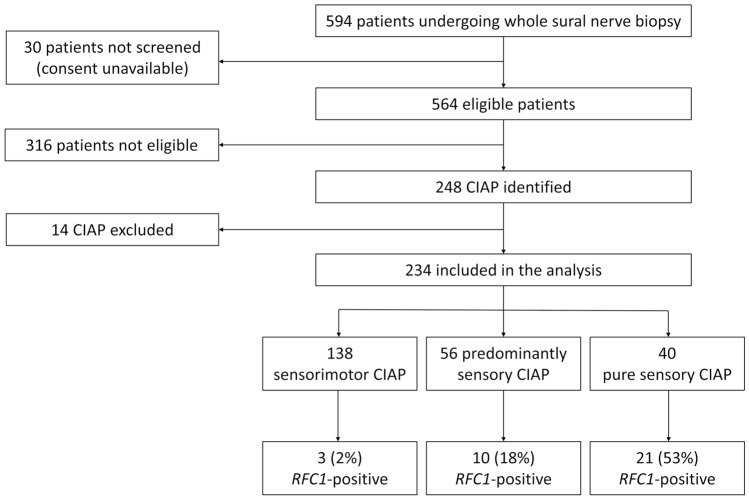
We screened 234 probands diagnosed with CIAP for a pathogenic biallelic RFC1 AAGGG repeat expansion. Patients were selected from 594 consecutive patients with neuropathy referred to our tertiary-care center for a sural nerve biopsy over 10 years.
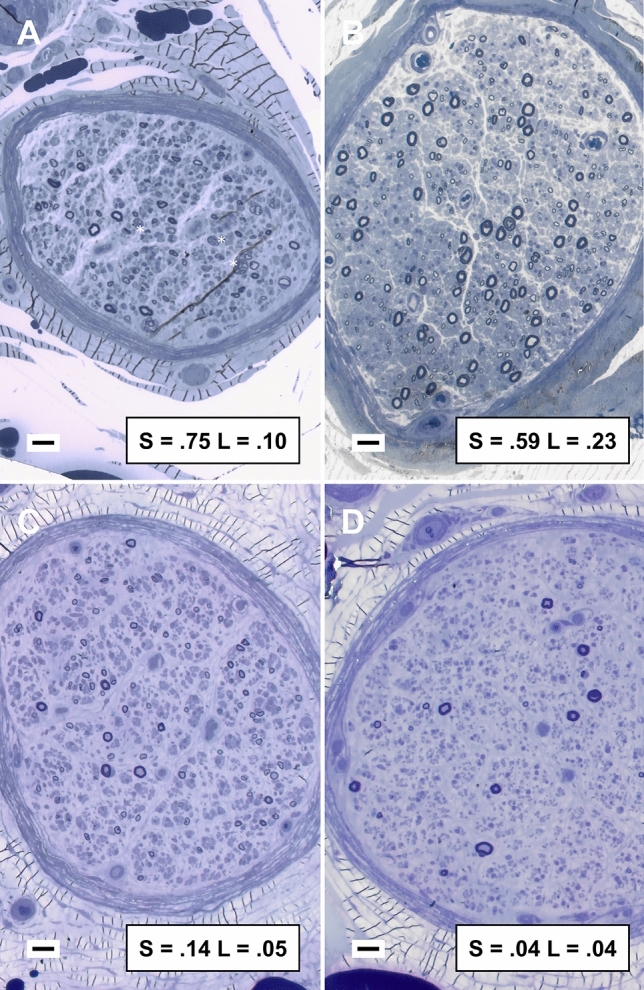
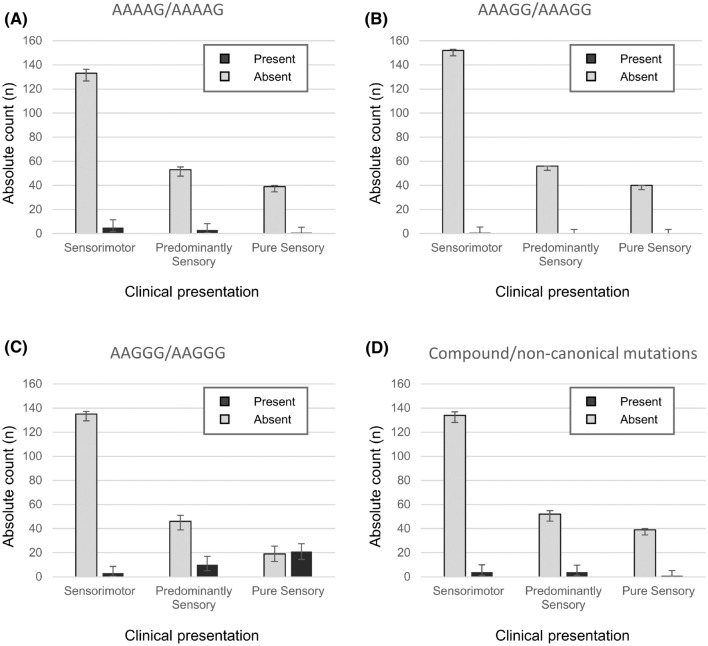
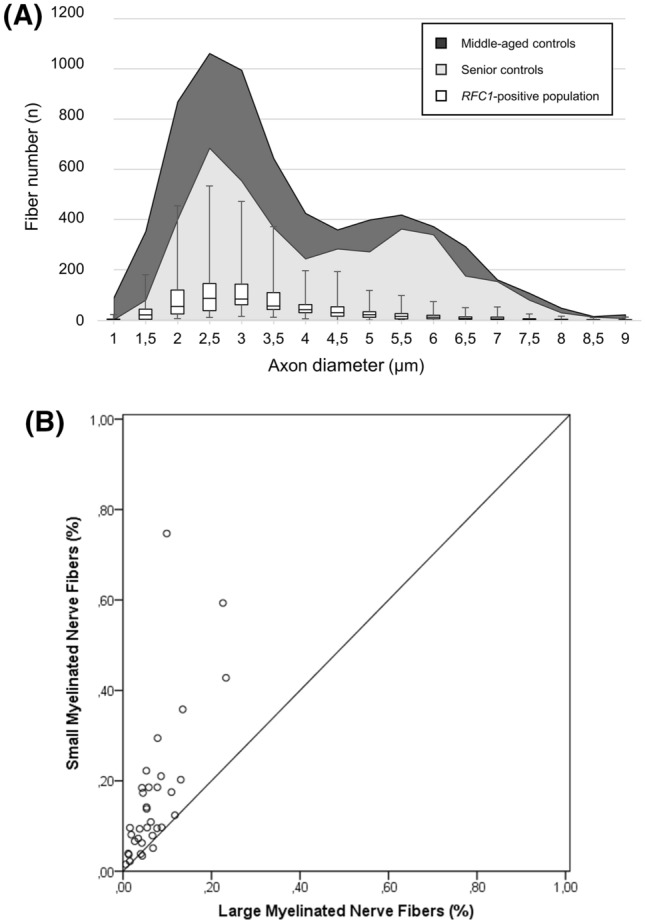
The RFC1 AAGGG repeat expansion was common in patients with pure sensory neuropathy (21/40, 53%) and less frequent in cases with predominantly sensory (10/56, 18%, P < 0.001) or sensorimotor (3/138, 2%, P < 0.001) neuropathy. The mutation was associated with sensory ataxia (τ = 0.254, P < 0.001), autonomic disturbances (35% vs 8%, Prevalence Odds Ratio-POR 6.73 CI 95% 2.79-16.2, P < 0.001), retained deep tendon reflexes (score 18.0/24 vs 11.5/24, R = 0.275, P < 0.001). On pathology, we observed absent/scant regenerative changes (τ = - 0.362, P < 0.001), concomitant involvement of large (100% and 99%, n.s.), small myelinated (97% vs 81%, POR 7.74 CI 95% 1.03-58.4, P = 0.02) and unmyelinated nerve fibers (85% vs 41%, POR 8.52 CI 95% 3.17-22.9, P < 0.001). Cerebellar or vestibular involvement was similarly rare in the two groups.
This study highlights the frequent occurrence of the RFC1 AAGGG repeat expansion in patients diagnosed with CIAP and characterizes the clinical and pathological features of the related neuro(no)pathy.
复制因子C亚基1(RFC1)基因中的双等位基因内含子AAGGG重复序列扩增最近与小脑共济失调、神经病变、前庭反射消失综合征相关,该疾病通常在发病时表现为缓慢进展的感觉神经病变。“慢性特发性轴索性多发性神经病”(CIAP)是成年期常见的一种隐匿性轴索性神经病,尽管经过全面检查仍未发现明确病因。
我们对234例被诊断为CIAP的先证者进行了致病性双等位基因RFC1 AAGGG重复序列扩增的筛查。患者选自10年间因腓肠神经活检转诊至我们三级医疗中心的594例连续神经病患者。
RFC1 AAGGG重复序列扩增在纯感觉性神经病患者中很常见(21/40,53%),而在以感觉为主(10/56,18%,P<0.001)或感觉运动性(3/138,2%,P<0.001)神经病患者中较少见。该突变与感觉性共济失调(τ=0.254,P<0.001)、自主神经功能障碍(35%对8%,患病率比值比-POR 6.73,95%置信区间2.79-16.2,P<0.001)、保留的深腱反射(评分18.0/24对11.5/24,R=0.275,P<0.001)相关。在病理学上,我们观察到再生改变缺失/稀少(τ=-0.362,P<0.001),同时大(100%和99%,无显著差异)、小髓鞘(97%对81%,POR 7.74,95%置信区间1.03-58.4,P=0.02)和无髓鞘神经纤维均受累(85%对41%,POR 8.52,95%置信区间3.17-22.9,P<0.001)。两组中小脑或前庭受累同样罕见。
本研究强调了在被诊断为CIAP的患者中RFC1 AAGGG重复序列扩增的频繁发生,并描述了相关神经病变的临床和病理特征。