Universidade Federal do Rio Grande do Sul (UFRGS), Faculdade de Odontologia, Programa de Pós-graduação em Odontologia, Porto Alegre, Brasil.
Universidade Federal de Ciências da Saúde de Porto Alegre (UCFSPA), Porto Alegre, Escola de Informática Biomédica, Porto Alegre, Brasil.
J Appl Oral Sci. 2021 Apr 19;29:e20200799. doi: 10.1590/1678-7757-2020-0799. eCollection 2021.
This study aimed to investigate patterns and risk factors related to the feasibility of achieving technical quality and periapical healing in root canal non-surgical retreatment, using regression and data mining methods.
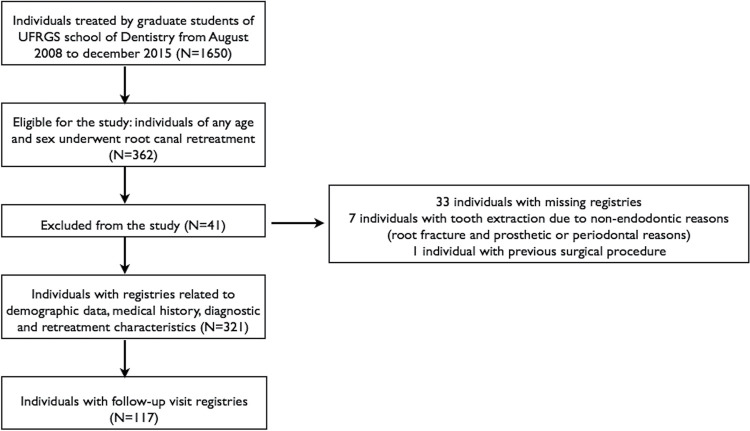
This retrospective observational study included 321 consecutive patients presenting for root canal retreatment. Patients were treated by graduate students, following standard protocols. Data on medical history, diagnosis, treatment, and follow-up visits variables were collected from physical records and periapical radiographs and transferred to an electronic chart database. Basic statistics were tabulated, and univariate and multivariate analytical methods were used to identify risk factors for technical quality and periapical healing. Decision trees were generated to predict technical quality and periapical healing patterns using the J48 algorithm in the Weka software.
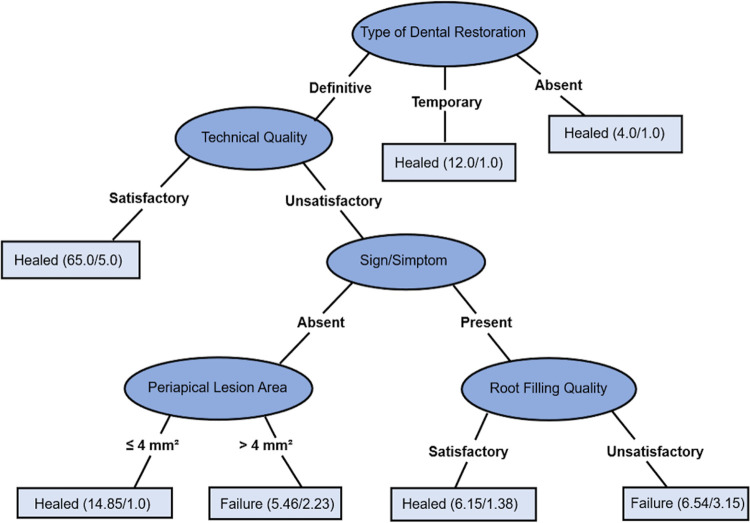
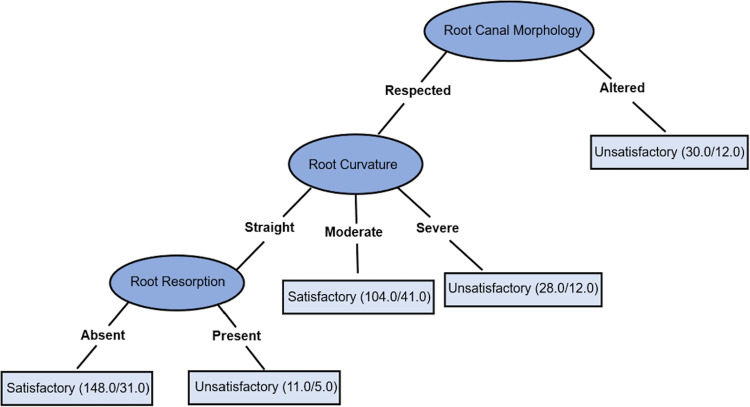
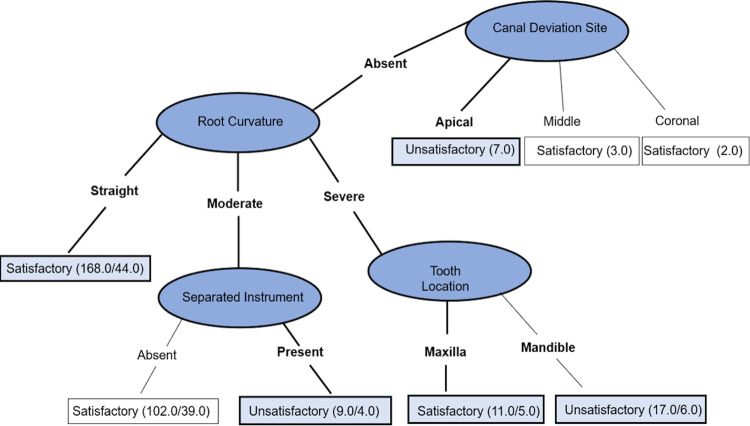
Technical outcome was satisfactory in 65.20%, and we observed periapical healing in 80.50% of the cases. Several factors were related to technical quality, including severity of root curvature and altered root canal morphology (p<0.05). Follow-up periods had a mean of 4.05 years. Periapical lesion area, tooth type, and apical resorption proved to be significantly associated with retreatment failure (p<0.05). Data mining analysis suggested that apical root resorption might prevent satisfactory technical outcomes even in teeth with straight root canals. Also, large periapical lesions and poor root filling quality in primary endodontic treatment might be related to healing failure.
Frequent patterns and factors affecting technical outcomes of endodontic retreatment included root canal morphological features and its alterations resulting from primary endodontic treatment. Healing outcomes were mainly associated with the extent of apical periodontitis pathological damages in dental and periapical tissues. To determine treatment predictability, we suggest patterns including clinical and radiographic features of apical periodontitis and technical quality of primary endodontic treatment.
本研究旨在使用回归和数据挖掘方法,调查与根管非手术再治疗的技术质量和根尖愈合相关的模式和危险因素。
本回顾性观察研究纳入了 321 名连续就诊的根管再治疗患者。学生按照标准方案进行治疗。从病历和根尖 X 光片中收集有关病史、诊断、治疗和随访变量的数据,并将其转移到电子图表数据库中。对基本统计数据进行制表,使用单变量和多变量分析方法确定技术质量和根尖愈合的危险因素。使用 Weka 软件中的 J48 算法生成决策树,以预测技术质量和根尖愈合模式。
技术结果令人满意的占 65.20%,我们观察到 80.50%的病例根尖愈合。几个因素与技术质量有关,包括根弯曲的严重程度和改变的根管形态(p<0.05)。随访期的平均时间为 4.05 年。根尖病变面积、牙齿类型和根尖吸收被证明与再治疗失败显著相关(p<0.05)。数据挖掘分析表明,即使在根管笔直的牙齿中,根尖根吸收也可能妨碍技术效果令人满意。此外,原发牙髓治疗中较大的根尖病变和较差的根管填充质量可能与愈合失败有关。
影响根管再治疗技术效果的常见模式和因素包括根管形态特征及其在原发牙髓治疗中的改变。愈合结果主要与牙齿和根尖组织中根尖牙周病病理损害的程度相关。为了确定治疗的可预测性,我们建议包括根尖牙周病的临床和影像学特征以及原发牙髓治疗的技术质量等模式。