Department of Biochemistry & Molecular Biology and Hollings Cancer Center, Medical University of South Carolina, Charleston, SC, USA.
Department of Biochemistry & Structural Biology University of Texas Health Science Center at San Antonio, San Antonio, TX, USA.
Nat Commun. 2021 Apr 22;12(1):2370. doi: 10.1038/s41467-021-22598-y.
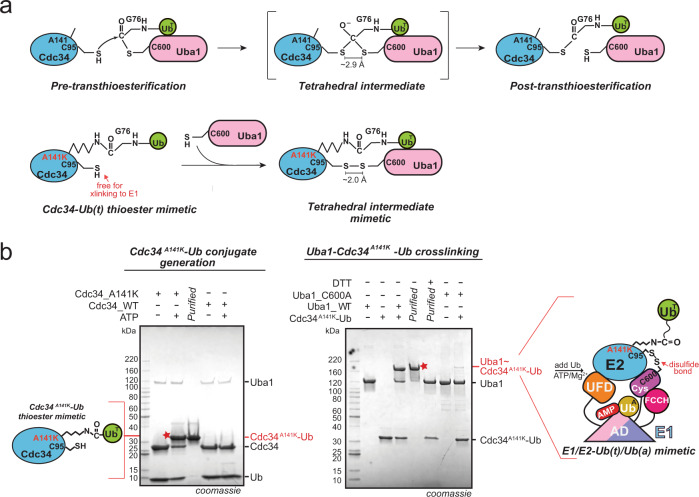
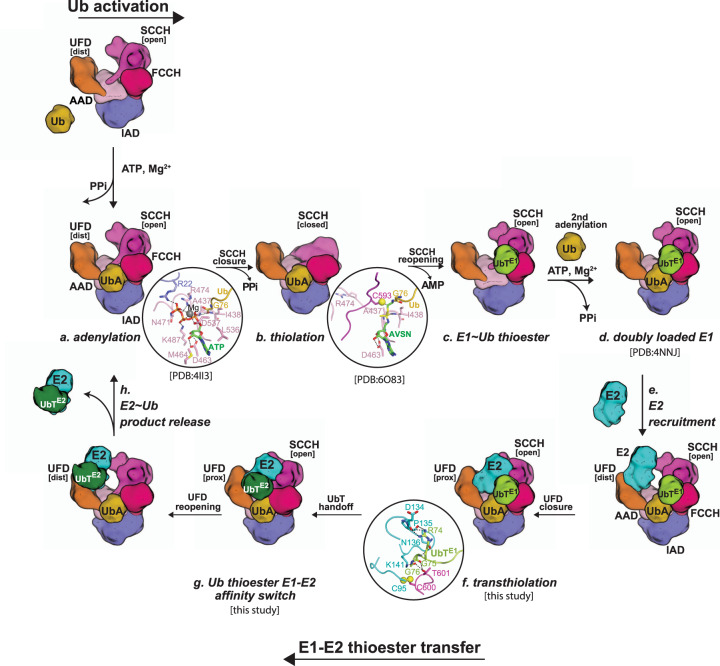
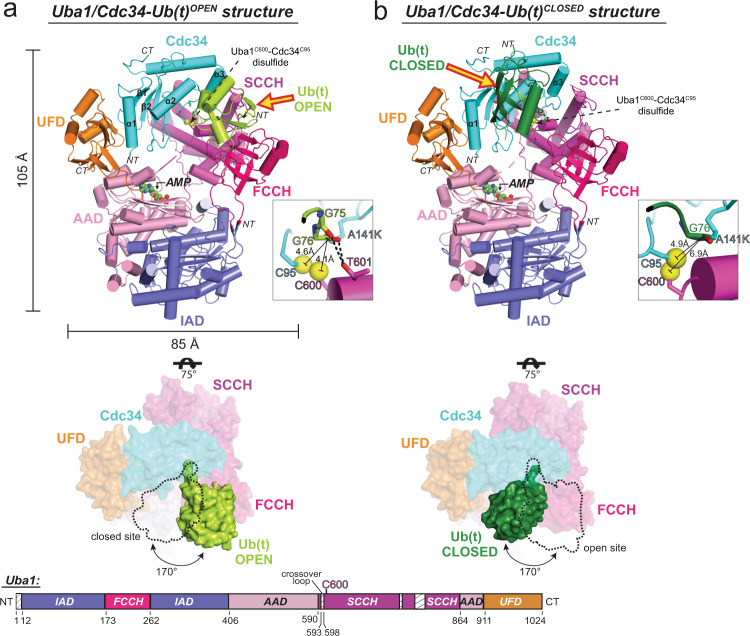
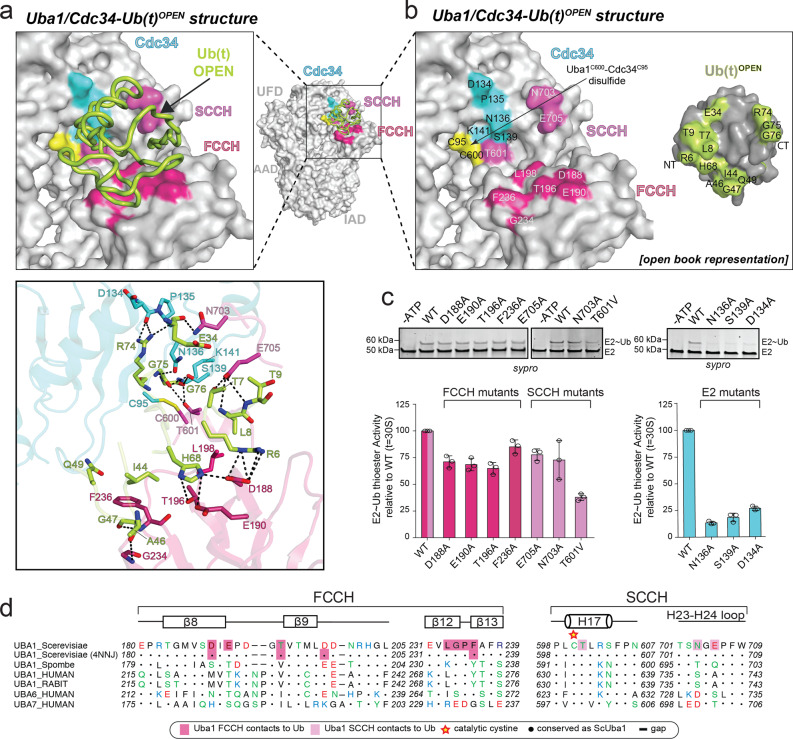
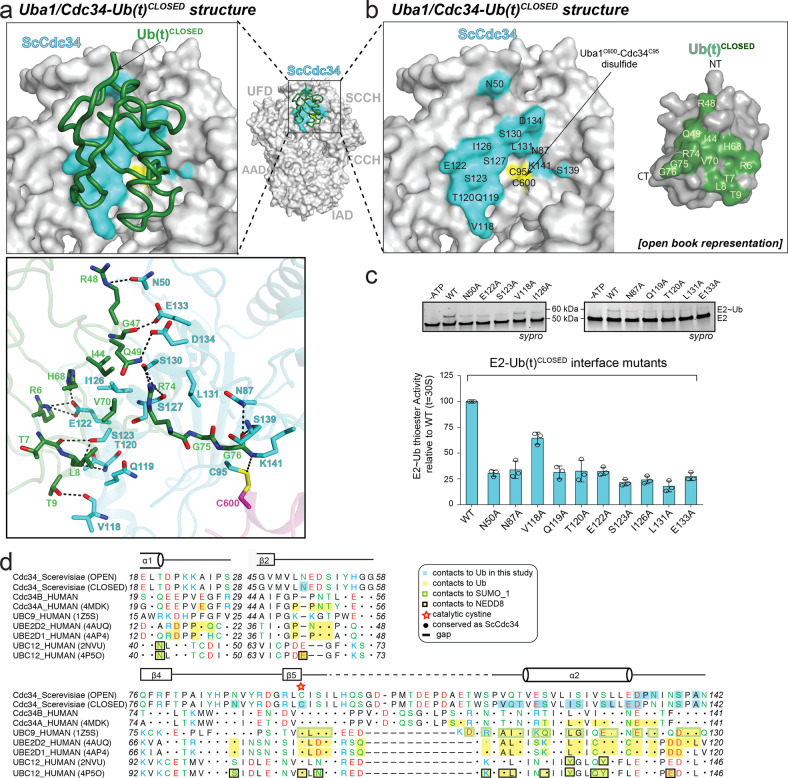
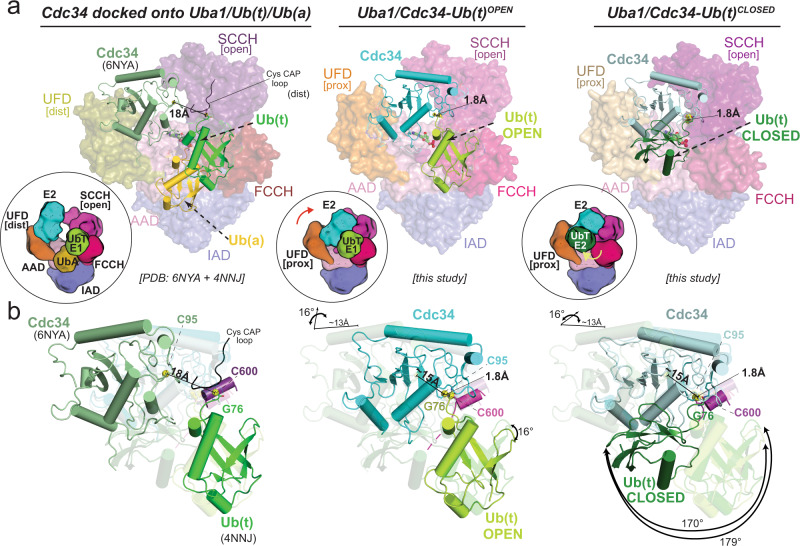
E1 enzymes function as gatekeepers of ubiquitin (Ub) signaling by catalyzing activation and transfer of Ub to tens of cognate E2 conjugating enzymes in a process called E1-E2 transthioesterification. The molecular mechanisms of transthioesterification and the overall architecture of the E1-E2-Ub complex during catalysis are unknown. Here, we determine the structure of a covalently trapped E1-E2-ubiquitin thioester mimetic. Two distinct architectures of the complex are observed, one in which the Ub thioester (Ub(t)) contacts E1 in an open conformation and another in which Ub(t) instead contacts E2 in a drastically different, closed conformation. Altogether our structural and biochemical data suggest that these two conformational states represent snapshots of the E1-E2-Ub complex pre- and post-thioester transfer, and are consistent with a model in which catalysis is enhanced by a Ub(t)-mediated affinity switch that drives the reaction forward by promoting productive complex formation or product release depending on the conformational state.
E1 酶作为泛素 (Ub) 信号的守门员,通过催化 Ub 的激活和转移到数十种同源的 E2 连接酶来发挥作用,这个过程称为 E1-E2 转硫酯化。转硫酯化的分子机制和催化过程中 E1-E2-Ub 复合物的整体结构尚不清楚。在这里,我们确定了一个共价捕获的 E1-E2-泛素硫酯类似物的结构。观察到复合物的两种不同结构,一种结构中 Ub 硫酯 (Ub(t)) 以开放构象与 E1 接触,另一种结构中 Ub(t) 反而以完全不同的封闭构象与 E2 接触。总之,我们的结构和生化数据表明,这两种构象状态代表了硫酯转移前后 E1-E2-Ub 复合物的快照,并且与一个模型一致,该模型表明,Ub(t) 介导的亲和力转换通过促进产物释放或产物释放来促进反应向前进行,从而增强催化作用,具体取决于构象状态。