
发现基于罕见硫酸化未取代葡糖胺的硫酸乙酰肝素类似物可选择性激活趋化因子。
Discovery of rare sulfated -unsubstituted glucosamine based heparan sulfate analogs selectively activating chemokines.
作者信息
Jain Prashant, Shanthamurthy Chethan D, Leviatan Ben-Arye Shani, Woods Robert J, Kikkeri Raghavendra, Padler-Karavani Vered
机构信息
Department of Chemistry , Indian Institute of Science Education and Research , Pune-411008 , India . Email:
Department of Cell Research and Immunology , The Shmunis School of Biomedicine and Cancer Research , The George S. Wise Faculty of Life Sciences , Tel Aviv University , Tel Aviv , 69978 , Israel . Email:
出版信息
Chem Sci. 2021 Jan 28;12(10):3674-3681. doi: 10.1039/d0sc05862a. eCollection 2021 Mar 14.
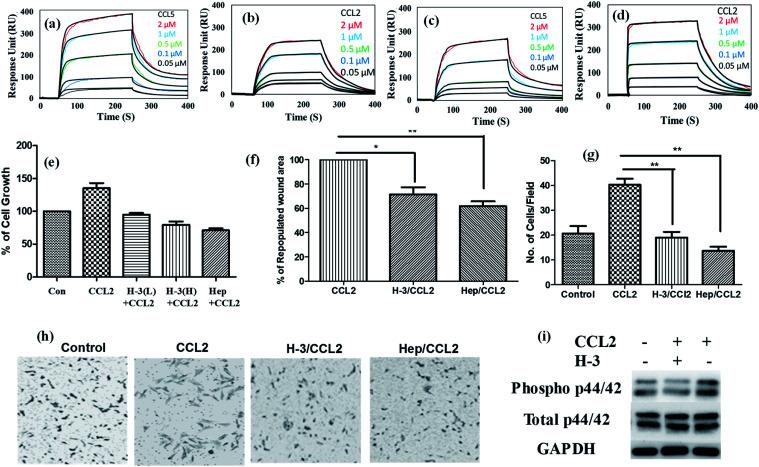
Achieving selective inhibition of chemokines with structurally well-defined heparan sulfate (HS) oligosaccharides can provide important insights into cancer cell migration and metastasis. However, HS is highly heterogeneous in chemical composition, which limits its therapeutic use. Here, we report the rational design and synthesis of -unsubstituted (NU) and -acetylated (NA) heparan sulfate tetrasaccharides that selectively inhibit structurally homologous chemokines. HS analogs were produced by divergent synthesis, where fully protected HS tetrasaccharide precursor was subjected to selective deprotection and regioselectively -sulfated, and -phosphorylated to obtain 13 novel HS tetrasaccharides. HS microarray and SPR analysis with a wide range of chemokines revealed the structural significance of sulfation patterns and NU domain in chemokine activities for the first time. Particularly, revealed selective recognition by CCL2 chemokine. Further systematic interrogation of the role of in cancer demonstrated an effective blockade of CCL2 and its receptor CCR2 interactions, thereby impairing cancer cell proliferation, migration and invasion, a step towards designing novel drug molecules.
用结构明确的硫酸乙酰肝素(HS)寡糖实现趋化因子的选择性抑制可为癌细胞迁移和转移提供重要见解。然而,HS的化学组成高度异质,这限制了其治疗用途。在此,我们报告了选择性抑制结构同源趋化因子的未取代(NU)和N-乙酰化(NA)硫酸乙酰肝素四糖的合理设计与合成。HS类似物通过发散合成产生,其中完全保护的HS四糖前体经过选择性脱保护,并进行区域选择性O-硫酸化和N-磷酸化,以获得13种新型HS四糖。HS微阵列和对多种趋化因子的SPR分析首次揭示了硫酸化模式和NU结构域在趋化因子活性中的结构意义。特别是,显示出被CCL2趋化因子选择性识别。对N在癌症中的作用的进一步系统研究表明,有效阻断了CCL2及其受体CCR2的相互作用,从而损害癌细胞的增殖、迁移和侵袭,这是设计新型药物分子的重要一步。


 Zotero 插件