Iyo Masaomi, Ishigooka Jun, Nakamura Masatoshi, Sakaguchi Reiko, Okamoto Keisuke, Mao Yongcai, Tsai Joyce, Fitzgerald Alison, Nosaka Tadashi, Higuchi Teruhiko
Department of Psychiatry, Graduate School of Medicine, Chiba University, Chiba, Japan.
Institute of CNS Pharmacology, Tokyo, Japan.
Psychiatry Clin Neurosci. 2021 Apr 23;75(7):227-35. doi: 10.1111/pcn.13221.
The aim of this study was to evaluate the efficacy of lurasidone in acute schizophrenia in Japan and other countries.
Subjects (aged 18-74 years) diagnosed with schizophrenia were randomized to lurasidone 40 mg/day or placebo. The primary efficacy endpoint was change from baseline on the Positive and Negative Syndrome Scale (PANSS) total score at Week 6. Secondary efficacy assessments included the Clinical Global Impression-Severity Scale (CGI-S). Safety endpoints included adverse events, and laboratory and electrocardiogram parameters.
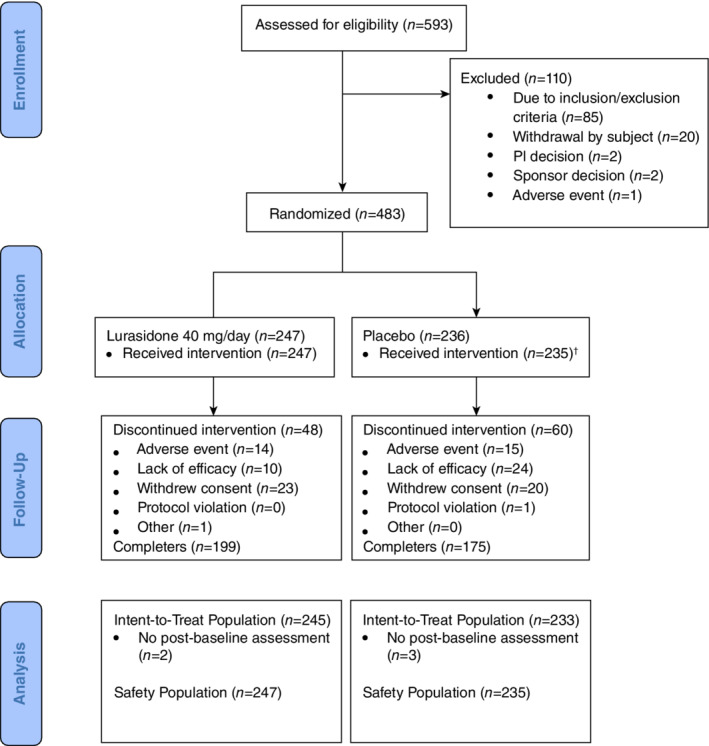
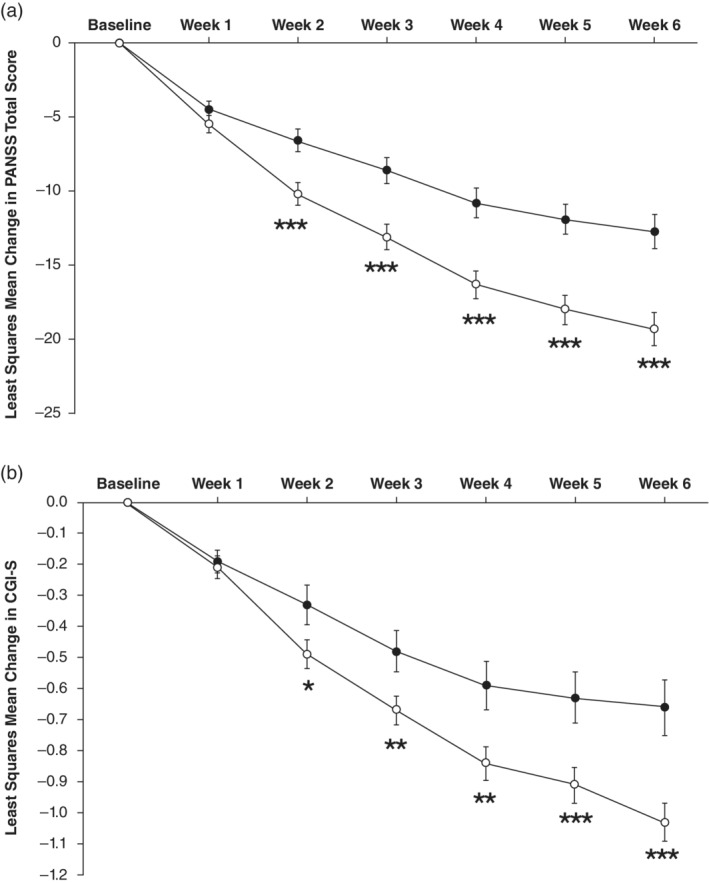
A total of 483 subjects were randomized to lurasidone or placebo; 107 subjects were from Japan. Mean changes from baseline at Week 6 endpoint in PANSS total scores were -19.3 in the lurasidone group and -12.7 in the placebo group (treatment difference: P < 0.001, effect size = 0.41). Changes from baseline for Week 6 CGI-S scores were -1.0 for lurasidone and -0.7 for placebo (treatment difference: P < 0.001, effect size = 0.41). All-cause discontinuation during the 6-week, double-blind period was 19.4% for lurasidone and 25.4% for placebo, and discontinuation rates due to adverse event were 5.7% for lurasidone and 6.4% for placebo. The following common treatment-emergent adverse events occurred in more than 2% on lurasidone and at a rate at least twice that of the placebo group: akathisia (4.0%), dizziness (2.8%), somnolence (2.8%), abdominal discomfort (2.0%) and asthenia (2.0%). No significant changes in bodyweight or metabolic parameters were observed.
Lurasidone 40 mg once daily dosing demonstrated efficacy in a patient population with acute schizophrenia, including subjects from Japan, and was generally safe and well-tolerated.
本研究旨在评估鲁拉西酮在日本及其他国家急性精神分裂症患者中的疗效。
将诊断为精神分裂症的受试者(年龄18 - 74岁)随机分为鲁拉西酮40毫克/天组或安慰剂组。主要疗效终点为第6周时阳性与阴性症状量表(PANSS)总分相对于基线的变化。次要疗效评估包括临床总体印象 - 严重程度量表(CGI - S)。安全性终点包括不良事件、实验室检查和心电图参数。
共有483名受试者被随机分为鲁拉西酮组或安慰剂组;107名受试者来自日本。在第6周终点时,鲁拉西酮组PANSS总分相对于基线的平均变化为 - 19.3,安慰剂组为 - 12.7(治疗差异:P < 0.001,效应大小 = 0.41)。第6周时鲁拉西酮组CGI - S评分相对于基线的变化为 - 1.0,安慰剂组为 - 0.7(治疗差异:P < 0.001,效应大小 = 0.41)。在6周双盲期内,鲁拉西酮组因各种原因停药的比例为19.4%,安慰剂组为25.4%,因不良事件停药的比例鲁拉西酮组为5.7%,安慰剂组为6.4%。鲁拉西酮组发生率超过2%且发生率至少是安慰剂组两倍的常见治疗中出现的不良事件有:静坐不能(4.0%)、头晕(2.8%)、嗜睡(2.8%)、腹部不适(2.0%)和乏力(2.0%)。未观察到体重或代谢参数有显著变化。
每日一次服用40毫克鲁拉西酮对包括来自日本的患者在内的急性精神分裂症患者群体显示出疗效,且总体安全,耐受性良好。