Nazaroff Jaron, Oyadomari Sarah, Brown Nolan, Wang Dean
University of California Irvine School of Medicine, Irvine, CA, United States of America.
Department of Orthopaedic Surgery, University of California Irvine Health, Orange, CA, United States of America.
PLoS One. 2021 Apr 23;16(4):e0250007. doi: 10.1371/journal.pone.0250007. eCollection 2021.
The clinical practice of platelet-rich plasma (PRP) therapy has grown significantly in recent years in multiple medical specialties. However, comparisons of PRP studies across medical fields remain challenging because of inconsistent reporting of protocols and characterization of the PRP being administered. The purpose of this systematic review was to determine the quantity of level I/II studies within each medical specialty and compare the level of study reporting across medical fields.
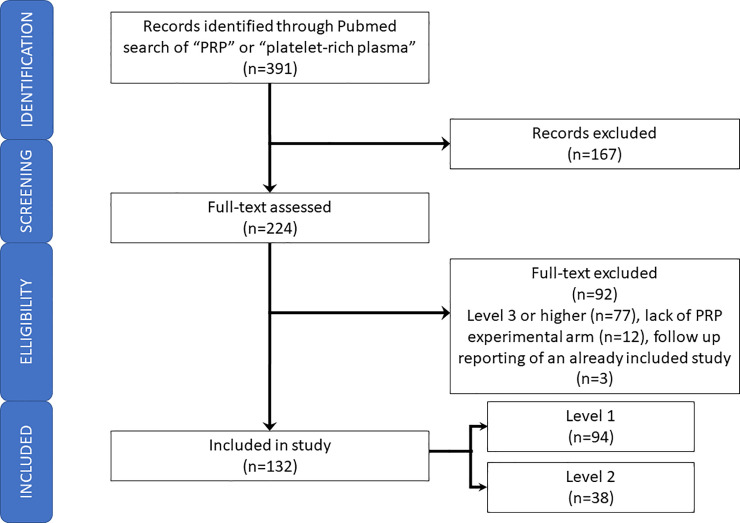
The Cochrane Database, PubMed, and EMBASE databases were queried for level I/II clinical studies on PRP injections across all medical specialties. From these studies, data including condition treated, PRP processing and characterization, delivery, control group, and assessed outcomes were collected.
A total of 132 studies met the inclusion and exclusion criteria and involved 28 different conditions across 8 specialties (cardiothoracic surgery, cosmetic, dermatology, musculoskeletal (MSK), neurology, oral maxillofacial surgery, ophthalmology, and plastic surgery). Studies on PRP for MSK injuries made up the majority of the studies (74%), with knee osteoarthritis and tendinopathy being most commonly studied. Of the 132 studies, only 44 (33%) characterized the composition of PRP used, and only 23 (17%) reported the leukocyte component. MSK studies were more likely to use patient-reported outcome measures to assess outcomes, while studies from other specialties were more likely to use clinician- or imaging-based objective outcomes. Overall, 61% of the studies found PRP to be favorable over control treatment, with no difference in favorable reporting between MSK and other medical specialties.
The majority of level I/II clinical studies investigating PRP therapy across all medical specialties have been conducted for MSK injuries with knee osteoarthritis and tendinopathy being the most commonly studied conditions. Inconsistent reporting of PRP composition exists among all studies in medicine. Rigorous reporting in human clinical studies across all medical specialties is crucial for evaluating the effects of PRP and moving towards disease-specific and individualized treatment.
近年来,富血小板血浆(PRP)疗法在多个医学专科的临床实践中得到了显著发展。然而,由于方案报告不一致以及所使用PRP的特性描述不一致,跨医学领域的PRP研究比较仍具有挑战性。本系统评价的目的是确定每个医学专科内I/II级研究的数量,并比较各医学领域的研究报告水平。
查询Cochrane数据库、PubMed和EMBASE数据库,以获取所有医学专科中关于PRP注射的I/II级临床研究。从这些研究中,收集包括治疗的疾病、PRP处理和特性、给药方式、对照组以及评估结果等数据。
共有132项研究符合纳入和排除标准,涉及8个专科(心胸外科、美容科、皮肤科、肌肉骨骼科(MSK)、神经科、口腔颌面外科、眼科和整形外科)的28种不同疾病。关于PRP治疗MSK损伤的研究占大多数(74%),其中最常研究的是膝关节骨关节炎和肌腱病。在这132项研究中,只有44项(33%)对所使用的PRP成分进行了特性描述,只有23项(17%)报告了白细胞成分。MSK研究更有可能使用患者报告的结局指标来评估结果,而其他专科的研究更有可能使用基于临床医生或影像学的客观结果。总体而言,61%的研究发现PRP优于对照治疗,MSK和其他医学专科之间在有利报告方面没有差异。
所有医学专科中调查PRP疗法的大多数I/II级临床研究都是针对MSK损伤进行的,其中膝关节骨关节炎和肌腱病是最常研究的疾病。医学领域的所有研究中都存在PRP成分报告不一致的情况。所有医学专科的人体临床研究进行严格报告对于评估PRP的效果以及朝着疾病特异性和个体化治疗发展至关重要。