Nyame Solomon, Adiibokah Edward, Mohammed Yasmin, Doku Victor C, Othieno Caleb, Harris Benjamin, Gureje Oye, Soraya Seedat, Appiah-Poku John
Kintampo Health Research Centre, Box 200, Kintampo, Bono East Region, Ghana.
Population Council, Accra, Ghana.
BMC Health Serv Res. 2021 Apr 23;21(1):375. doi: 10.1186/s12913-021-06313-7.
In low- and middle-income countries, the paucity of conventional health services means that many people with mental health problems rely on traditional health practitioners (THPs). This paper examines the possibility of forging partnerships at the Primary Health Care (PHC) level in two geopolitical regions of Ghana, to maximize the benefits to both health systems.
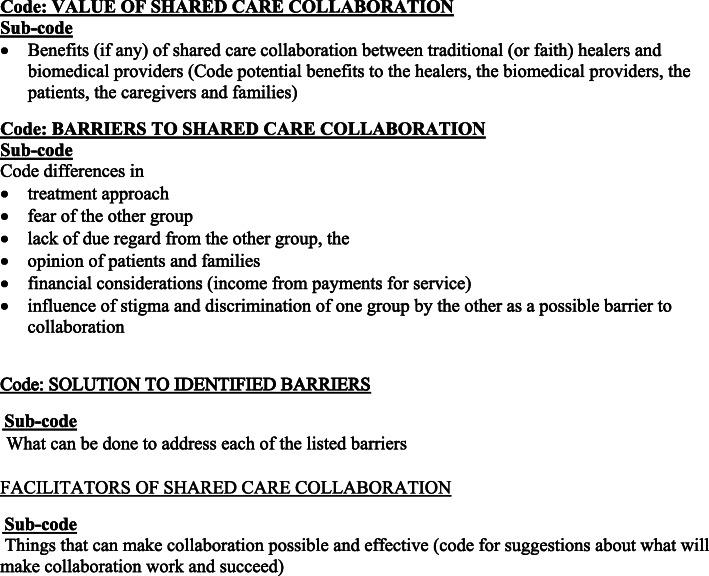
The study was a qualitative cross-sectional survey. Eight (8) focus group discussions (FGDs) were conducted between February and April 2014. The views of THPs, PHC providers, service users (i.e. patients) and their caregivers, on the perceived benefits, barriers and facilitators of forging partnerships were examined. A thematic framework approach was employed for analysis.
The study revealed that underlying the widespread approval of forging partnerships, there were mutual undertones of suspicion. While PHC providers were mainly concerned that THPs may incur harms to service users (e.g., through delays in care pathways and human rights abuses), service users and their caregivers highlighted the failure of conventional medical care to meet their healthcare needs. There are practical challenges to these collaborations, including the lack of options to adequately deal with human rights issues such as some patients being chained and exposed to the vagaries of the weather at THPs. There is also the issue of the frequent shortage of psychotropic medication at PHCs.
Addressing these barriers could enhance partnerships. There is also a need to educate all providers, which should include sessions clarifying the potential value of such partnerships.
在低收入和中等收入国家,传统卫生服务的匮乏意味着许多有心理健康问题的人依赖传统卫生从业者(THPs)。本文探讨了在加纳两个地缘政治区域的初级卫生保健(PHC)层面建立伙伴关系的可能性,以实现对两个卫生系统的最大利益。
该研究为定性横断面调查。2014年2月至4月期间进行了八次焦点小组讨论(FGDs)。研究了传统卫生从业者、初级卫生保健提供者、服务使用者(即患者)及其照顾者对建立伙伴关系的感知利益、障碍和促进因素的看法。采用主题框架方法进行分析。
研究表明,在对建立伙伴关系的广泛认可背后,存在相互的怀疑情绪。初级卫生保健提供者主要担心传统卫生从业者可能会对服务使用者造成伤害(例如,通过护理途径的延迟和侵犯人权行为),而服务使用者及其照顾者则强调传统医疗服务未能满足他们的医疗需求。这些合作存在实际挑战,包括缺乏适当处理人权问题的选择,例如一些患者在传统卫生从业者处被锁链束缚并暴露在恶劣天气中。初级卫生保健机构还存在精神药物经常短缺的问题。
解决这些障碍可以加强伙伴关系。还需要对所有提供者进行教育,其中应包括阐明此类伙伴关系潜在价值的课程。