Department of Pharmacy, Gifu University Hospital, 1-1 Yanagido, Gifu, 501-1194, Japan.
Department of Emergency and Disaster Medicine, Gifu University Graduate School of Medicine, 1-1 Yanagido, Gifu, 501-1194, Japan.
Sci Rep. 2021 Apr 23;11(1):8864. doi: 10.1038/s41598-021-88303-7.
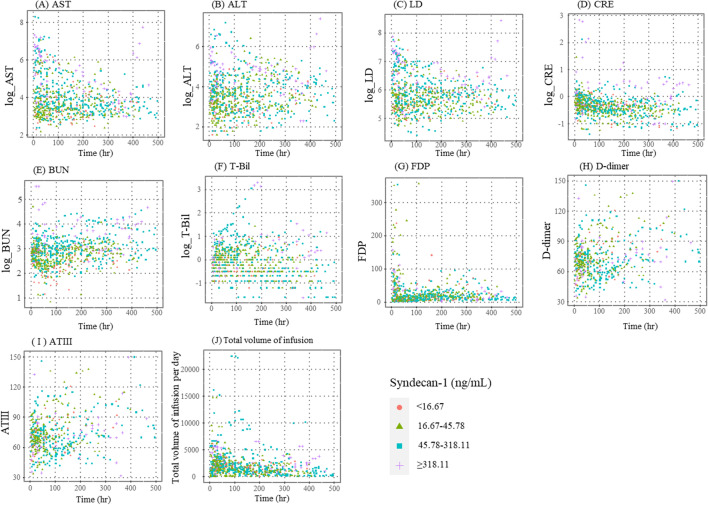
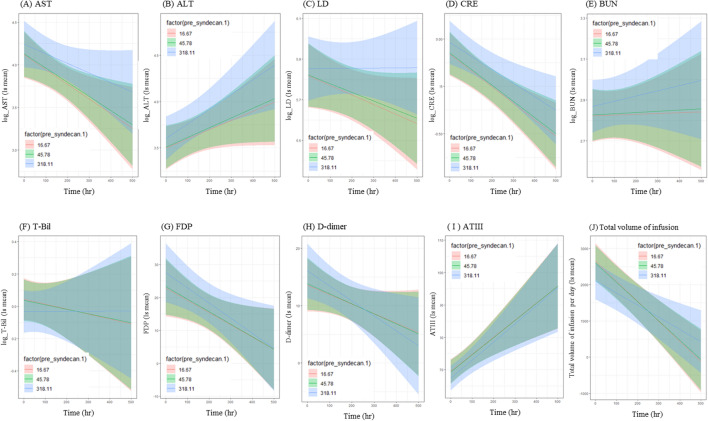
Syndecan-1 (SDC-1) is found in the endothelial glycocalyx and shed into the blood during systemic inflammatory conditions. We investigated organ dysfunction associated with changing serum SDC-1 levels for early detection of organ dysfunction in critically ill patients. To evaluate the effect of SDC-1 on laboratory parameters measured the day after SDC-1 measurement with consideration for repeated measures, linear mixed effects models were constructed with each parameter as an outcome variable. A total of 94 patients were enrolled, and 831 samples were obtained. Analysis using mixed effects models for repeated measures with adjustment for age and sex showed that serum SDC-1 levels measured the day before significantly affected several outcomes, including aspartate aminotransferase (AST), alanine transaminase (ALT), creatinine (CRE), blood urea nitrogen (BUN), antithrombin III, fibrin degradation products, and D-dimer. Moreover, serum SDC-1 levels of the prior day significantly modified the effect between time and several outcomes, including AST, ALT, CRE, and BUN. Additionally, increasing serum SDC-1 level was a significant risk factor for mortality. Serum SDC-1 may be a useful biomarker for daily monitoring to detect early signs of kidney, liver and coagulation system dysfunction, and may be an important risk factor for mortality in critically ill patients.
硫酸乙酰肝素蛋白聚糖-1(SDC-1)存在于血管内皮糖萼中,并在全身炎症状态下释放入血。我们研究了与血清 SDC-1 水平变化相关的器官功能障碍,以早期发现危重症患者的器官功能障碍。为了评估 SDC-1 对实验室参数的影响,我们在测量 SDC-1 后的第二天测量了这些参数,并考虑了重复测量,用线性混合效应模型将每个参数作为因变量进行了构建。共纳入 94 例患者,获得 831 份样本。使用混合效应模型进行重复测量分析,并调整年龄和性别,结果表明,前一天测量的血清 SDC-1 水平显著影响了多个结局指标,包括天冬氨酸转氨酶(AST)、丙氨酸转氨酶(ALT)、肌酐(CRE)、血尿素氮(BUN)、抗凝血酶 III、纤维蛋白降解产物和 D-二聚体。此外,前一天的血清 SDC-1 水平显著改变了时间与多个结局指标之间的关系,包括 AST、ALT、CRE 和 BUN。此外,血清 SDC-1 水平升高是死亡的显著危险因素。血清 SDC-1 可能是一种有用的生物标志物,用于日常监测,以发现肾脏、肝脏和凝血系统功能障碍的早期迹象,并且可能是危重症患者死亡的重要危险因素。