Department of Infectious Diseases and Immunology, University of Florida, Gainesville, FL.
Department of Pathobiological Sciences, University of Wisconsin-Madison, Madison, WI.
Nicotine Tob Res. 2021 Aug 29;23(10):1763-1770. doi: 10.1093/ntr/ntab080.
Both smoking and infection adversely impact pregnancy. Previously, our group identified in a rodent model that 6 mg/kg/d nicotine increased the risk of fetal infection at gestation day (GD) 18. Here, we investigate lower nicotine doses.
Pregnant Sprague-Dawley rats received nicotine infusion at 0, 1, or 3 mg/kg/d (no, low-, and mid-dose nicotine, respectively) from GD 6, with intravenous inoculation with Mycoplasma pulmonis (MP) at 107 CFU (N = 20) or sterile broth (sham) (N = 11) on GD 14. Uterus and fetuses were retrieved on GD 18 for MP culture and histopathologic evaluation of maternal and fetal inflammatory responses (MIR and FIR).
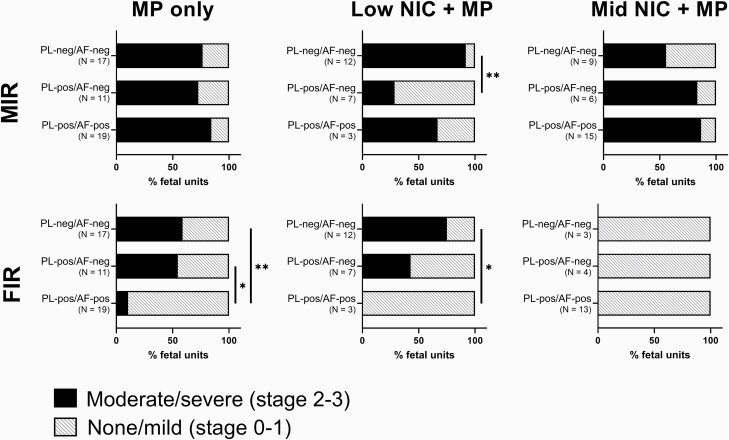
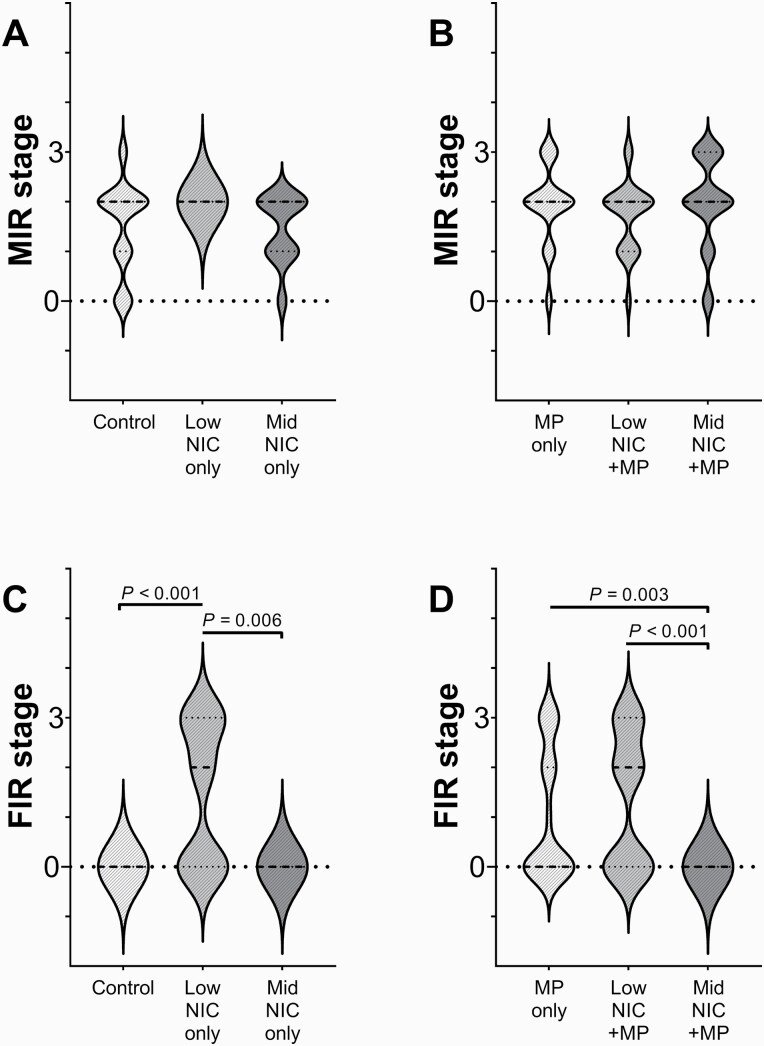
At 1 mg/kg/d nicotine, MP colonization rates were decreased, from 100% (9 of 9) to 40% (2 of 5) of MP-inoculated dams (p = .03), and 59% (66 of 111) to 39% (24 of 62) of fetuses (p = .01), versus no nicotine. Low-dose nicotine resulted in increased MIR and FIR in the sham-inoculated group; in the MP-inoculated group, this resulted in reduced relative risk (RR) for placental colonization (RR, 95% CI with high MIR = 0.14, 0.02 to 0.65; FIR = 0.38, 0.12 to 0.93). In contrast, 3 mg/kg/d nicotine treatment did not alter colonization rates; furthermore, FIR was completely suppressed, even in the face of placental or amniotic fluid colonization.
The 1 mg/kg/d nicotine dose decreased risk of intrauterine infection, with increased MIR and FIR. The 3 mg/kg/d nicotine dose inhibited FIR, and increased risk for intrauterine infection. Nicotine alterations of the intrauterine environment were markedly dose-dependent.
Nicotine exposure alters intrauterine infection and inflammation in a dose-dependent manner, potentially impacting fetal development and programming. Previous work in a rodent model showed that high-dose nicotine (6 mg/kg/d) exposure exacerbated intrauterine infection during pregnancy. The current study found that low-dose nicotine (1 mg/kg/d) exposure reduced colonization of placenta and amniotic fluid; this decrease was associated with increased intrauterine inflammation. Exposure to mid-dose nicotine (3 mg/kg/d) suppressed fetal inflammation. Elucidation of underlying mechanisms of these phenomena will inform public health and clinical care decisions, particularly in the context of risk assessment of nicotine replacement therapy during pregnancy for smoking cessation.
吸烟和感染都会对妊娠产生不利影响。此前,我们的研究小组在一种啮齿动物模型中发现,每天 6 毫克/千克的尼古丁会增加妊娠第 18 天胎儿感染的风险。在这里,我们研究了较低剂量的尼古丁。
从妊娠第 6 天开始,妊娠 Sprague-Dawley 大鼠接受 0、1 或 3 毫克/千克/天(分别为无、低和中剂量尼古丁)的尼古丁输注,在妊娠第 14 天静脉接种支原体肺炎(MP)107CFU(N=20)或无菌肉汤(假)(N=11)。在妊娠第 18 天取出子宫和胎儿,进行 MP 培养和母体和胎儿炎症反应(MIR 和 FIR)的组织病理学评估。
在 1 毫克/千克/天的尼古丁剂量下,MP 定植率从 9 只(9/9)到 5 只(2/5)的 MP 接种母鼠(p=0.03)和 111 只(66/111)到 62 只(24/62)的胎儿(p=0.01)下降,与无尼古丁相比。低剂量尼古丁导致假接种组 MIR 和 FIR 增加;在 MP 接种组中,这导致胎盘定植的相对风险降低(高 MIR=0.14,0.02-0.65;FIR=0.38,0.12-0.93)。相比之下,3 毫克/千克/天的尼古丁处理并未改变定植率;此外,即使胎盘或羊水定植,FIR 也完全受到抑制。
1 毫克/千克/天的尼古丁剂量降低了宫内感染的风险,同时增加了 MIR 和 FIR。3 毫克/千克/天的尼古丁剂量抑制了 FIR,增加了宫内感染的风险。尼古丁对宫内环境的改变明显呈剂量依赖性。
尼古丁暴露以剂量依赖的方式改变宫内感染和炎症,可能影响胎儿发育和编程。之前在啮齿动物模型中的研究表明,高剂量尼古丁(6 毫克/千克/天)暴露会加剧妊娠期间的宫内感染。本研究发现,低剂量尼古丁(1 毫克/千克/天)暴露降低了胎盘和羊水的定植;这种减少与宫内炎症增加有关。中剂量尼古丁(3 毫克/千克/天)暴露抑制了胎儿炎症。阐明这些现象的潜在机制将为公共卫生和临床护理决策提供信息,特别是在评估尼古丁替代疗法在怀孕期间戒烟的风险方面。