Miguel David, Saornil María Antonia, de Frutos Jesús María, García-Álvarez Ciro, Alonso Pilar, Diezhandino Patricia
Intraocular Tumors Unit, Valladolid University Hospital, Valladolid, Spain.
J Contemp Brachytherapy. 2021 Apr;13(2):117-125. doi: 10.5114/jcb.2021.105278. Epub 2021 Apr 14.
The aim of this study was to analyze regression rates and local control of uveal melanoma patients treated with iodine-125 I) brachytherapy based on initial tumor apical height.
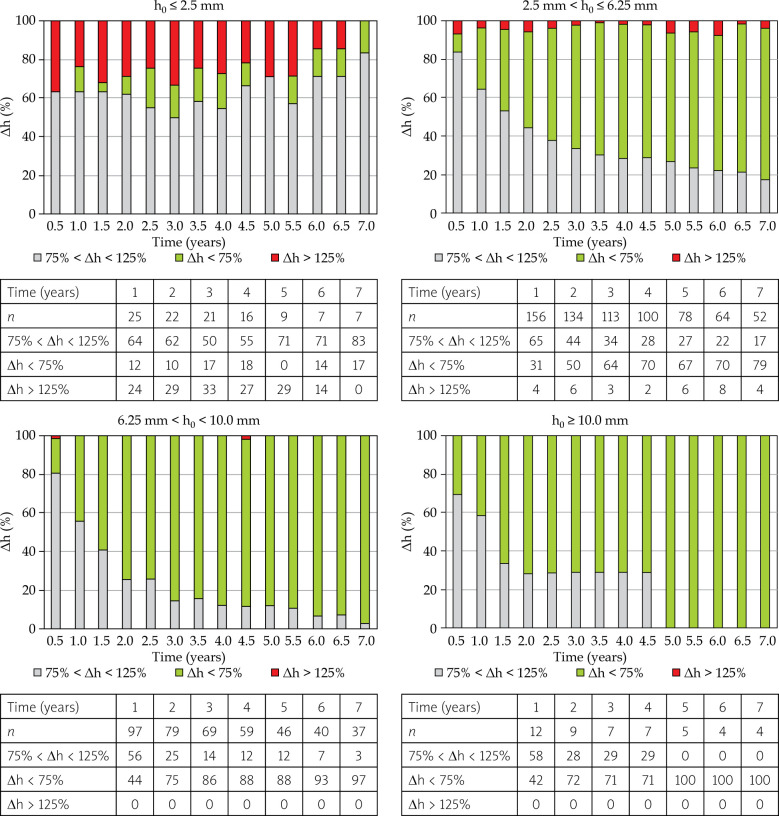
Patients treated in a single institution from January 1, 1996 to 2019 with I plaques (ROPES and COMS) for uveal melanoma were included in this study. Patients treated with brachytherapy for iris and those treated with transpupillary thermotherapy prior to brachytherapy were excluded. The sample was classified into 4 categories depending on initial apical tumor height (h), i.e., h ≤ 2.5 (small), 2.5 < h ≤ 6.25 (small-medium), 6.25 < h ≤ 10 (medium-large), and h > 10 mm (large). Percentage of original tumor apical height (Δh) was collected during follow-ups. Patterns of regression were evaluated using linear least squares adjustments. Multivariable Cox regression were performed.
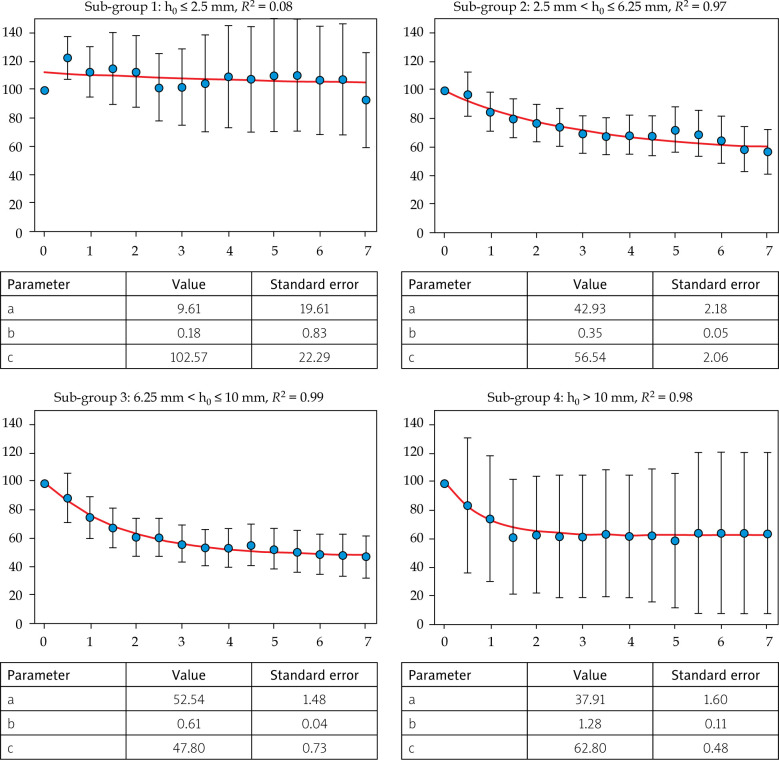
In total, 305 patients met the inclusion criteria, and 27, 166, 100, and 13 were considered for small, small-medium, medium-large, and large categories, respectively. Median follow-up was 82.4, 56.8, 76.1, 89.1, and 100.1 months for the entire cohort and each sub-group, respectively. Pattern of decrease when h ≤ 2.5 mm was not detectable. For the rest sub-groups, changes in height could be fitted using functional form: Δh (T) = ae + c, ≥ 0.97. Multivariate Cox analysis factors predictive of local control failure revealed a hazard ratio (HR) of 6.1 (95% CI: 0.7-58.2%, = 0.05) for patients who remained similar sized after treatment for small-medium tumors. For the rest sub-groups, Cox analysis did not indicate statistical significance in any single variable.
Height changes can be modeled by a negative exponential function for the first 7 years after treatment depending on the initial height, except for those less than 2.5 mm. Non-responding small-medium tumors multiply by 6 the probability of failure in local control.
本研究旨在基于初始肿瘤顶端高度分析接受碘 - 125(¹²⁵I)近距离放射治疗的葡萄膜黑色素瘤患者的消退率和局部控制情况。
本研究纳入了1996年1月1日至2019年在单一机构接受¹²⁵I敷贴器(ROPES和COMS)治疗葡萄膜黑色素瘤的患者。排除接受虹膜近距离放射治疗的患者以及在近距离放射治疗前接受经瞳孔温热疗法的患者。根据初始顶端肿瘤高度(h)将样本分为4类,即h≤2.5(小)、2.5<h≤6.25(中小)、6.25<h≤10(中 - 大)和h>10 mm(大)。在随访期间收集原始肿瘤顶端高度的百分比(Δh)。使用线性最小二乘法调整评估消退模式。进行多变量Cox回归分析。
共有305例患者符合纳入标准,分别有27例、166例、100例和13例被纳入小、中小、中 - 大、大类别。整个队列和每个亚组的中位随访时间分别为82.4个月、56.8个月、76.1个月、89.1个月和100.1个月。当h≤2.5 mm时,无法检测到高度下降模式。对于其余亚组,高度变化可以用函数形式拟合:Δh(T) = ae⁻ᵇᵀ + c,拟合优度R²≥0.97。多变量Cox分析预测局部控制失败的因素显示,中小肿瘤患者治疗后大小保持相似的患者的风险比(HR)为6.1(95% CI:0.7 - 58.2%,P = 0.05)。对于其余亚组,Cox分析在任何单个变量中均未显示统计学意义。
除高度小于2.5 mm的情况外,治疗后的前7年,高度变化可以根据初始高度用负指数函数建模。无反应的中小肿瘤使局部控制失败的概率增加6倍。