Department of Veterinary Physiology and Pharmacology, College of Veterinary Medicine and Biomedical Sciences, Texas A&M University, College Station, Texas.
Agricultural Animal Care and Use Program, Office of the Vice Chancellor for Research, University of Illinois Urbana-Champaign, Urbana, Illinois.
Am J Physiol Endocrinol Metab. 2021 Jun 1;320(6):E1107-E1118. doi: 10.1152/ajpendo.00281.2020. Epub 2021 Apr 26.
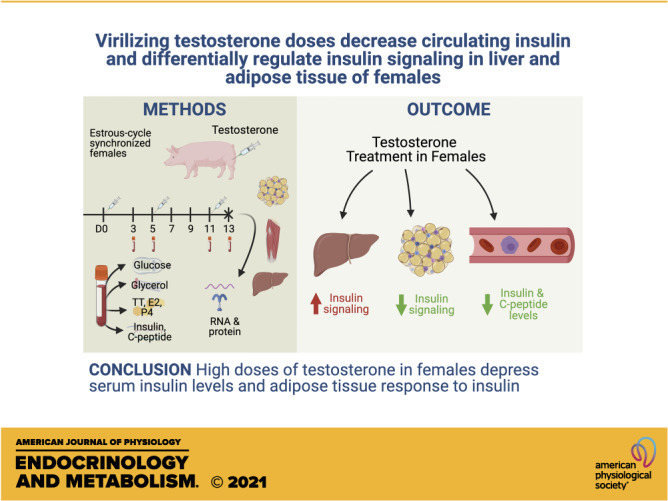
Transgender men undergoing hormone therapy are at risk for insulin resistance. However, how virilizing testosterone therapy affects serum insulin and peripheral insulin sensitivity in transgender men is unknown. This study assessed the effect of acute, virilizing testosterone on serum insulin concentrations and insulin signaling in liver, skeletal muscle, and white adipose tissue (WAT) of female pigs as a translational model for transgender men. Females received three doses of intramuscular testosterone cypionate (TEST females; 50 mg/day/pig) or corn oil (control) spaced 6 days apart starting on the day of estrus (). Fasting blood was collected on , , , , and , and females were euthanized on . On , TEST females had virilizing concentrations of serum testosterone with normal concentrations of serum estradiol. Virilizing serum testosterone concentrations () were associated with decreased serum insulin and C-peptide concentrations. Blood glucose and serum glycerol concentrations were not altered by testosterone. Virilizing concentrations of testosterone downregulated and in subcutaneous (sc) WAT and upregulated transcript levels of insulin-signaling pathway components in WAT and liver. At the protein level, virilizing testosterone concentrations were associated with increased PI3K 110α in liver and increased insulin receptor (INSR) and phospho(Ser256)-FOXO1 in visceral (v) WAT but decreased phospho(Ser473)-AKT in vWAT and scWAT. These results suggest that acute exposure to virilizing concentrations of testosterone suppresses circulating insulin levels and results in increased abundance of proteins in the insulin-signaling pathway in liver and altered phosphorylation of key proteins in control of insulin sensitivity in WAT. Acute virilizing doses of testosterone administered to females suppress circulating insulin levels, upregulate components of the insulin-signaling pathway in liver, and suppress insulin signaling in white adipose tissue. These results suggest that insulin resistance in transgender men may be due to suppression of the insulin-signaling pathway and decreased insulin sensitivity in white adipose tissue.
接受激素治疗的跨性别男性存在胰岛素抵抗的风险。然而,雄性化睾丸激素治疗如何影响跨性别男性的血清胰岛素和外周胰岛素敏感性尚不清楚。本研究评估了急性雄性化睾丸酮对雌性猪作为跨性别男性转化模型的肝脏、骨骼肌和白色脂肪组织(WAT)中血清胰岛素浓度和胰岛素信号的影响。雌性猪在发情日()开始,每隔 6 天接受 3 次肌肉内注射睾丸酮环戊丙酸酯(TEST 雌性猪;50mg/天/猪)或玉米油(对照)。在第 0、3、6、9 和 12 天采集空腹血液,雌性猪在第 12 天被安乐死。在第 3 天,TEST 雌性猪的血清睾丸酮具有雄性化浓度,而血清雌二醇的浓度正常。雄性化的血清睾丸酮浓度()与血清胰岛素和 C 肽浓度降低有关。血清葡萄糖和甘油浓度不受睾丸酮的影响。雄性化的睾丸酮浓度下调了皮下(sc)WAT 中的和,并上调了 WAT 和肝脏中胰岛素信号通路成分的转录水平。在蛋白质水平上,雄性化的睾丸酮浓度与肝脏中 PI3K110α的增加以及内脏(v)WAT 和 scWAT 中胰岛素受体(INSR)和磷酸化(Ser256)-FOXO1 的增加有关,但 vWAT 和 scWAT 中磷酸化(Ser473)-AKT 的减少有关。这些结果表明,急性暴露于雄性化的睾丸酮浓度会抑制循环胰岛素水平,并导致肝脏中胰岛素信号通路中的蛋白质丰度增加,并改变 WAT 中胰岛素敏感性控制的关键蛋白质的磷酸化。给予雌性猪急性雄性化睾丸酮剂量可抑制循环胰岛素水平,上调肝脏胰岛素信号通路成分,并抑制白色脂肪组织中的胰岛素信号。这些结果表明,跨性别男性的胰岛素抵抗可能是由于胰岛素信号通路的抑制和白色脂肪组织中胰岛素敏感性的降低。