Department of Chemical, Biological and Environmental Engineering, School of Engineering, Universitat Autònoma de Barcelona, 08193, Bellaterra (Cerdanyola del Vallès), Spain.
Institute of Molecular Biotechnology, Graz University of Technology, Petersgasse 14, 8010, Graz, Austria.
Microb Cell Fact. 2021 Apr 26;20(1):90. doi: 10.1186/s12934-021-01577-4.
Currently, the numerous and versatile applications in pharmaceutical and chemical industry make the recombinant production of cytochrome P450 enzymes (CYPs) of great biotechnological interest. Accelerating the drug development process by simple, quick and scalable access of human drug metabolites is key for efficient and targeted drug development in response to new and sometimes unexpected medical challenges and needs. However, due its biochemical complexity, scalable human CYP (hCYP) production and their application in preparative biotransformations was still in its infancy.
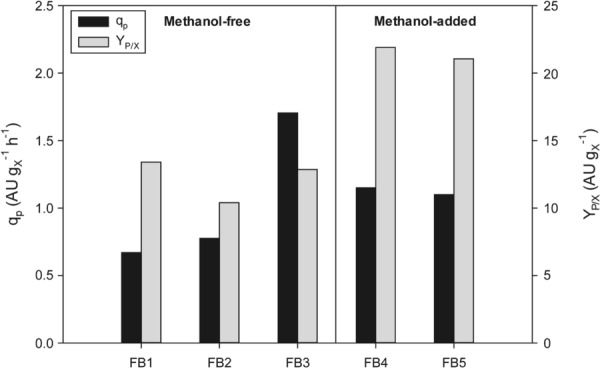
A scalable bioprocess for fine-tuned co-expression of hCYP2C9 and its essential complementary human cytochrome P450 reductase (hCPR) in the yeast Pichia pastoris (Komagataella phaffii) is presented. High-throughput screening (HTS) of a transformant library employing a set of diverse bidirectional expression systems with different regulation patterns and a fluorimetric assay was used in order to fine-tune hCYP2C9 and hCPR co-expression, and to identify best expressing clonal variants. The bioprocess development for scalable and reliable whole cell biocatalyst production in bioreactors was carried out based on rational optimization criteria. Among the different alternatives studied, a glycerol carbon-limiting strategy at high µ showed highest production rates, while methanol co-addition together with a decrease of µ provided the best results in terms of product to biomass yield and whole cell activity. By implementing the mentioned strategies, up to threefold increases in terms of production rates and/or yield could be achieved in comparison with initial tests. Finally, the performance of the whole cell catalysts was demonstrated successfully in biotransformation using ibuprofen as substrate, demonstrating the expected high selectivity of the human enzyme catalyst for 3'hydroxyibuprofen.
For the first time a scalable bioprocess for the production of hCYP2C9 whole cell catalysts was successfully designed and implemented in bioreactor cultures, and as well, further tested in a preparative-scale biotransformation of interest. The catalyst engineering procedure demonstrated the efficiency of the employment of a set of differently regulated bidirectional promoters to identify transformants with most effective membrane-bound hCYP/hCPR co-expression ratios and implies to become a model case for the generation of other P. pastoris based catalysts relying on co-expressed enzymes such as other P450 catalysts or enzymes relying on co-expressed enzymes for co-factor regeneration.
目前,医药和化学工业领域的众多应用使得细胞色素 P450 酶(CYPs)的重组生产具有巨大的生物技术意义。通过简单、快速和可扩展的方式获得人体药物代谢物,加速药物开发进程,是应对新的、有时是意外的医疗挑战和需求的高效、有针对性的药物开发的关键。然而,由于其生化复杂性,可扩展的人源细胞色素 P450(hCYP)生产及其在制备生物转化中的应用仍处于起步阶段。
本文提出了一种可扩展的生物工艺,用于在毕赤酵母(Komagataella phaffii)中精细调控共表达人细胞色素 P4502C9(hCYP2C9)及其必需的互补人类细胞色素 P450 还原酶(hCPR)。采用高通量筛选(HTS)技术,对一组具有不同调控模式的双向表达系统的转化体文库进行筛选,并采用荧光测定法对 hCYP2C9 和 hCPR 共表达进行微调,鉴定最佳表达的克隆变体。根据合理的优化标准,进行了在生物反应器中进行可扩展和可靠的全细胞生物催化剂生产的生物工艺开发。在所研究的不同替代方案中,高μ时的甘油碳限制策略显示出最高的生产速率,而甲醇共添加与μ的降低相结合,在产物与生物质产率和全细胞活性方面提供了最佳结果。通过实施所述策略,与初始测试相比,生产速率和/或产率可提高三倍。最后,使用布洛芬作为底物成功地在生物转化中展示了全细胞催化剂的性能,证明了人源酶催化剂对 3'-羟基布洛芬的高选择性。
本文首次成功设计并在生物反应器培养中实施了用于生产 hCYP2C9 全细胞催化剂的可扩展生物工艺,并在有意义的制备规模生物转化中进行了进一步测试。催化剂工程程序证明了使用一组不同调控的双向启动子来鉴定具有最有效的膜结合 hCYP/hCPR 共表达比的转化体的效率,并暗示成为其他基于毕赤酵母的催化剂的生成的模型案例,这些催化剂依赖于共表达的酶,例如其他 P450 催化剂或依赖于共表达的酶进行辅助因子再生的酶。