Lee Jinkyu, Lee Sangmin, Kim Sung Min, Shin Heungsoo
Department of Bioengineering, Hanyang University, Seoul, 04763, Republic of Korea.
BK21 FOUR, Human-Tech Convergence Program, Hanyang University, Seoul, 04763, Republic of Korea.
Biomater Res. 2021 Apr 26;25(1):14. doi: 10.1186/s40824-021-00215-9.
Fabrication of three-dimensional stem cell spheroids have been studied to improve stem cell function, but the hypoxic core and limited penetration of nutrients and signaling cues to the interior of the spheroid were challenges. The incorporation of polymers such as silica and gelatin in spheroids resulted in relatively relaxed assembly of composite spheroids, and enhancing transport of nutrient and biological gas. However, because of the low surface area between cells and since the polymers were heterogeneously distributed throughout the spheroid, these polymers cannot increase the cell to extracellular matrix interactions needed to support differentiation.
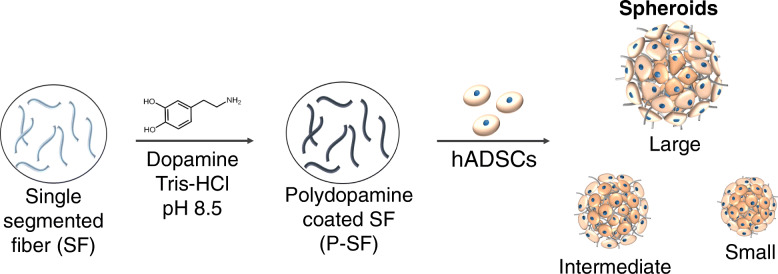
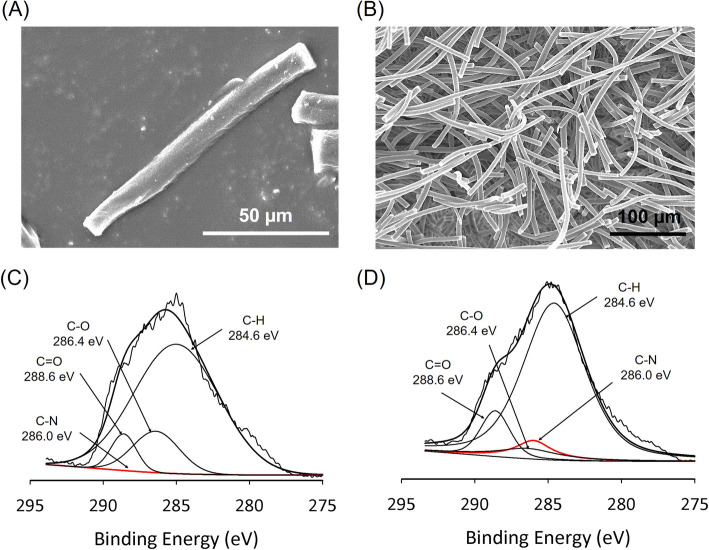
We developed the stem cell spheroids that incorporate poly(ι-lactic acid) single-segmented fibers synthesized by electrospinning and physical and chemical fragmentation. The proper mixing ratio was 2000 cells/μg fibers (average length of the fibers was 50 μm - 100 μm). The SFs were coated with polydopamine to increase cell binding affinity and to synthesize various-sized spheroids. The function of spheroids was investigated by in vitro analysis depending on their sizes. For statistical analysis, Graphpad Prism 5 software (San Diego, CA, USA) was used to perform one-way analysis of variance ANOVA with Tukey's honest significant difference test and a Student's t-test (for two variables) (P < 0.05).
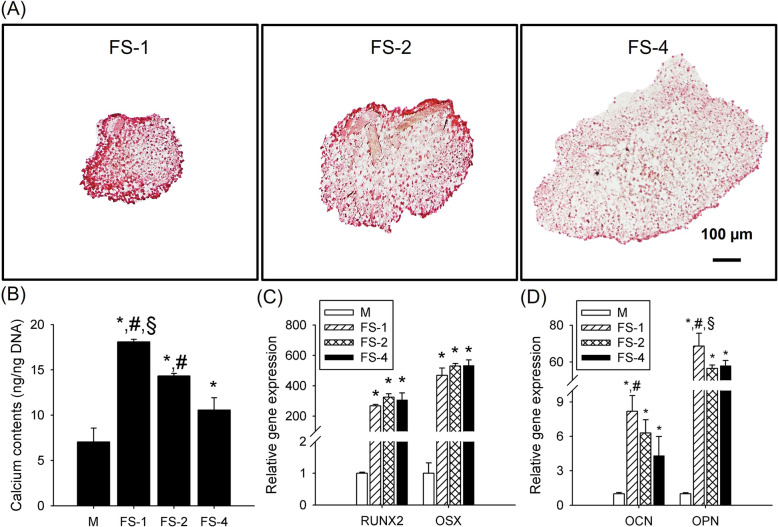
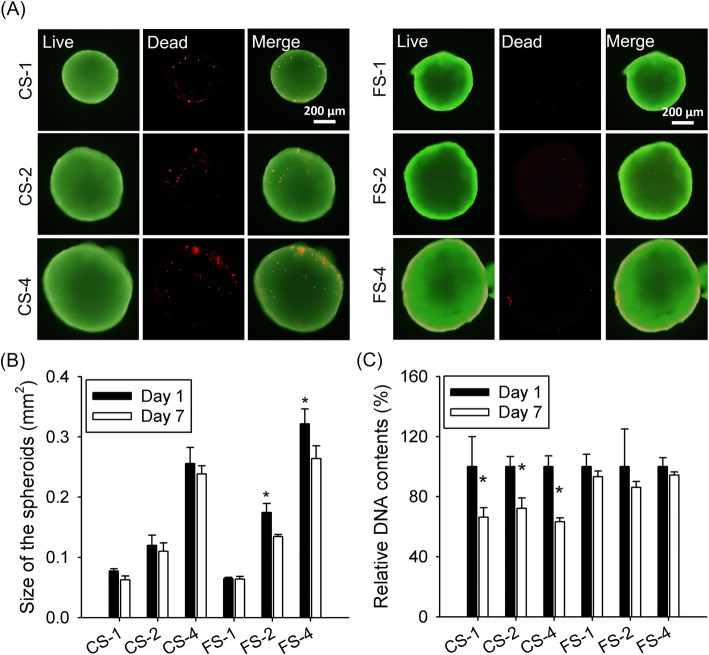
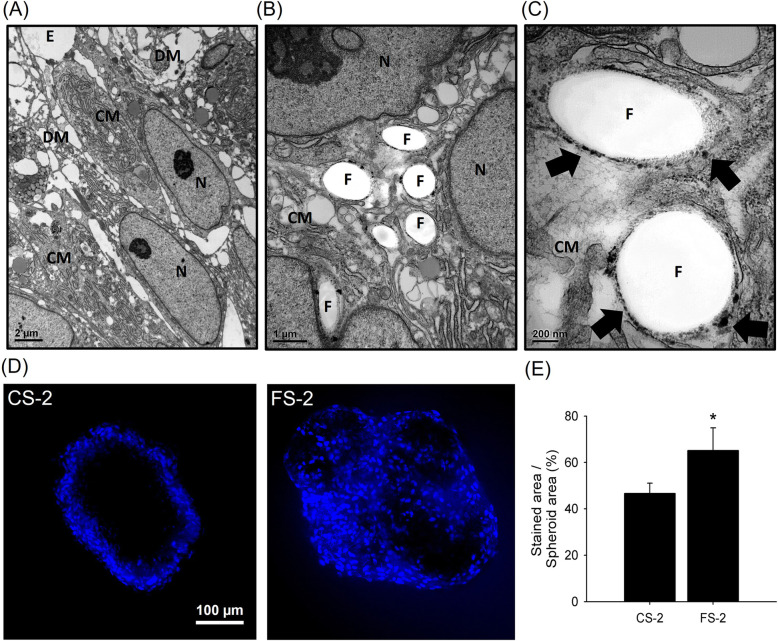
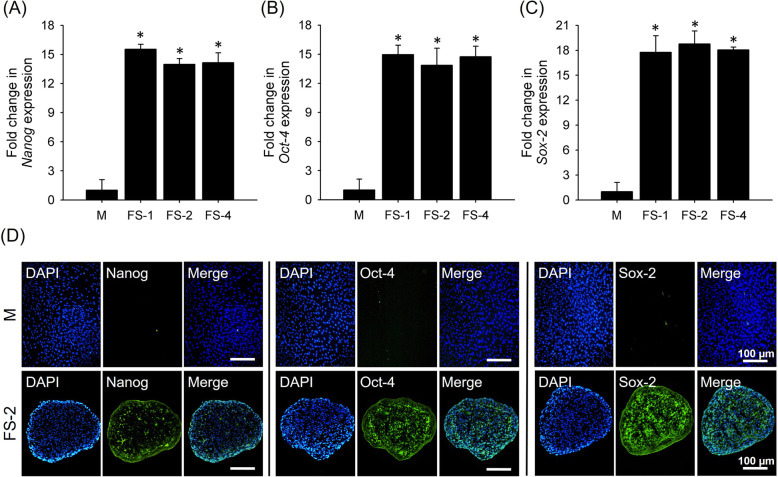
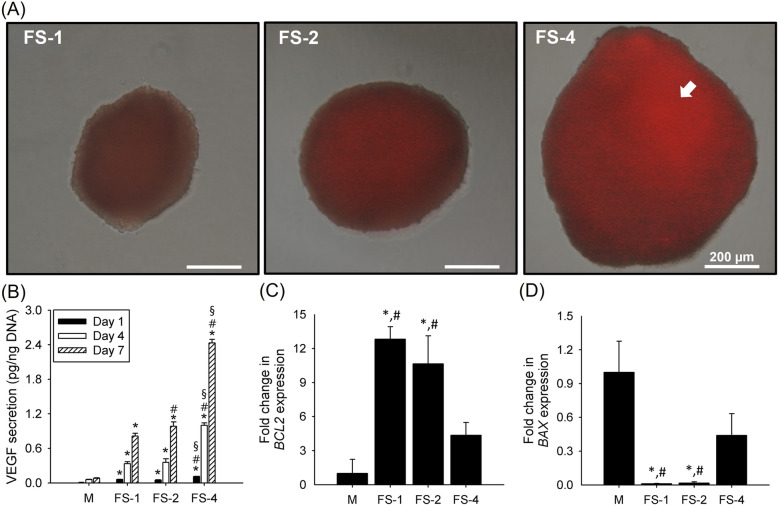
Spheroids of different sizes were created by modulating the amount of cells and fibers (0.063 mm-0.322 mm). The fibers in the spheroid were homogenously distributed and increased cell viability, while cell-only spheroids showed a loss of DNA contents, internal degradation, and many apoptotic signals. Furthermore, we investigated stemness and various functions of various-sized fiber-incorporated spheroids. In conclusion, the spheroid with the largest size showed the greatest release of angiogenic factors (released VEGF: 0.111 ± 0.004 pg/ng DNA), while the smallest size showed greater effects of osteogenic differentiation (mineralized calcium: 18.099 ± 0.271 ng/ng DNA).
The spheroids incorporating polydopamine coated single-segmented fibers showed enhanced viability regardless of sizes and increased their functionality by regulating the size of spheroids which may be used for various tissue reconstruction and therapeutic applications.
三维干细胞球体的构建已被研究用于改善干细胞功能,但球体的缺氧核心以及营养物质和信号分子向球体内的渗透受限是挑战。在球体中加入二氧化硅和明胶等聚合物会导致复合球体的组装相对疏松,并增强营养物质和生物气体的运输。然而,由于细胞间表面积较低,且聚合物在整个球体中分布不均,这些聚合物无法增加支持分化所需的细胞与细胞外基质的相互作用。
我们开发了一种包含通过静电纺丝以及物理和化学破碎合成的聚(ι-乳酸)单段纤维的干细胞球体。合适的混合比例是2000个细胞/μg纤维(纤维的平均长度为50μm - 100μm)。将这些单段纤维用聚多巴胺包被以增加细胞结合亲和力并合成各种大小的球体。根据球体大小,通过体外分析研究球体的功能。为进行统计分析,使用Graphpad Prism 5软件(美国加利福尼亚州圣地亚哥)进行单因素方差分析(ANOVA),并采用Tukey诚实显著差异检验和学生t检验(用于两个变量)(P < 0.05)。
通过调节细胞和纤维的量(0.063mm - 0.322mm)创建了不同大小的球体。球体中的纤维分布均匀,提高了细胞活力,而仅含细胞的球体则出现DNA含量损失、内部降解以及许多凋亡信号。此外,我们研究了不同大小的含纤维球体的干性和各种功能。总之,最大尺寸的球体显示出最大的血管生成因子释放量(释放的VEGF:0.111±0.004 pg/ng DNA),而最小尺寸的球体显示出更大的成骨分化效果(矿化钙:18.099±0.271 ng/ng DNA)。
包含聚多巴胺包被单段纤维的球体无论大小均显示出增强的活力,并通过调节球体大小增加了其功能,这可用于各种组织重建和治疗应用。