Centre for Affective Disorders, Institute of Psychiatry, Psychology & Neuroscience, King's College London, London, UK.
National Institute for Health Research (NIHR) Mental Health Biomedical Research Centre, South London and Maudsley NHS Foundation Trust and King's College London, London, UK.
Transl Psychiatry. 2021 Apr 26;11(1):244. doi: 10.1038/s41398-021-01343-5.
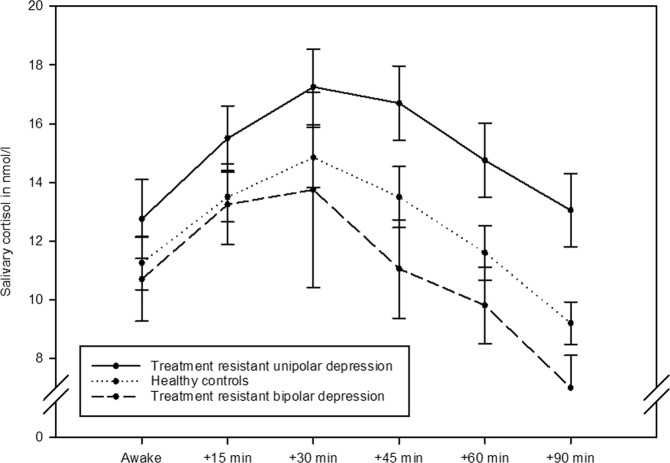
Altered functioning of the hypothalamic-pituitary-adrenal (HPA) axis has been demonstrated in patients with treatment-resistant depression, although studies have often conflated patients with unipolar and bipolar depression. This is problematic given that the two groups often present with opposed neurovegetative symptom patterns. The aim of this study was to test, for the first time, whether post-awakening cortisol, a highly reliable, naturalistic measure of HPA functioning, could distinguish patients with clearly defined treatment-resistant unipolar (TRUD) and bipolar depression (TRBD). A total of 37 patients with TRUD, 17 patients with TRBD, and 47 healthy controls were recruited. Areas under the curve (AUC) with respect to the ground (g) and increase (i) of post-awakening cortisol concentrations (awakening, +15, +30, +45, +60, +90 min) were measured over two days. Patients with TRUD had higher total cortisol production in the morning hours compared to controls (AUCg, p = 0.01), while they did not differ in terms of the awakening response (AUCi, p = 0.28). By contrast, subjects with TRBD had lower total cortisol when compared to controls by trend (AUCg, p = 0.07), while they did not differ in the awakening response (AUCi, p = 0.15). A direct comparison of TRUD and TRBD revealed differences in the AUCg (p = 0.003) and AUCi (p = 0.03). This finding of comparatively elevated HPA axis activity in the morning in TRUD and attenuated HPA axis activity in TRBD attests to a fundamental biological distinction between unipolar and bipolar depression. It has implications for the understanding and treatment of bipolar depression and in differentiating the two types of depression.
下丘脑-垂体-肾上腺(HPA)轴功能障碍已在治疗抵抗性抑郁症患者中得到证实,尽管研究经常将单相和双相抑郁症患者混淆在一起。鉴于这两个群体通常表现出相反的神经植物症状模式,这是有问题的。本研究的目的是首次测试,觉醒后皮质醇(一种高度可靠的、自然的 HPA 功能测量方法)是否可以区分明确界定的治疗抵抗性单相(TRUD)和双相抑郁症(TRBD)患者。共招募了 37 名 TRUD 患者、17 名 TRBD 患者和 47 名健康对照者。在两天内测量了觉醒后皮质醇浓度(觉醒时、+15 分钟、+30 分钟、+45 分钟、+60 分钟和+90 分钟)的曲线下面积(AUC)与基础(g)和增加(i)。与对照组相比,TRUD 患者在早晨的总皮质醇产生量更高(AUCg,p=0.01),而在觉醒反应方面没有差异(AUCi,p=0.28)。相比之下,TRBD 患者的总皮质醇水平趋势上低于对照组(AUCg,p=0.07),而在觉醒反应方面没有差异(AUCi,p=0.15)。TRUD 和 TRBD 的直接比较显示 AUCg(p=0.003)和 AUCi(p=0.03)存在差异。TRUD 中早晨 HPA 轴活性升高和 TRBD 中 HPA 轴活性减弱的这一发现证明了单相和双相抑郁症之间存在基本的生物学差异。这对理解和治疗双相抑郁症以及区分这两种类型的抑郁症具有重要意义。