Laboratório de Patologia Molecular, Departamento de Patologia - Escola Paulista de Medicina/Universidade Federal de São Paulo (EPM/UNIFESP), Rua Botucatu 740, Edifício Lemos Torres. Vila Clementino, São Paulo, SP, CEP 04023-62, Brazil.
Academia de Polícia de São Paulo (ACADEPOL), São Paulo, Brazil.
Sci Rep. 2021 Apr 26;11(1):8918. doi: 10.1038/s41598-021-87937-x.
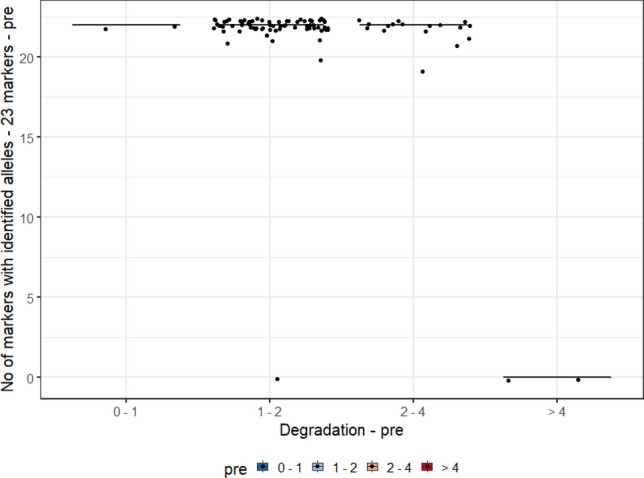
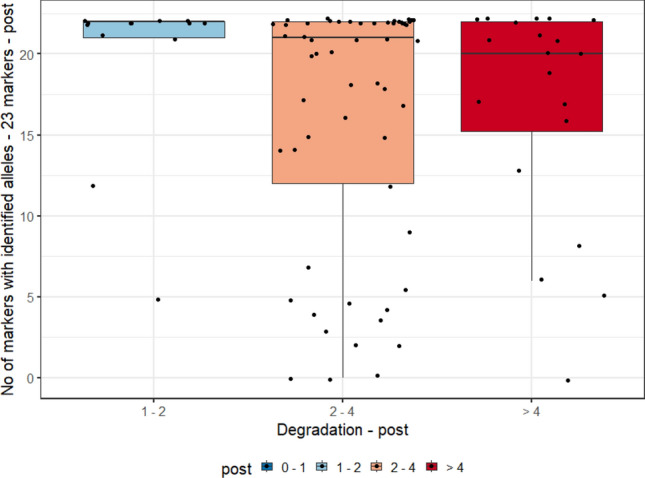
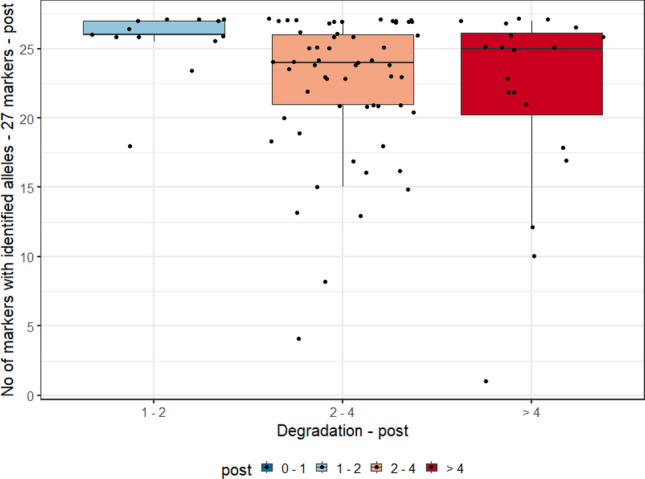
To understand stored evidence and the insertion in genetic databases is important in forensic investigations. Blood, pre- and post-vasectomy semen from 90 fertile male individuals, aged 24 to 45, were donated for research after informed consent. The semen samples were stored in the form of 30 µL stains on cotton fabric, for 16 years at room temperature in the laboratory. As well as the seminal fluid post vasectomy stains, which were performed after microscopy analyzes and certainty of the absence of spermatozoon. The pre vasectomy stains contained mainly haploid spermatozoon and the post vasectomy stains diploid epithelial cells and leukocytes. DNA extraction was performed with magnetic resin, followed by quantification and analysis of degradation of DNA. In this study we analyze these genetic profiles of DNA from stains on cotton fabric, using two Short Tandem Repeat multiplex systems, the PowerPlex Fusion 6C and Y23. Electrophoresis was performed on a 3500xL and analyzed using the Gene Mapper ID-X software. The genetic profiles of the 90 individuals were fully amplified in pre-vasectomy and partially in post-vasectomy stain samples, using the both multiplex systems. The results provide information about 0.25 cm semen stains on cotton fabric from 90 individuals, correlating concentration, degradation, and allele analysis. It also provides an understanding of the cells present in semen stains and the implications of individual factors. In the stains of post-vasectomy samples the small quantity of DNA was one of the limiting factors, in addition to degradation. Considering that all evaluations were carried out in a laboratory that has a quality control certificate and audited for being part of the national genetic profile database, the results were very consistent. Many aspects of the semen samples stored in the form of stains on cotton fabric have been clarified. The performance and sensitivity of the amplification systems used in the genotyping of azoospermic individuals were assessed. Conclusions: Genetic profiles were satisfactorily amplified in pre-vasectomy stain samples, and partially amplified in post-vasectomy stain samples, stored for almost two decades at room temperature in a tropical country. The small amount of DNA was one of the limitations in post-vasectomy stain samples, in addition to degradation and fragmentation. There are no publications in the literature on PowerPlex Fusion 6C and Y23 analyses using blood, sperm, and seminal fluids of the same individual, much less in the form of stains. This study can serve as a benchmark for the tracking analyses of stored samples. In addition, it anticipates a few social issues related to the analysis of post-vasectomy samples in forensic cases, most notably sex crimes.
要理解存储的证据和在遗传数据库中的插入,在法医学调查中很重要。在知情同意后,从 90 名年龄在 24 至 45 岁之间的有生育能力的男性中收集了血液、输精管切除术前后的精液,用于研究。精液样本以 30µL 棉织物污渍的形式储存,在实验室中于室温下储存了 16 年。以及在显微镜分析后进行的输精管切除术后精液污渍,以确定没有精子。输精管切除术前的污渍主要包含单倍体精子,而输精管切除术后的污渍则包含二倍体上皮细胞和白细胞。使用磁性树脂进行 DNA 提取,然后定量分析和降解 DNA。在这项研究中,我们使用两种短串联重复(STR)多重扩增系统(PowerPlex Fusion 6C 和 Y23)分析来自棉织物污渍的这些遗传特征。电泳在 3500xL 上进行,并使用 Gene Mapper ID-X 软件进行分析。使用两种多重扩增系统,在输精管切除术前的污渍样本中完全扩增了 90 个人的遗传特征,而在输精管切除术后的污渍样本中部分扩增了。结果提供了 90 个人 0.25 cm 棉织物精液污渍的相关信息,包括浓度、降解和等位基因分析。它还提供了对精液污渍中存在的细胞以及个体因素影响的理解。在输精管切除术后样本的污渍中,除了降解之外,DNA 的少量是限制因素之一。考虑到所有评估都是在具有质量控制证书的实验室中进行的,并且该实验室经过审核可作为国家遗传特征数据库的一部分,因此结果非常一致。已经澄清了以棉织物污渍形式储存的精液样本的许多方面。评估了用于对无精子个体进行基因分型的扩增系统的性能和灵敏度。结论:在近二十年前于热带国家室温下储存的输精管切除术前污渍样本中,遗传特征得到了令人满意的扩增,而在输精管切除术后污渍样本中部分得到了扩增。在输精管切除术后的污渍样本中,除了降解和碎片化之外,DNA 的少量也是限制因素之一。关于同一个体的血液、精子和精液的 PowerPlex Fusion 6C 和 Y23 分析,文献中没有出版物,更不用说以污渍的形式了。这项研究可以作为储存样本跟踪分析的基准。此外,它还预测了与法医案例中输精管切除术后样本分析相关的一些社会问题,尤其是性犯罪。