Department of Hepatobiliary Surgery, The First Affiliated Hospital of Guangxi Medical University, Nanning, China.
Medicine (Baltimore). 2021 Apr 30;100(17):e25648. doi: 10.1097/MD.0000000000025648.
Robot-assisted and laparoscopic surgery are the most minimally invasive surgical approaches for the removal of liver lesions. Minor hepatectomy is a common surgical procedure. In this study, we evaluated the advantages and disadvantages of robot-assisted vs laparoscopic minor hepatectomy (LMH).
A systematic literature search was performed in PubMed, Embase, and the Cochrane Library to identify comparative studies on robot-assisted vs. laparoscopicminor hepatectomy up to February, 2020. The odds ratios (OR) and mean differences with 95% confidence intervals were calculated using the fixed-effects model or random-effects model.
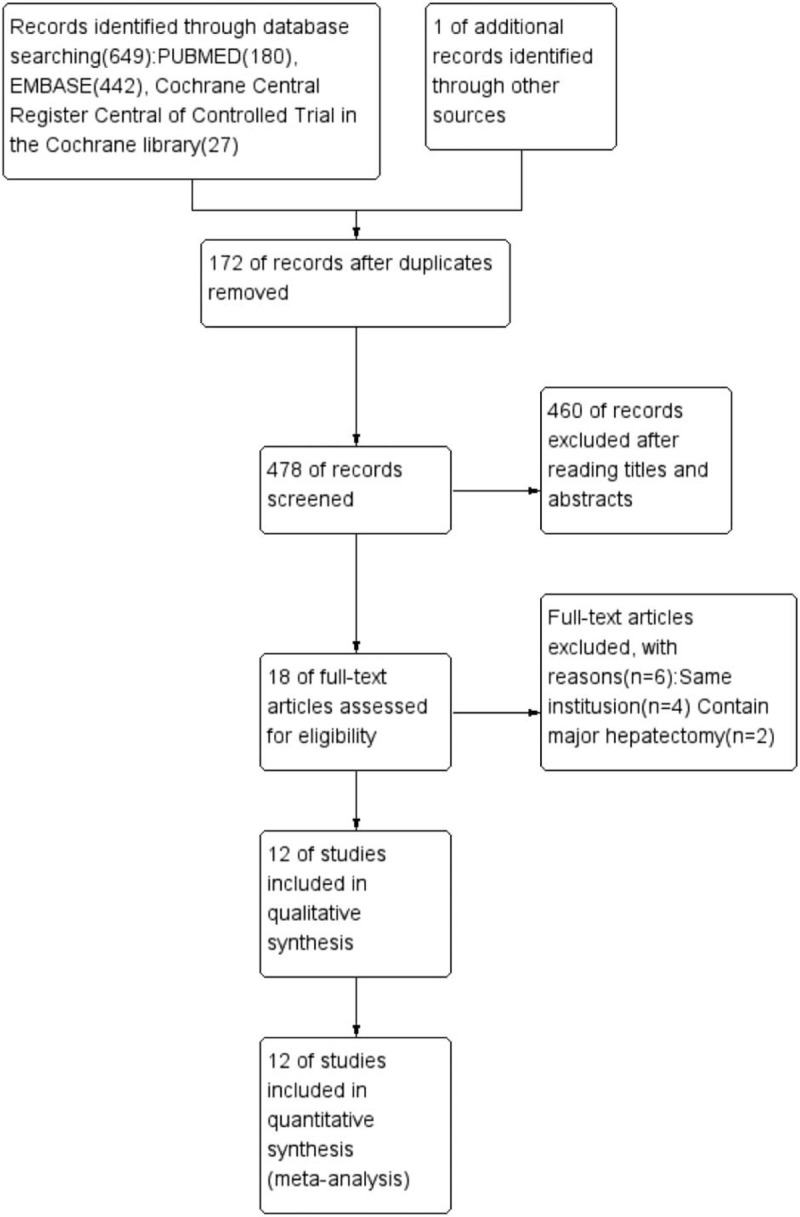
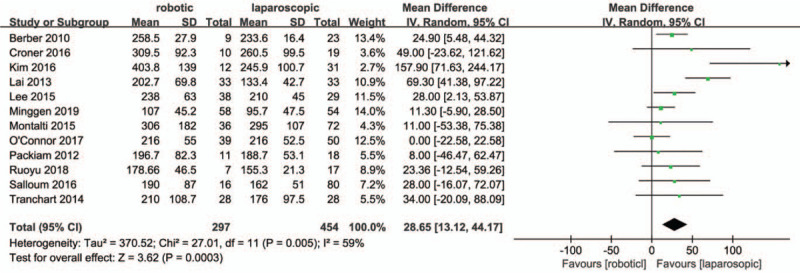
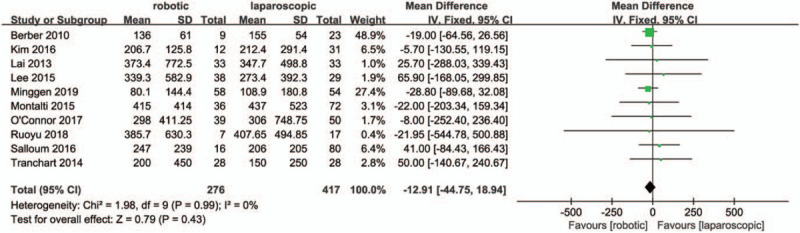
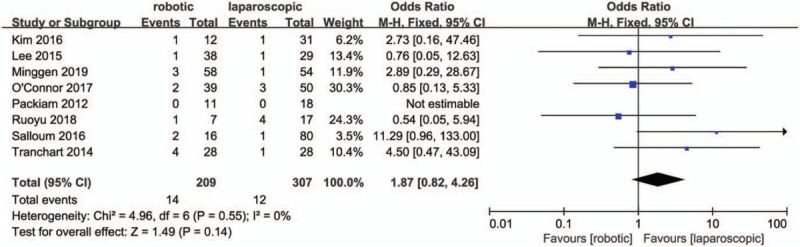
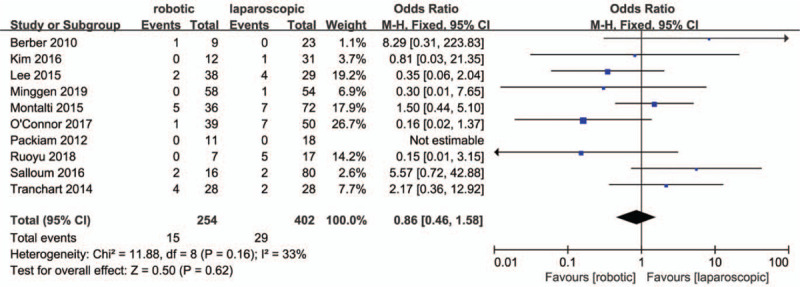
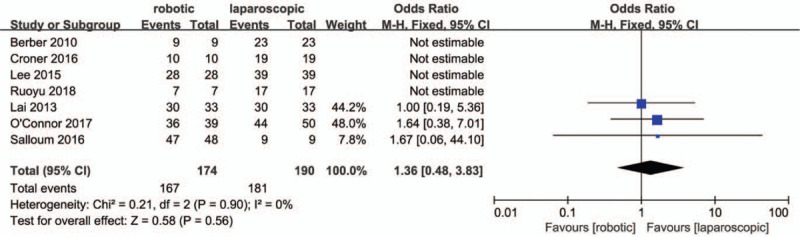
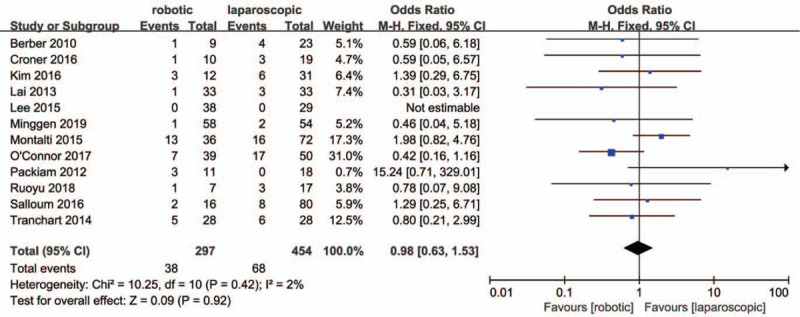
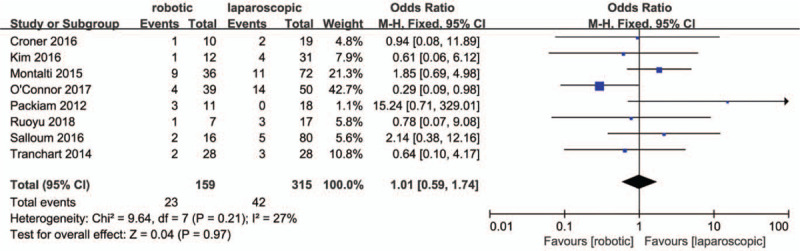
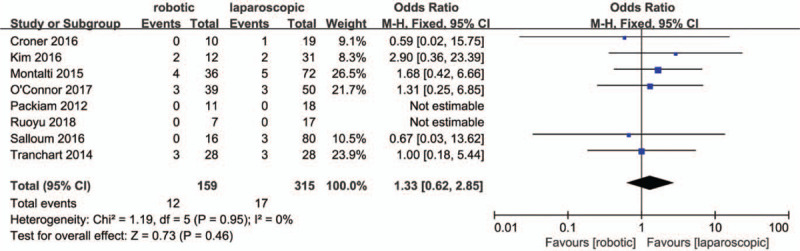
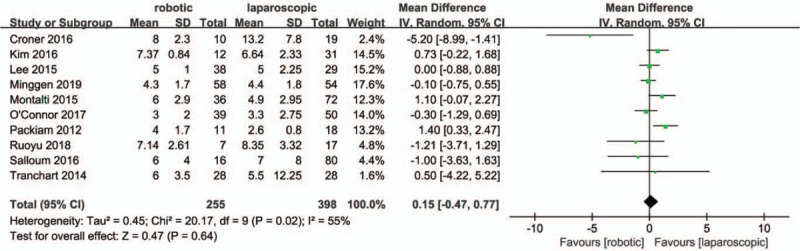
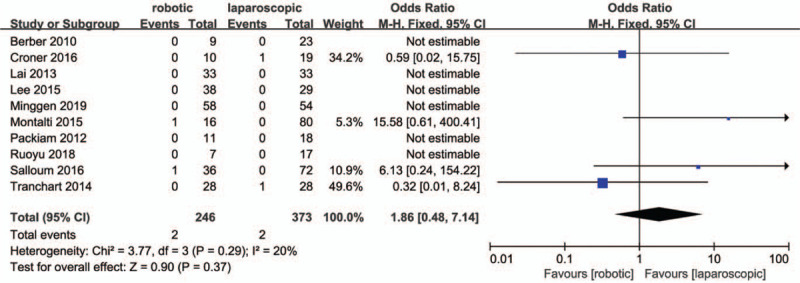
A total of 12 studies involving 751 patients were included in the meta-analysis. Among them, 297 patients were in the robot-assisted minor hepatectomy (RMH) group and 454 patients were in the LMH group. There were no significant differences in intraoperative blood loss (P = .43), transfusion rates (P = .14), length of hospital stay (P > .64), conversion rate (P = .62), R0 resection rate (P = .56), complications (P = .92), or mortaliy (P = .37) between the 2 groups. However, the RMH group was associated with a longer operative time (P = .0003), and higher cost (P < .00001) compared to the LMH group. No significant differences in overall survival or disease free survival between the 2 groups were observed. In the subgroup analysis of left lateral sectionectomies, RMH was still associated with a longer operative time, but no other differences in clinical outcomes were observed.
Although RMH is associated with longer operation times and higher costs, it exhibits the same safety and effectiveness as LMH. Prospective randomized controlled clinical trials should now be considered to obtain better evidence for clinical consensus.
机器人辅助手术和腹腔镜手术是切除肝病变的最微创外科方法。小范围肝切除术是一种常见的手术。在这项研究中,我们评估了机器人辅助与腹腔镜小范围肝切除术(LMH)的优缺点。
系统检索了PubMed、Embase 和 Cochrane 图书馆中截至 2020 年 2 月关于机器人辅助与腹腔镜小范围肝切除术的比较研究。使用固定效应模型或随机效应模型计算比值比(OR)和 95%置信区间的均数差值。
共纳入 12 项研究,涉及 751 例患者的荟萃分析。其中,297 例患者在机器人辅助小范围肝切除术(RMH)组,454 例患者在腹腔镜小范围肝切除术(LMH)组。两组术中出血量(P=0.43)、输血率(P=0.14)、住院时间(P>0.64)、转化率(P=0.62)、R0 切除率(P=0.56)、并发症(P=0.92)或死亡率(P=0.37)无显著差异。然而,与 LMH 组相比,RMH 组手术时间较长(P=0.0003),费用较高(P<0.00001)。两组的总生存率或无病生存率无显著差异。在左外侧段切除术的亚组分析中,RMH 仍与手术时间较长相关,但临床结局无其他差异。
尽管 RMH 与手术时间较长和费用较高有关,但它与 LMH 具有相同的安全性和有效性。现在应该考虑进行前瞻性随机对照临床试验,以获得更好的临床共识证据。