Magnocavallo Michele, Bernardini Alessia, Mariani Marco Valerio, Piro Agostino, Marini Massimiliano, Nicosia Antonino, Adduci Carmen, Rapacciuolo Antonio, Saporito Davide, Grossi Stefano, Santarpia Giuseppe, Vaccaro Paola, Rordorf Roberto, Pentimalli Francesco, Giunta Giuseppe, Campari Monica, Valsecchi Sergio, Lavalle Carlo
Department of Cardiovascular, Respiratory, Nephrology, Anaesthesiology and Geriatric Sciences, Sapienza University of Rome, Rome, Italy.
Department of Cardiology, S. Chiara Hospital, Trento, Italy.
Pacing Clin Electrophysiol. 2021 Jun;44(6):995-1003. doi: 10.1111/pace.14251. Epub 2021 May 15.
During the COVID-19 pandemic in-person visits for patients with cardiac implantable electronic devices should be replaced by remote monitoring (RM), in order to prevent viral transmission. A direct home-delivery service of the RM communicator has been implemented at 49 Italian arrhythmia centers.
According to individual patient preference or the organizational decision of the center, patients were assigned to the home-delivery group or the standard in-clinic delivery group. In the former case, patients received telephone training on the activation process and use of the communicator. In June 2020, the centers were asked to reply to an ad hoc questionnaire to describe and evaluate their experience in the previous 3 months.
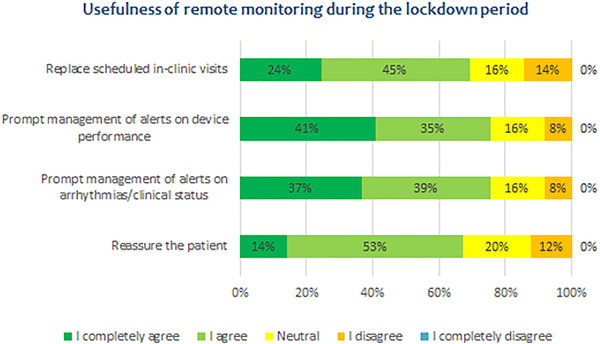
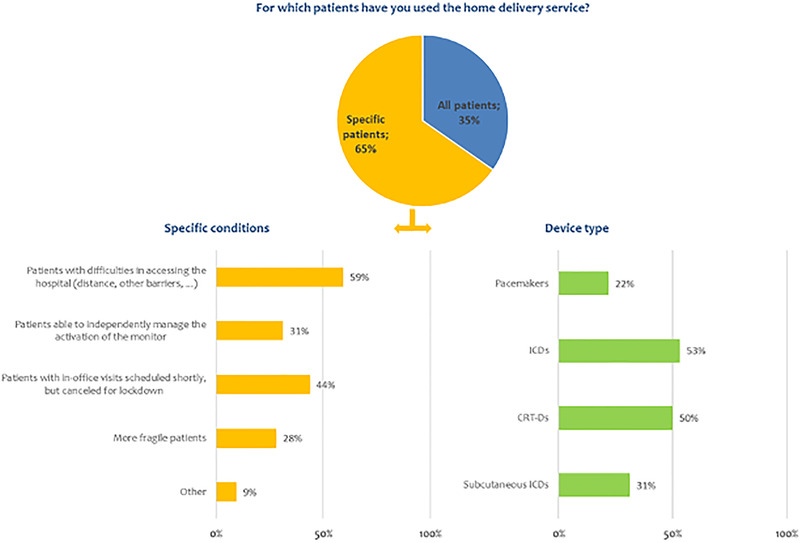
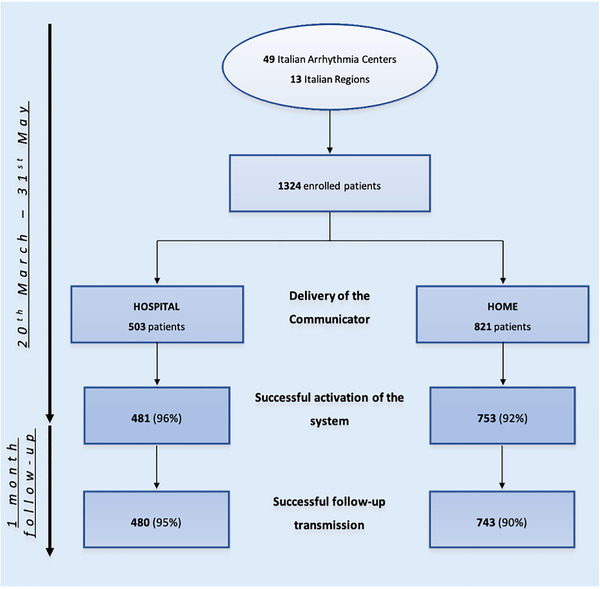
RM was activated in 1324 patients: 821 (62%) received the communicator at home and the communicator was activated remotely. Activation required one additional call in 49% of cases, and the median time needed to complete the activation process was 15 min [25th-75th percentile: 10-20]. 753 (92%) patients were able to complete the correct activation of the system. At the time when the questionnaire was completed, 743 (90%) communicators were regularly transmitting data. The service was generally deemed useful (96% of respondents) in facilitating the activation of RM during the COVID-19 pandemic and possibly beyond.
Home delivery of the communicator proved to be a successful approach to system activation, and received positive feedback from clinicians. The increased use of a RM protocol will reduce risks for both providers and patients, while maintaining high-quality care.
在新冠疫情期间,为预防病毒传播,心脏植入式电子设备患者的门诊就诊应改为远程监测(RM)。意大利49个心律失常中心已实施了RM通信器的直接送货上门服务。
根据患者个人偏好或中心的组织决定,将患者分配到送货上门组或标准的门诊交付组。在前一种情况下,患者接受了关于通信器激活过程和使用的电话培训。2020年6月,要求各中心回复一份特别问卷,以描述和评估其在过去3个月的经验。
1324例患者激活了RM:821例(62%)在家中收到通信器并远程激活。49%的病例激活需要额外打一个电话,完成激活过程所需的中位时间为15分钟[第25-75百分位数:10-20]。753例(92%)患者能够正确激活系统。在完成问卷时,743个(90%)通信器正在定期传输数据。该服务在促进新冠疫情期间及可能更长时间内RM的激活方面通常被认为是有用的(96%的受访者)。
事实证明,通信器送货上门是系统激活的一种成功方法,并得到了临床医生的积极反馈。增加RM协议的使用将降低提供者和患者的风险,同时保持高质量护理。