Department of Psychotherapy and Psychosomatic Medicine, Technische Universität Dresden, Dresden, Germany.
Department of Psychiatry, University of Oxford, Oxford, UK.
J Psychopharmacol. 2021 Jun;35(6):641-651. doi: 10.1177/02698811211001087. Epub 2021 Apr 28.
Glucocorticoid (GC) administration prior to exposure-based cognitive-behavioural therapy (CBT) has emerged as a promising approach to facilitate treatment outcome in anxiety disorders. Further components relevant for improved CBT efficacy include raised GCs and reductions in information-processing biases to threat.
To investigate hydrocortisone as an adjunct to CBT for spider fear and the modulating role of threat bias change and endogenous short-term and long-term GCs for treatment response.
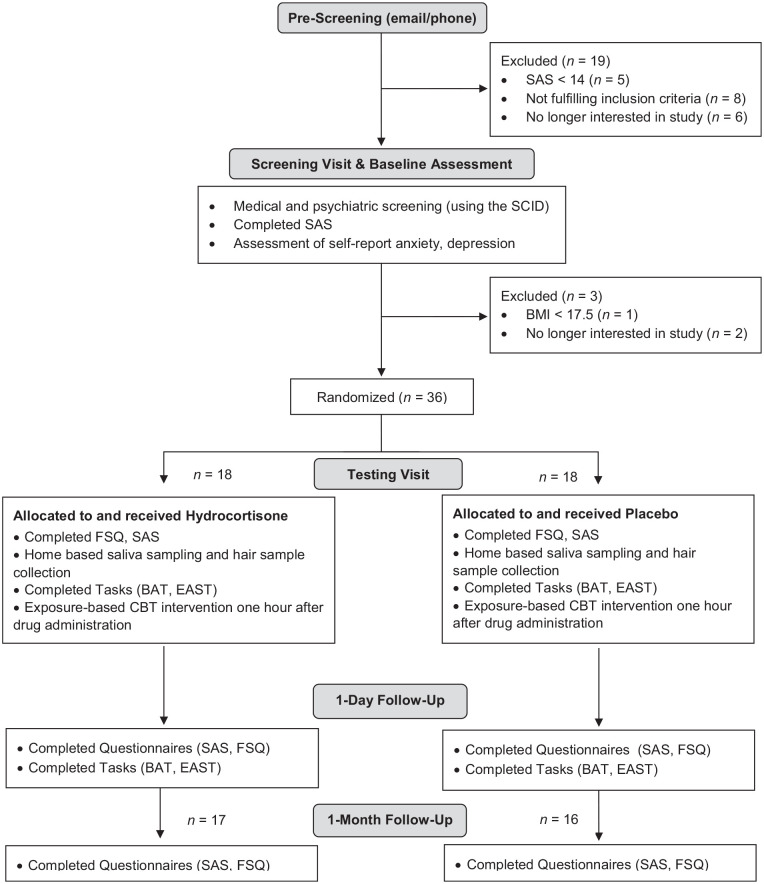
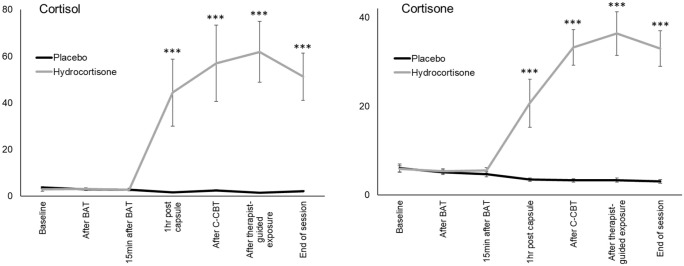
Spider-fearful individuals were randomized to receiving either 20 mg of hydrocortisone ( = 17) or placebo ( = 16) one hour prior to single-session predominantly computerised exposure-based CBT. Spider fear was assessed using self-report and behavioural approach measures at baseline, 1-day and 1-month follow-up. Threat processing was assessed at baseline and 1-day follow-up. Cortisol and cortisone were analysed from hair and saliva samples at baseline.
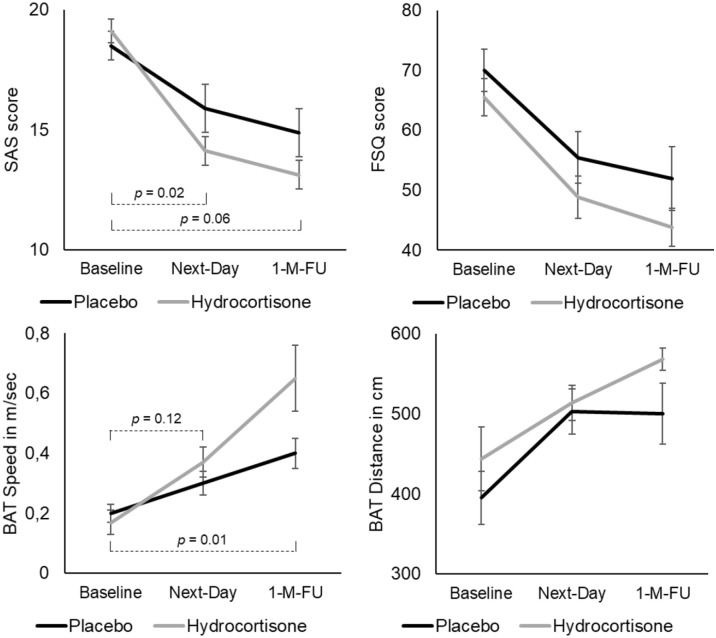
RESULTS/OUTCOMES: Self-report, behavioural and threat processing indices improved following CBT. Hydrocortisone augmentation resulted in greater improvement of self-report spider fear and stronger increase in speed when approaching a spider, but not on threat bias. Neither threat bias nor endogenous GCs predicted symptom change, and no interactive effects with hydrocortisone emerged. Preliminary evidence indicated higher hair cortisone as predictor of a stronger threat bias reduction.
CONCLUSIONS/INTERPRETATION: Our data extend earlier findings by suggesting that GC administration boosts the success of exposure therapy for specific fear even with a low-level therapist involvement. Future studies corroborating our result of a predictive hair GC relationship with threat bias change in larger clinical samples are needed.
在暴露为基础的认知行为疗法(CBT)之前给予糖皮质激素(GC)已成为一种很有前途的方法,可以促进焦虑症的治疗效果。进一步提高 CBT 疗效的相关因素包括升高 GC 和减少对威胁的信息处理偏差。
研究氢化可的松作为蜘蛛恐惧的 CBT 辅助治疗方法,以及威胁偏见变化和内源性短期和长期 GC 对治疗反应的调节作用。
将蜘蛛恐惧的个体随机分为接受 20mg 氢化可的松(n=17)或安慰剂(n=16)组,在单次主要基于计算机的暴露 CBT 之前一小时给予。在基线、1 天和 1 个月随访时使用自我报告和行为接近测量来评估蜘蛛恐惧。在基线和 1 天随访时评估威胁处理。在基线时分析头发和唾液样本中的皮质醇和皮质酮。
结果/结果:CBT 后,自我报告、行为和威胁处理指标均得到改善。氢化可的松增强治疗导致自我报告的蜘蛛恐惧和接近蜘蛛时速度的更大改善,但对威胁偏见没有影响。威胁偏见或内源性 GC 均不能预测症状变化,且与氢化可的松之间没有交互作用。初步证据表明,较高的头发皮质酮是威胁偏见降低更强的预测因子。
结论/解释:我们的数据扩展了早期的发现,表明 GC 给药甚至在治疗师参与程度较低的情况下,也能增强特定恐惧的暴露疗法的成功率。需要在更大的临床样本中进一步研究证实我们的头发 GC 与威胁偏见变化的预测关系的结果。