Escola de Medicina e Cirurgia, Universidade Federal do Estado do Rio de Janeiro, Rio de Janeiro, RJ, Brazil.
Faculdade Israelita de Ciências da Saúde Albert Einstein, Hospital Israelita Albert Einstein, São Paulo, SP, Brazil.
Einstein (Sao Paulo). 2021 Apr 26;19:eMD5703. doi: 10.31744/einstein_journal/2021MD5703. eCollection 2021.
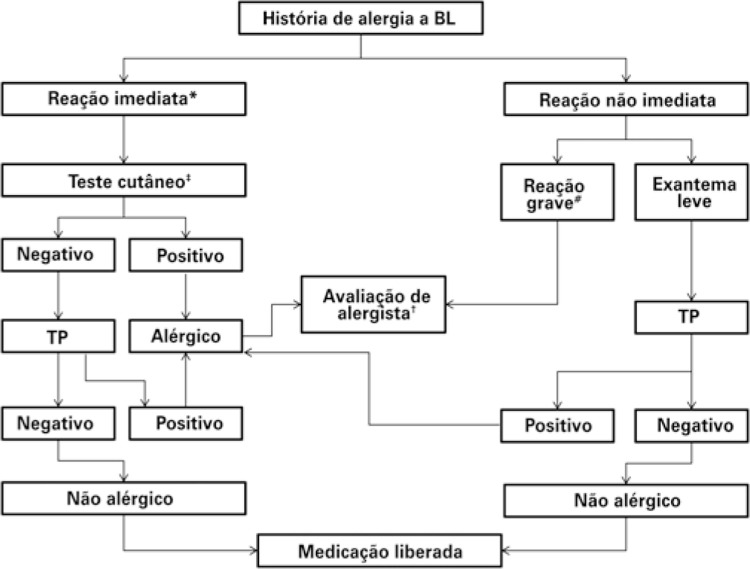
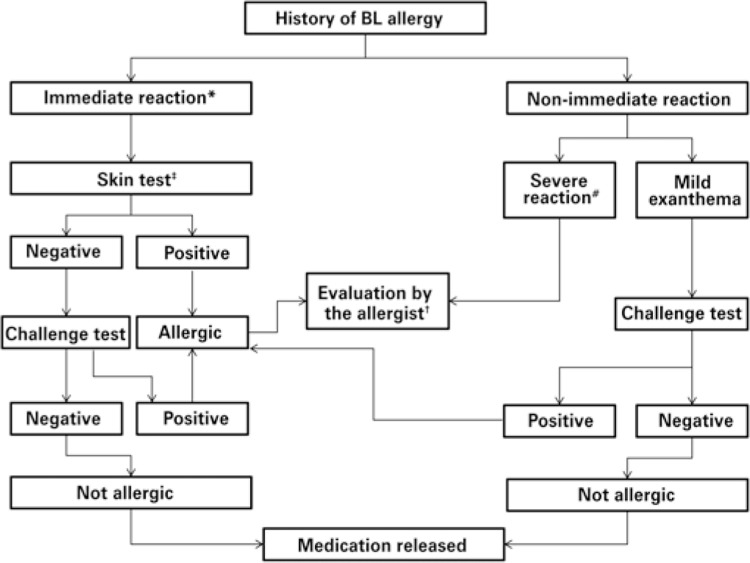
Betalactams are the most frequent cause of hypersensitivity reactions to drugs mediated by a specific immune mechanism. Immediate reactions occur within 1 to 6 hours after betalactam administration, and are generally IgE-mediated. They clinically translate into urticaria, angioedema and anaphylaxis. Non-immediate or delayed reactions occur after 1 hour of administration. These are the most common reactions and are usually mediated by T cells. The most frequent type is the maculopapular or morbilliform exanthematous eruption. Most individuals who report allergies to penicillin and betalactams can tolerate this group of antibiotics. To make diagnosis, a detailed medical history is essential to verify whether it was an immediate or non-immediate reaction. Thereafter, in vivo and/or in vitro tests for investigation may be performed. The challenging test is considered the gold standard method for diagnosis of betalactam hypersensitivity. The first approach when suspecting a reaction to betalactam is to discontinue exposure to the drug, and the only specific treatment is desensitization, which has very precise indications. The misdiagnosis of penicillin allergy affects the health system, since the "penicillin allergy" label is associated with increased bacterial resistance, higher rate of therapeutic failure, prolonged hospitalizations, readmissions, and increased costs. Thus, it is essential to develop strategies to assist the prescription of antibiotics in patients identified with a label of "betalactam allergy" at hospitals, and to enhance education of patients and their caregivers, as well as of non-specialist physicians.
β-内酰胺类药物是通过特定免疫机制介导的药物超敏反应中最常见的原因。立即反应发生在β-内酰胺类药物给药后 1 至 6 小时内,通常是 IgE 介导的。它们在临床上表现为荨麻疹、血管性水肿和过敏反应。非立即或迟发性反应发生在给药 1 小时后。这些是最常见的反应,通常由 T 细胞介导。最常见的类型是斑丘疹或麻疹样发疹性皮疹。大多数报告对青霉素和β-内酰胺类药物过敏的个体可以耐受这类抗生素。为了做出诊断,详细的病史是必不可少的,以确定是立即反应还是迟发反应。此后,可能会进行体内和/或体外检查以进行调查。挑战性测试被认为是诊断β-内酰胺类药物超敏反应的金标准方法。怀疑对β-内酰胺类药物发生反应时,首先要停止接触该药物,唯一的特异性治疗方法是脱敏,其适应证非常明确。青霉素过敏的误诊会影响卫生系统,因为“青霉素过敏”标签与细菌耐药性增加、治疗失败率更高、住院时间延长、再入院率增加和成本增加有关。因此,有必要制定策略,协助在医院中确定有“β-内酰胺类药物过敏”标签的患者使用抗生素,并加强对患者及其护理人员以及非专科医生的教育。