Institute of Population Health, University of Liverpool, Brownlow Hill, Liverpool, L69 3BX, UK.
Epidemiol Psychiatr Sci. 2021 Apr 29;30:e34. doi: 10.1017/S2045796021000263.
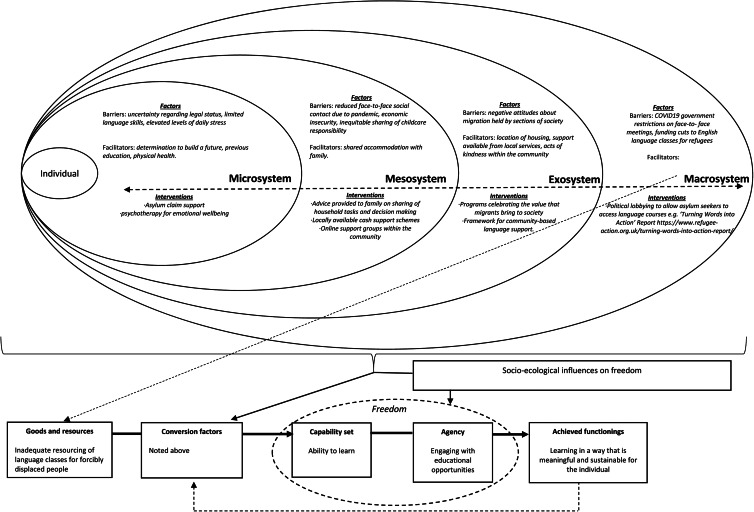
The mental health of individuals who have been forcibly displaced can be impacted both by war-related traumatic events and displacement-related stressors, which arise as a consequence of their migratory journey and subsequent experiences. In addition to focusing on mental disorders, there is a need to explore broader psychosocial outcomes that are important for forcibly displaced people. Our aim is to present a coherent explanatory framework to understand how both past traumatic events and ongoing stressors operating throughout forcibly displaced people's social environment can impact mental health and psychosocial wellbeing.
We describe the capability approach (CA), a human development framework that foregrounds individuals' freedom to engage in forms of being and doing that are valuable to them. We consider the opportunities that the CA provides for understanding how a myriad of factors can impact forcibly displaced people, and how different forms of support can be configured to meet the needs of particular people and communities.
The CA recognises that various factors can share a common putative causal mechanism in their impact on forcibly displaced people, i.e. these factors limit a person's ability to develop capabilities and their freedom to engage in valued forms of being and doing. The rights based ethos of the CA enables multisectoral and coordinated activity, which can be directed towards addressing factors across the social environment. Importantly, the CA helps to explain why particular forms of support may be more beneficial for individuals or communities at certain times compared to others.
The application of the CA can help to guard against the risk that the aspirations of assessment instruments and interventions aimed at supporting forcibly displaced people are narrowly focused on addressing distress and disorders, to instead adopt a more expansive focus on forcibly displaced people's potential and the possibilities that they wish to realise.
经历过强迫性流离失所的个人的心理健康可能会受到战争相关创伤事件和流离失所相关压力源的影响,这些压力源是由于他们的移民旅程和随后的经历而产生的。除了关注精神障碍外,还需要探索对强迫性流离失所者很重要的更广泛的社会心理结果。我们的目的是提出一个连贯的解释框架,以了解过去的创伤事件和贯穿强迫性流离失所者社会环境的持续压力源如何影响心理健康和社会心理幸福感。
我们描述了能力方法(CA),这是一个突出个人参与对他们有价值的存在和行为形式的自由的人类发展框架。我们考虑了 CA 提供的机会,以了解有多少因素可以影响强迫性流离失所者,以及如何配置不同形式的支持以满足特定个人和社区的需求。
CA 认识到,各种因素在其对强迫性流离失所者的影响中可能具有共同的潜在因果机制,即这些因素限制了一个人发展能力的能力及其参与有价值的存在和行为的自由。CA 的基于权利的精神使多部门和协调的活动成为可能,这些活动可以针对社会环境中的各种因素。重要的是,CA 有助于解释为什么在某些时候,特定形式的支持可能对个人或社区更有益,而在其他时候则不然。
CA 的应用可以帮助防止评估工具和旨在支持强迫性流离失所者的干预措施的愿望过于狭隘地关注解决痛苦和障碍的风险,而是采取更广泛的关注强迫性流离失所者的潜力和他们希望实现的可能性。