González-Seguel Felipe, Camus-Molina Agustín, Jasmén Anita, Molina Jorge, Pérez-Araos Rodrigo, Graf Jerónimo
Servicio de Medicina Física y Rehabilitación, Departamento de Medicina Interna, Facultad de Medicina, Clínica Alemana Universidad del Desarrollo, Santiago, Chile.
Carrera de Kinesiología, Facultad de Medicina, Clínica Alemana Universidad del Desarrollo, Santiago, Chile.
Crit Care Explor. 2021 Apr 26;3(4):e0407. doi: 10.1097/CCE.0000000000000407. eCollection 2021 Apr.
This scoping review is aimed to summarize current knowledge on respiratory support adjustments and monitoring of metabolic and respiratory variables in mechanically ventilated adult patients performing early mobilization.
Eight electronic databases were searched from inception to February 2021, using a predefined search strategy.
Two blinded reviewers performed document selection by title, abstract, and full text according to the following criteria: mechanically ventilated adult patients performing any mobilization intervention, respiratory support adjustments, and/or monitoring of metabolic/respiratory real-time variables.
Four physiotherapists extracted relevant information using a prespecified template.
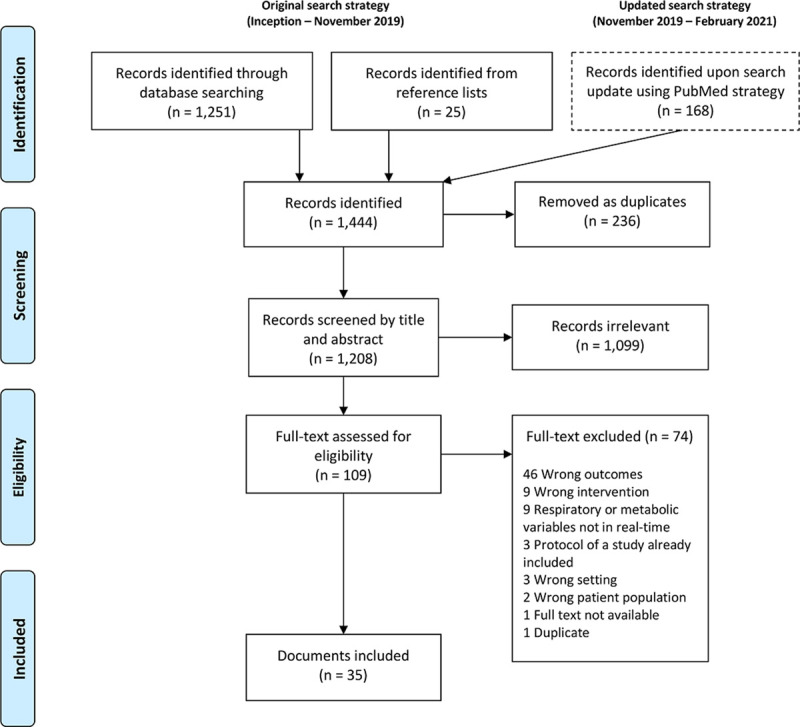
From 1,208 references screened, 35 documents were selected for analysis, where 20 (57%) were published between 2016 and 2020. Respiratory support settings (ventilatory modes or respiratory variables) were reported in 21 documents (60%). Reported modes were assisted ( = 11) and assist-control ( = 9). Adjustment of variables and modes were identified in only seven documents (20%). The most frequent respiratory variable was the Fio, and only four studies modified the level of ventilatory support. Mechanical ventilator brand/model used was not specified in 26 documents (74%). Monitoring of respiratory, metabolic, and both variables were reported in 22 documents (63%), four documents (11%) and 10 documents (29%), respectively. These variables were reported to assess the physiologic response ( = 21) or safety ( = 13). Monitored variables were mostly respiratory rate ( = 26), pulse oximetry ( = 22), and oxygen consumption ( = 9). Remarkably, no study assessed the work of breathing or effort during mobilization.
Little information on respiratory support adjustments during mobilization of mechanically ventilated patients was identified. Monitoring of metabolic and respiratory variables is also scant. More studies on the effects of adjustments of the level/mode of ventilatory support on exercise performance and respiratory muscle activity monitoring for safe and efficient implementation of early mobilization in mechanically ventilated patients are needed.
本综述旨在总结目前关于在进行早期活动的机械通气成年患者中呼吸支持调整以及代谢和呼吸变量监测的知识。
使用预定义的检索策略,检索了8个电子数据库,时间跨度从建库至2021年2月。
两名盲法评审员根据以下标准通过标题、摘要和全文进行文献筛选:进行任何活动干预、呼吸支持调整和/或监测代谢/呼吸实时变量的机械通气成年患者。
四名物理治疗师使用预先指定的模板提取相关信息。
在筛选的1208篇参考文献中,选择了35篇文献进行分析,其中20篇(57%)发表于2016年至2020年之间。21篇文献(60%)报告了呼吸支持设置(通气模式或呼吸变量)。报告的模式有辅助通气(n = 11)和辅助控制通气(n = 9)。仅在7篇文献(20%)中确定了变量和模式的调整。最常见的呼吸变量是FiO₂,只有4项研究调整了通气支持水平。26篇文献(74%)未指明所使用的机械通气品牌/型号。分别有22篇文献(63%)、4篇文献(11%)和10篇文献(29%)报告了对呼吸、代谢以及两者变量的监测。报告这些变量是为了评估生理反应(n = 21)或安全性(n = 13)。监测的变量主要是呼吸频率(n = 26)、脉搏血氧饱和度(n = 22)和氧耗量(n = 9)。值得注意的是,没有研究评估活动期间的呼吸功或用力情况。
关于机械通气患者活动期间呼吸支持调整的信息很少。对代谢和呼吸变量的监测也很匮乏。需要更多关于通气支持水平/模式调整对运动表现的影响以及为安全有效地对机械通气患者实施早期活动而进行呼吸肌活动监测的研究。