Department of Molecular and Comparative Biology.
Division of Clinical Pharmacology.
JCI Insight. 2021 Jun 8;6(11):146215. doi: 10.1172/jci.insight.146215.
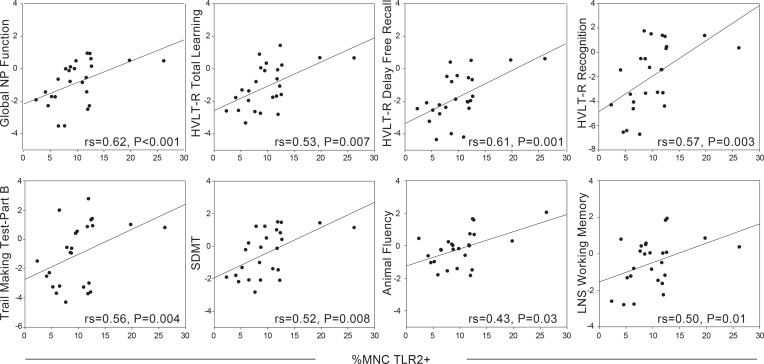
BACKGROUNDIdentifying a quantitative biomarker of neuropsychiatric dysfunction in people with HIV (PWH) remains a significant challenge in the neuroHIV field. The strongest evidence to date implicates the role of monocytes in central nervous system (CNS) dysfunction in HIV, yet no study has examined monocyte subsets in blood as a correlate and/or predictor of neuropsychiatric function in virally suppressed PWH.METHODSIn 2 independent cohorts of virologically suppressed women with HIV (vsWWH; n = 25 and n = 18), whole blood samples were obtained either in conjunction with neuropsychiatric assessments (neuropsychological [NP] test battery, self-report depression and stress-related symptom questionnaires) or 1 year prior to assessments. Immune cell subsets were assessed by flow cytometry.RESULTSA higher proportion of intermediate monocytes (CD14+CD16+) was associated with lower global NP function when assessing monocytes concurrently and approximately 1 year before (predictive) NP testing. The same pattern was seen for executive function (mental flexibility) and processing speed. Conversely, there were no associations with monocyte subsets and depression or stress-related symptoms. Additionally, we found that a higher proportion of classical monocytes was associated with better cognition.CONCLUSIONAlthough it is widely accepted that lentiviral infection of the CNS targets cells of monocyte-macrophage-microglial lineage and is associated with an increase in intermediate monocytes in the blood and monocyte migration into the brain, the percentage of intermediate monocytes in blood of vsWWH has not been associated with neuropsychiatric outcomes. Our findings provide evidence for a new, easily measured, blood-based cognitive biomarker in vsWWH.FUNDINGR01-MH113512, R01-MH113512-S, P30-AI094189, R01-MH112391, R01-AI127142, R00-DA044838, U01-AI35004, and P30-MH075673.
在 HIV 感染者(PWH)中,确定神经精神功能障碍的定量生物标志物仍然是神经 HIV 领域的一个重大挑战。迄今为止,最强有力的证据表明单核细胞在 HIV 中枢神经系统(CNS)功能障碍中发挥作用,但尚无研究检测血液中的单核细胞亚群作为病毒抑制的 PWH 神经心理功能的相关性和/或预测因子。
在 2 个独立的、病毒学抑制的 HIV 女性队列中(vsWWH;n = 25 和 n = 18),要么在进行神经心理评估(神经心理[NP]测试组合、自我报告抑郁和应激相关症状问卷)时,要么在评估前 1 年获得全血样本。通过流式细胞术评估免疫细胞亚群。
当同时评估单核细胞和大约 1 年前(预测性)NP 测试时,中间单核细胞(CD14+CD16+)比例较高与整体 NP 功能较低相关。同样的模式也见于执行功能(心理灵活性)和加工速度。相反,单核细胞亚群与抑郁或应激相关症状无关联。此外,我们发现经典单核细胞比例较高与认知能力较好相关。
尽管人们普遍认为 CNS 的慢病毒感染靶向单核细胞-巨噬细胞-小胶质细胞谱系的细胞,并与血液中中间单核细胞的增加和单核细胞向大脑的迁移相关,但 vsWWH 血液中的中间单核细胞比例与神经精神结局无关。我们的研究结果为 vsWWH 中提供了一种新的、易于测量的基于血液的认知生物标志物。
R01-MH113512、R01-MH113512-S、P30-AI094189、R01-MH112391、R01-AI127142、R00-DA044838、U01-AI35004 和 P30-MH075673。