Lou Tiejiong, Li Zhangxiang, Pang Miao
Hubei Key Laboratory of Roadway Bridge & Structure Engineering, Wuhan University of Technology, Wuhan 430070, China.
Department of Civil Engineering, Zhejiang University, Hangzhou 310058, China.
Polymers (Basel). 2021 Apr 7;13(8):1181. doi: 10.3390/polym13081181.
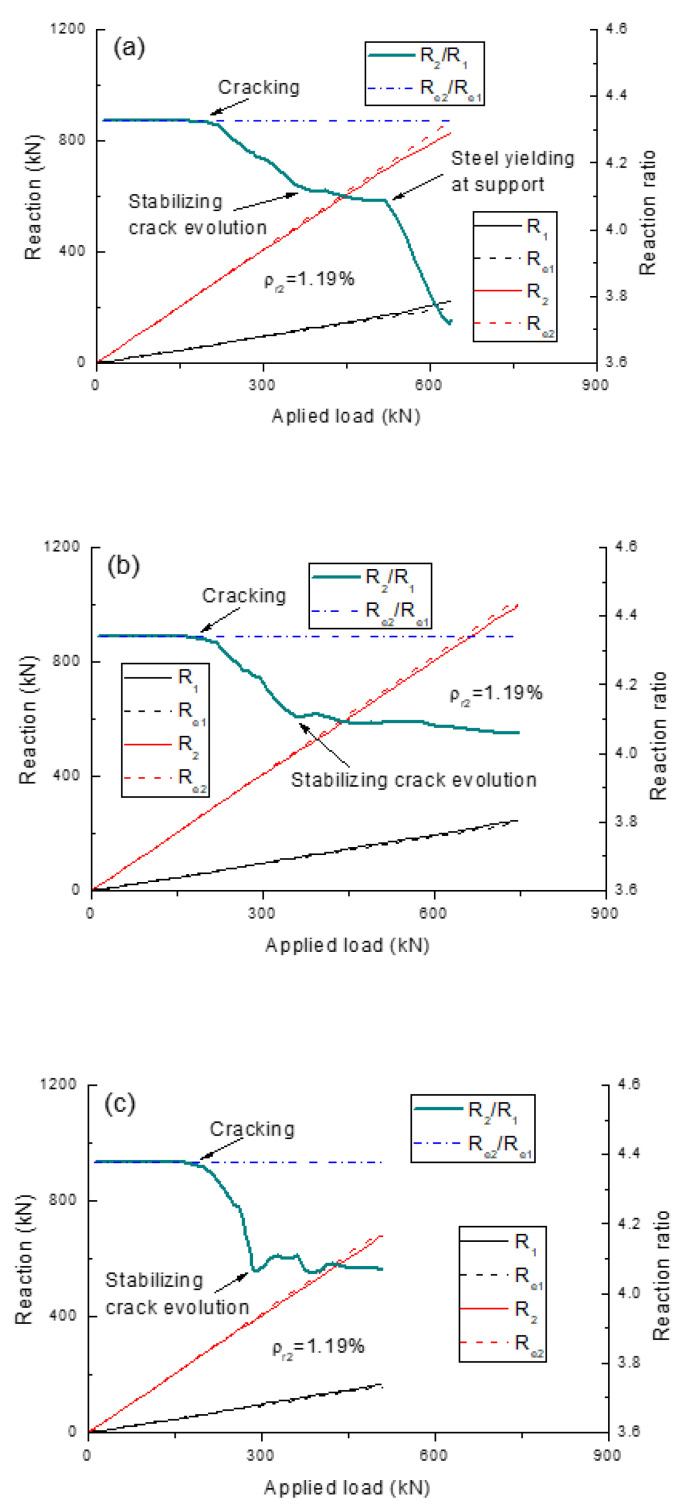
This paper assesses the impact of adopting carbon- or glass-fiber-reinforced polymer (CFRP or GFRP) instead of steel rebars on the redistribution of moments in prestressed concrete beams (PCBs) with external CFRP tendons. A numerical program is introduced, and numerical simulations are performed on two-span continuous beams with steel, CFRP or GFRP rebars of various areas, i.e., Ar2 = 360-3560 mm, and Ar1/Ar2 = 1.5, where Ar1 and Ar2 are areas of tensile rebars over the positive and negative moment zones, respectively. The results show the moment redistribution is contributed by concrete cracking only for the beams with fiber-reinforced polymer (FRP) rebars, and by concrete cracking and steel yielding for the beams with steel rebars. As a result, the use of FRP rebars leads to a substantially lower moment redistribution than in steel rebars. It is also demonstrated that Eurocode 2, CSA A23.3-04 and ACI 318-19 fail to reflect the rebar influence on moment redistribution in PCBs with external tendons. A simplified equation for the quantification of moment redistribution in externally PCBs with steel and FRP rebars is recommended, which yields accurate and conservative predictions.
本文评估了采用碳纤维或玻璃纤维增强聚合物(CFRP或GFRP)代替钢筋对带有外部CFRP拉索的预应力混凝土梁(PCB)中弯矩重分布的影响。介绍了一个数值程序,并对具有不同面积(即Ar2 = 360 - 3560 mm,且Ar1/Ar2 = 1.5,其中Ar1和Ar2分别为正弯矩区和负弯矩区受拉钢筋的面积)的钢、CFRP或GFRP钢筋的两跨连续梁进行了数值模拟。结果表明,弯矩重分布仅由带有纤维增强聚合物(FRP)钢筋的梁中的混凝土开裂引起,而由带有钢筋的梁中的混凝土开裂和钢筋屈服引起。因此,使用FRP钢筋导致的弯矩重分布比使用钢筋时要低得多。还表明,欧洲规范2、CSA A23.3 - 04和ACI 318 - 19未能反映钢筋对带有外部拉索的PCB中弯矩重分布的影响。推荐了一个用于量化带有钢和FRP钢筋的外部PCB中弯矩重分布的简化方程,该方程能给出准确且保守的预测。