Department of Psychology and Centre for Psychosocial Health, The Education University of Hong Kong, Hong Kong, China.
Department of Psychology, The Education University of Hong Kong, Hong Kong, China.
Int J Environ Res Public Health. 2021 Apr 8;18(8):3916. doi: 10.3390/ijerph18083916.
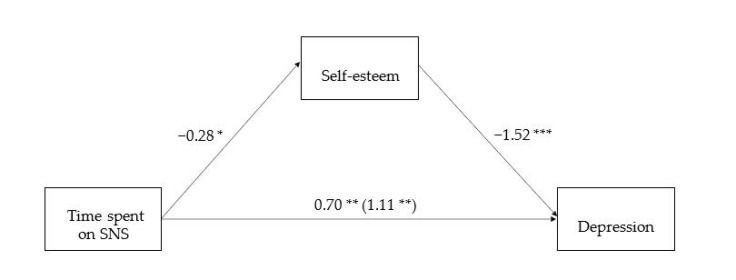
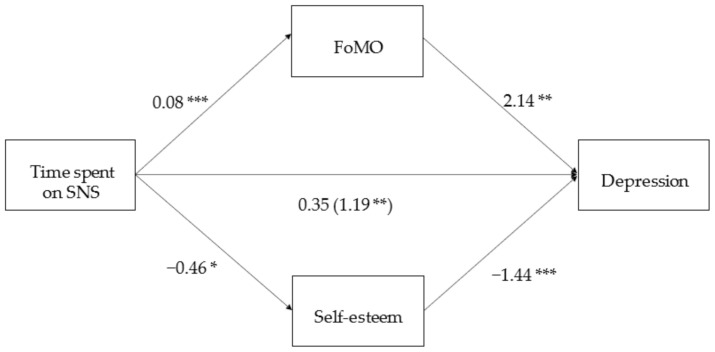
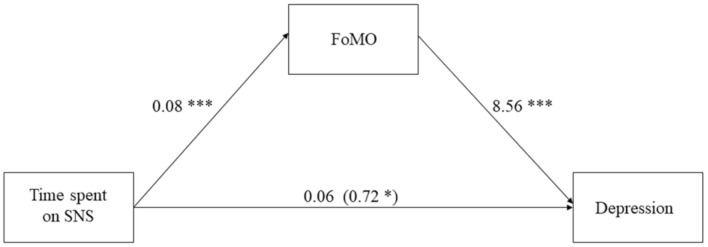
The goal of the study was to understand the mechanisms of how social networking sites (SNS) usage is related to depression symptoms, as measured by the Center for Epidemiological Studies-Depression Scale (CESD). Three studies were conducted to examine the mediation roles of self-esteem and Fear of Missing Out (FoMO). In Study 1, among 347 Chinese college students, time spent on SNS was negatively associated with self-esteem; while self-esteem then negatively associated with depression symptoms. In Study 2, among 180 Chinese college students, time spent on SNS was positively related to FoMO; while FoMO then positively related to depression symptoms. In Study 3, among 233 Chinese university students, both self-esteem and FoMO were simultaneously included in the mediation model to test their respective roles in explaining depression symptoms. Results showed that more time spent on SNS was related to lower self-esteem, and higher FoMO, respectively; while self-esteem then negatively, and FoMO then positively, explained depression symptoms, respectively. In addition, when participants spent 3.5 h (Study 1), 2.5 h (Study 2), and 2.54 h (Study 3) on SNS, they reached the cutoff for subthreshold depression, as measured by CESD. Combining results from three studies, both self-esteem and FoMO mediated the relation between SNS usage and depression symptoms. This study provides implications to understand the mechanism of SNS-related depression.
本研究旨在探讨社交网站(SNS)使用与抑郁症状之间的关系机制,使用的抑郁评估工具为流行病学研究中心抑郁量表(CESD)。通过三项研究来检验自尊和错失恐惧(FoMO)在其中的中介作用。在研究 1 中,对 347 名中国大学生进行研究,发现 SNS 使用时间与自尊呈负相关;而自尊与抑郁症状呈负相关。在研究 2 中,对 180 名中国大学生进行研究,发现 SNS 使用时间与 FoMO 呈正相关;而 FoMO 与抑郁症状呈正相关。在研究 3 中,对 233 名中国大学生进行研究,同时纳入自尊和 FoMO 进入中介模型,以检验它们各自在解释抑郁症状方面的作用。结果表明,SNS 使用时间与自尊降低和 FoMO 升高分别相关;而自尊负向、FoMO 正向解释了抑郁症状。此外,当参与者每天花 3.5 小时(研究 1)、2.5 小时(研究 2)和 2.54 小时(研究 3)在 SNS 上时,他们的 CESD 得分达到了亚临床抑郁的标准。综合三项研究结果,自尊和 FoMO 均在 SNS 使用与抑郁症状之间起中介作用。本研究为理解 SNS 相关抑郁的机制提供了启示。