de la Rubia Ortí Jose Enrique, Armero Jose Luis Platero, Sanchis-Sanchis Claudia Emmanuela, Sancho-Castillo Sandra, Salazar Alejandro, Caplliure-Llopis Jordi, Navarro-Illana Esther, Barrios Carlos, Escribá-Alepuz Jesús, Benlloch María
Department of Basic Medical Sciences, Catholic University of Valencia, 46001 Valencia, Spain.
Department of Statistics and Operational Research, University of Cádiz, Puerto Real, 11510 Cádiz, Spain.
J Clin Med. 2021 Apr 9;10(8):1582. doi: 10.3390/jcm10081582.
One of the pathogenic mechanisms of ALS disease is perturbed energy metabolism particularly glucose metabolism. Given the substantial difference in the severity and the prognosis of the disease, depending on whether it has a bulbar or spinal onset, the aim of the study was to determine metabolic differences between both types of ALS, as well as the possible relationship with muscle function.
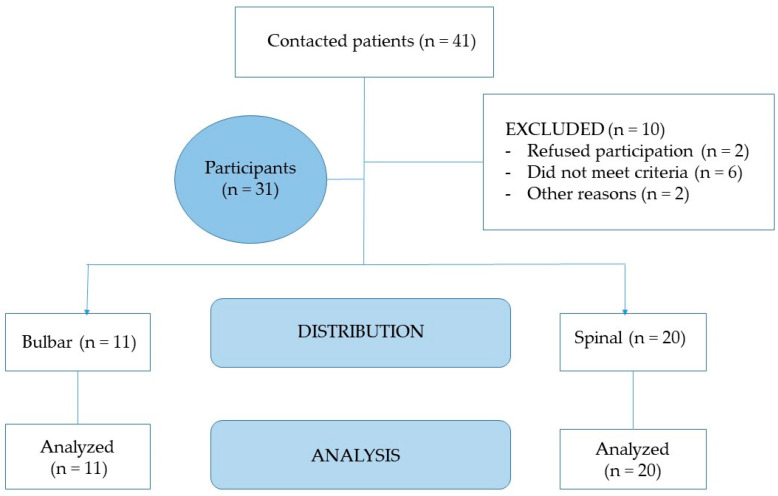
A descriptive, analytical, quantitative, and transversal study was carried out in hospitals and Primary Care centers in the region of Valencia, Spain. Fasting glucose and alkaline phosphatase (AP) levels in venous blood, muscle percentage, fat percentage, muscle strength (MRC scale), and functional capacity (Barthel Index) were measured in 31 patients diagnosed with ALS (20 with spinal onset ALS and 11 with bulbar onset ALS). A healthy control of 29 people was included.
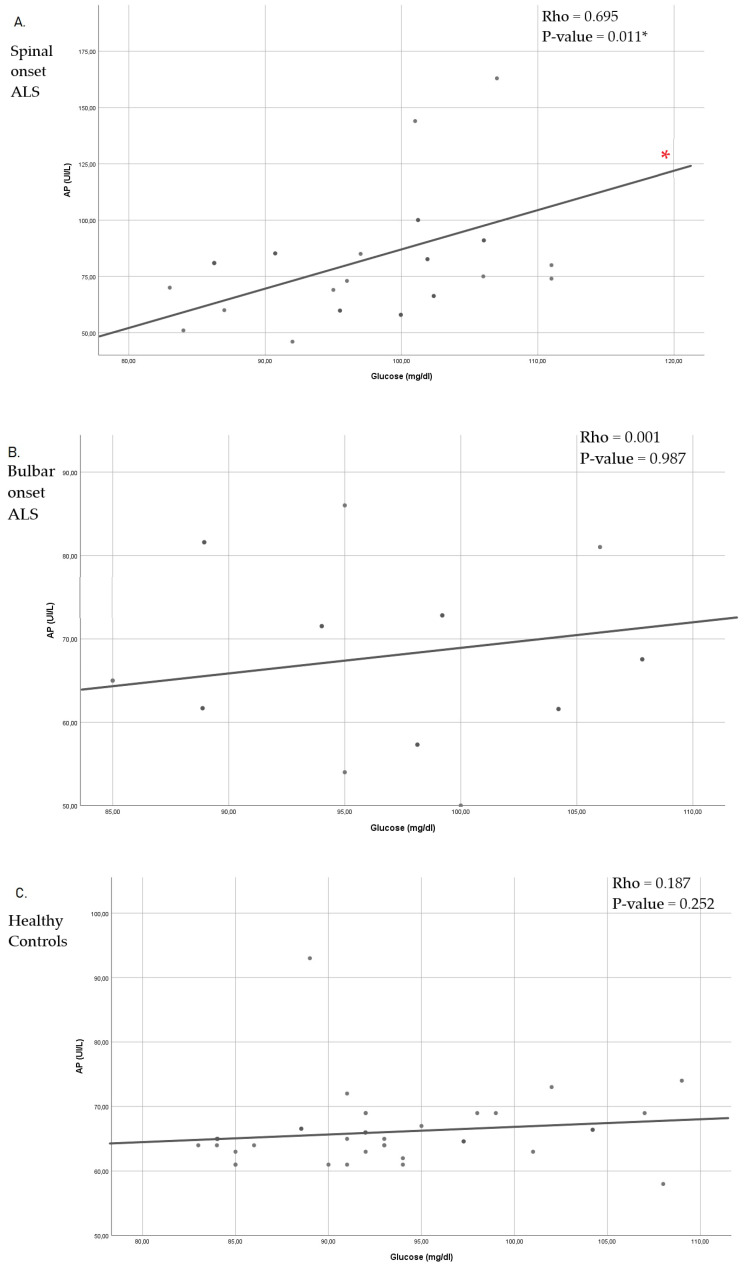
No significant differences were observed in blood AP and glucose levels between spinal onset and bulbar onset ALS patients. However, a significant positive correlation was observed between the mean values of both substances in patients with spinal onset ALS. Moreover, a lower percentage of muscle mass and a higher percentage of fat mass were also seen in spinal ALS patients, who also presented lower muscle strength and lower functional capacity.
The results of this study seem to point to a possible difference in the peripheral use of glucose between patients with bulbar onset ALS and spinal onset ALS, who appear to have possible insulin resistance. These metabolic differences could explain the lower muscle percentage and lower muscular function in spinal onset ALS patients, although further studies are required.
肌萎缩侧索硬化症(ALS)疾病的致病机制之一是能量代谢紊乱,尤其是葡萄糖代谢。鉴于该疾病在严重程度和预后方面存在显著差异,这取决于其发病部位是延髓还是脊髓,本研究的目的是确定两种类型的ALS之间的代谢差异,以及与肌肉功能的可能关系。
在西班牙巴伦西亚地区的医院和初级保健中心进行了一项描述性、分析性、定量和横向研究。对31例诊断为ALS的患者(20例脊髓型ALS患者和11例延髓型ALS患者)测量了静脉血中的空腹血糖和碱性磷酸酶(AP)水平、肌肉百分比、脂肪百分比、肌肉力量(医学研究委员会量表)和功能能力(巴氏指数)。纳入了29名健康对照者。
脊髓型和延髓型ALS患者的血液AP和葡萄糖水平未观察到显著差异。然而,在脊髓型ALS患者中,这两种物质的平均值之间观察到显著的正相关。此外,脊髓型ALS患者的肌肉质量百分比更低,脂肪质量百分比更高,他们还表现出更低的肌肉力量和更低的功能能力。
本研究结果似乎表明,延髓型ALS患者和脊髓型ALS患者在葡萄糖的外周利用方面可能存在差异,后者似乎存在胰岛素抵抗。这些代谢差异可以解释脊髓型ALS患者较低的肌肉百分比和较低的肌肉功能,尽管还需要进一步研究。